


A Guide to Modern Parking Lot Security
- Бонус за регистрацию онлайн казино
- Jul 23, 2025
- 17 min read
Parking lot security isn't just about protecting cars. It’s about protecting people, your property, and ultimately, the reputation of your business. The best approach is what we call a layered defense—a smart combination of environmental design, modern technology like cameras and lighting, and good old-fashioned human oversight. Together, they create a tough barrier against common threats like theft, vandalism, and even violent crime.
Why Your Parking Lot Is a Critical Security Focus
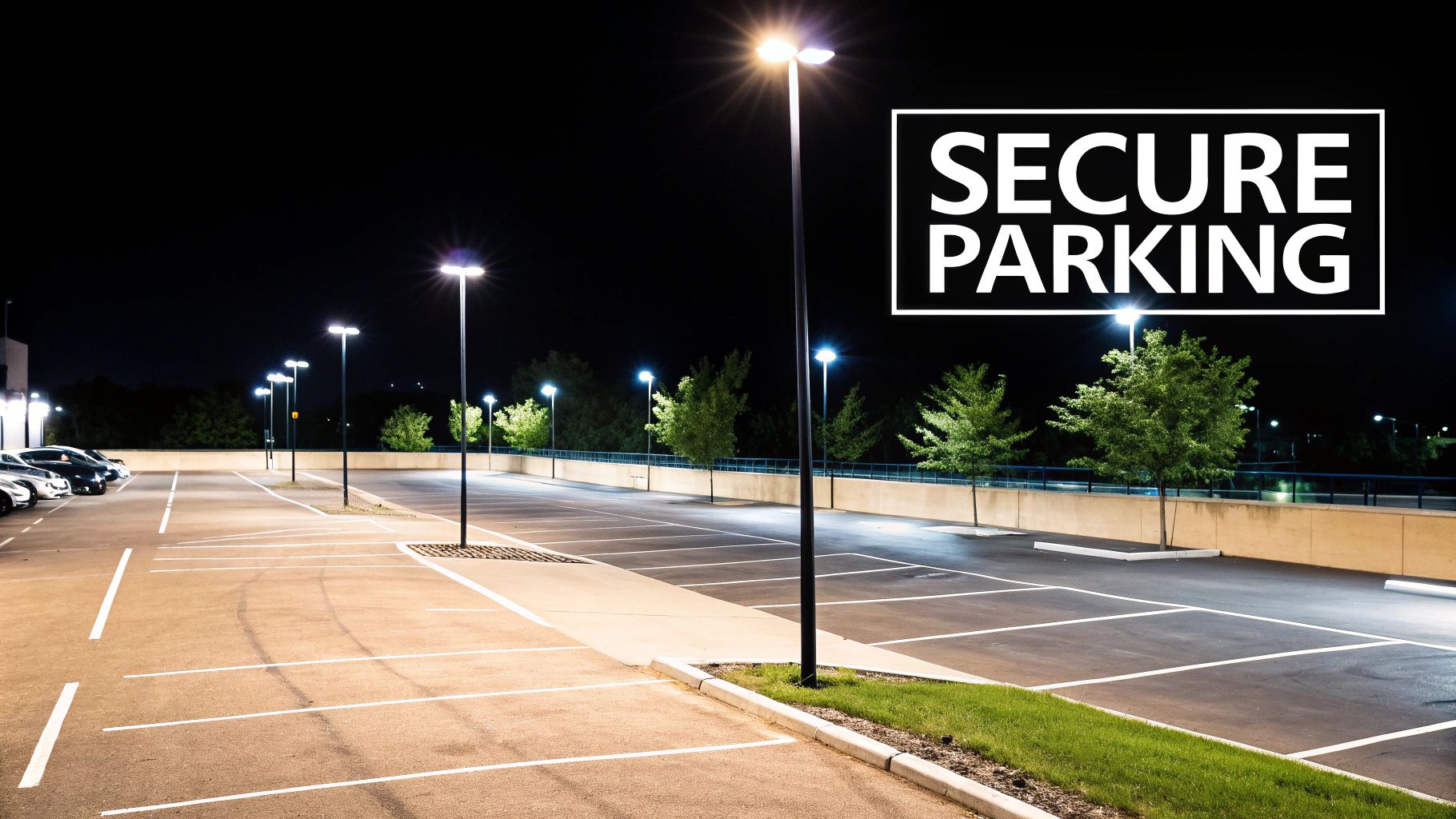
Think of your parking lot as the front door to your business. It’s where your customers and employees form their very first and last impressions. A lot that feels dark, neglected, or just plain sketchy doesn't just look bad—it practically screams vulnerability. This perception can attract all sorts of unwanted activity, turning your property into a magnet for risks you simply can't afford.
The numbers back this up. Official reports show that a staggering 1 in 10 property crimes happens in a parking lot or garage. We're not just talking about a smashed window or a bit of graffiti. These incidents range from organized car break-ins and catalytic converter theft rings to serious, violent assaults, all of which create huge liabilities for property owners.
More Than Just a Place to Park
A solid security plan starts by recognizing that a parking lot is a living, breathing environment with its own set of challenges. It's not a static grid of painted lines; it's a space with a constant flow of people and vehicles, and every interaction is a potential security event. Effective parking lot security is about getting ahead of these risks before they turn into expensive, damaging problems.
A well-secured parking area is a powerful deterrent. It sends a clear message that the property is actively monitored and managed, encouraging criminals to look for easier targets elsewhere.
To really lock down your parking area, you have to start with a deep dive into your specific vulnerabilities. It's a lot like conducting a comprehensive risk assessment for your physical space. Pinpointing those weak spots—the blind corners, the poorly lit areas, the uncontrolled entry points—is the first, most critical step in building a defense that actually works.
To give you a clearer picture, let's break down the essential pillars of a modern security plan into a simple table.
Core Components of a Modern Security Plan
Security Pillar | Primary Goal | Key Elements |
|---|---|---|
Design & Environment | Deter crime naturally | Clear sightlines, strategic landscaping, visible entry/exit points |
Technology Systems | Monitor & control activity | HD cameras, smart lighting, access control gates, emergency call stations |
Human Oversight | Respond & adapt | Security patrols, staff training on protocols, clear emergency procedures |
By integrating these three pillars, you create a security posture that is both proactive and reactive, covering all your bases.
The Growing Demand for Secure Parking
This isn't just a niche concern; the global demand for better security systems is booming. As cities grow and more people own cars, the need for safe, reliable parking has exploded. Just look at the parking lot barrier market—it’s valued at roughly $2.5 billion as of 2025 and is projected to keep climbing. This trend shows a major shift in thinking: business owners now understand that investing in security isn't just an expense, it’s a fundamental part of running a successful and responsible operation.
Designing a Safer Space with CPTED
What if you could discourage crime in your parking lot before it even starts, just by changing its physical layout? That's the powerful idea behind Crime Prevention Through Environmental Design, or CPTED. It’s a practical philosophy that uses smart, strategic design to make a space feel—and actually be—safer. For anyone concerned with parking lot security, it’s a total game-changer.
Think about the gut feeling you get in a dark, overgrown alley versus a bright, open courtyard. One feels risky, the other feels safe. CPTED takes that same human instinct and applies it to your property. By making a few intentional choices about things like lighting, landscaping, and pathways, you’re sending a clear message: this lot is controlled, cared for, and someone is watching.
Best of all, this approach often involves low-cost, high-impact changes that work perfectly alongside security technology. Let's dig into the core principles you can put to work.
Cultivate Natural Surveillance
At its heart, natural surveillance is all about maximizing visibility. Criminals look for shadows and places where they can operate unseen. Your job is to take away those hiding spots. You want to create an environment where your customers, your employees, and even just people passing by become a natural deterrent. The more eyes on the area, the less appealing it is for crime.
Here are a few ways to make it happen:
Strategic Lighting: This is about more than just flicking on bright lights. You need to place them carefully to eliminate deep shadows, especially around entrances, along walkways, and between parked cars.
Landscaping Choices: Keep shrubs trimmed low to the ground and prune tree branches up to about head height. The goal is to make sure your landscaping can’t create blind spots or a convenient place for someone to hide.
Building Placement: If you're designing from scratch or renovating, think about adding windows that overlook the parking area. Even just the perception of being watched can be a powerful deterrent.
Implement Natural Access Control
Natural access control is the practice of using your physical environment to guide people where you want them to go. It’s about creating obvious, predictable paths for both cars and pedestrians, which makes it much harder for someone to wander into an area where they don't belong. This isn't about building a fortress; it’s about providing intuitive direction.
By subtly directing foot and vehicle traffic, you reduce opportunities for crime. A well-defined path makes it harder for individuals with bad intentions to blend in or approach potential targets unnoticed.
Consider these real-world examples:
Defined Walkways: Use different paving stones, painted lines, or low planter boxes to create clear walking paths that are separate from where cars drive.
Landscaping as Barriers: A line of thorny bushes, decorative fencing, or raised garden beds can effectively discourage people from taking shortcuts through restricted areas.
Single Entry/Exit Points: Whenever it makes sense for your property, funneling all traffic through one well-lit and monitored entry and exit point gives you a massive boost in control.
Reinforce Your Territory
Territorial reinforcement is all about perception. It’s how you send the unmistakable signal that this space is owned, managed, and actively cared for. A lot that looks neglected—with faded lines, potholes, and graffiti—screams that nobody is paying attention, which is an open invitation for crime. A well-maintained property, on the other hand, shows pride and communicates that you're on top of things.
This is often the easiest and cheapest principle to put into action.
Clear Signage: Post professional, easy-to-read signs that lay out the rules, hours of operation, and state that the area is under surveillance.
Consistent Maintenance: This is huge. Fix potholes, repaint parking lines when they fade, and get rid of litter and graffiti right away. A clean lot is a secure lot.
Physical Boundaries: Use fencing, bollards, or even a simple line of trees to clearly mark the edge of your property. It defines your space and establishes a clear zone of control.
The Technology That Powers Modern Security

While smart environmental design lays a powerful foundation, it’s technology that gives you the active eyes, ears, and control needed for real-world parking lot security. The right tech acts as a force multiplier, turning a passive space into a monitored, responsive environment. Think of it as a layered digital defense that works around the clock to deter, detect, and document activity on your property.
Three pillars form the backbone of this technological defense: lighting, surveillance, and access control. When they work together, they create a formidable system. Each piece supports the others, covering potential weaknesses and creating a powerful deterrent that criminals simply can't ignore.
Let’s dig into how each of these elements works to protect your lot.
The First Line of Defense Is Light
Poor lighting is an open invitation for trouble. It gives criminals plenty of cover and, just as importantly, makes your patrons and employees feel unsafe. Modern security lighting isn’t just about making things bright; it's about strategic illumination that wipes out shadows and creates a uniform field of view across your entire property.
The goal is to get rid of any "hiding spots" where someone could lurk undetected. This means focusing light not just in the open areas but also between parking spaces, along walkways, and near building entrances and exits.
Here's what makes for effective lighting:
LED Technology: Modern LED fixtures are the industry standard for good reason. They're brighter, use significantly less energy than old-school bulbs, and last much longer, which means lower maintenance bills for you.
Uniform Coverage: You want to avoid creating bright "hot spots" and deep, dark shadows. The aim is consistent, even light distribution. This allows security cameras to capture clear images and, more simply, helps people feel more secure.
Smart Controls: Look into systems with timers, motion sensors, or photocells. These can automatically adjust the lighting based on the time of day or detected activity, saving energy while ensuring light is always there when it's needed most.
Surveillance Beyond Simple Recording
Today's security cameras are so much more than simple recording devices. They are intelligent sentinels that can actively analyze what they see and alert you to potential threats as they happen. For any business, this shifts surveillance from a reactive tool—used only after an incident—to a proactive measure that can stop crime before it even starts.
Imagine a camera system that can tell the difference between a person walking to their car and someone loitering suspiciously in a dark corner. That's the power of AI-driven video analytics.
Modern surveillance systems act as a virtual security guard, constantly scanning for specific behaviors and anomalies. This allows you to respond instantly to potential threats, rather than discovering a break-in hours later.
These advanced systems can be programmed to flag specific events, such as:
Loitering Detection: Triggers an alert when a person or vehicle stays in a designated area for too long.
Perimeter Crossing: Notifies you if someone enters a restricted zone or crosses a virtual "tripwire."
Object Removal: Can detect if a valuable asset, like a piece of equipment, is moved from its spot.
For covering especially large areas, property managers can even explore options like drone-in-a-box solutions that offer on-demand aerial views. This kind of tech turns your surveillance into an active, intelligent part of your parking lot security plan.
Access Control Is the Gatekeeper
The final technological pillar is access control—the systems that decide who gets in and who stays out. This is your digital gatekeeper, and it's a powerful way to manage entry and exit points, especially for private or employee-only lots. The options range from simple and practical to highly advanced, depending on what your site needs.
Parking access control is becoming essential for boosting both security and efficiency. The global market is forecast to hit roughly $12.9 billion by 2032, a big jump from an estimated $7 billion in 2025. This growth is fueled by technologies like License Plate Recognition (LPR) and automated barriers, which have been shown to slash vehicle wait times at entrances by about 24% compared to manual checks.
Let's compare a few common methods.
Access Control Method | How It Works | Best For |
|---|---|---|
Barrier Gate Arms | A simple, automated arm raises and lowers to control the flow of cars. | High-traffic lots where managing the flow of entry and exit is the main priority. |
Keycard/Fob Systems | Employees or authorized users swipe a card or fob to open a gate. | Employee parking, residential garages, and other restricted commercial lots. |
License Plate Recognition (LPR) | A camera reads a vehicle's license plate, checks it against a database, and grants access. | Secure facilities that need seamless, automated entry for pre-approved vehicles. |
By combining strategic lighting, intelligent surveillance, and robust access control, you create a layered security system that makes your property a much harder target. Each technology backs up the others, ensuring your parking lot isn't just perceived as safe, but is actively protected.
How to Choose the Right Security Cameras
Picking out security cameras for your parking lot can feel like a real chore. You're faced with a mountain of options, and it’s easy to get bogged down in technical specs. But here’s the thing: the goal isn’t to buy the most expensive gear on the shelf. It’s about making a smart, strategic investment that actually solves the unique security challenges of your property.
Think of it like putting together the right toolkit. You wouldn't use a sledgehammer to hang a picture frame. In the same way, the camera you need for a wide-open lot is completely different from one meant to capture a license plate at a narrow gate. Making the right choice starts with understanding these differences and how they apply to your space.
Matching Camera Types to Your Needs
To get started, let’s look at the main players. Different cameras are built for different jobs.
For keeping a watchful eye over large, active areas, a Pan-Tilt-Zoom (PTZ) camera is a fantastic tool. You can control it remotely to scan left and right, look up and down, and zoom in on anything suspicious. It's essentially a virtual security guard on patrol, giving you a live, dynamic view of your entire lot.
On the flip side, for those critical choke points like entrances and exits, a fixed 4K camera is often the better bet. It doesn’t move, but its incredibly high resolution captures crystal-clear, detailed images. This level of detail is vital when you need to identify license plates or facial features, which can make all the difference during an investigation.
The most effective surveillance setups almost always use a mix of camera types. A PTZ camera can handle the broad oversight, while fixed 4K cameras lock down your most important spots. This tag-team approach gives you both wide coverage and undeniable evidence.
Choosing the right hardware is especially important for outdoor settings where durability is key. For a deeper dive into what makes a great camera for Kiwi conditions, check out this guide on Choosing Your Best NZ Outdoor Security Camera.
To help you decide, let's break down the common types of cameras and where they shine.
Security Camera Type Comparison for Parking Lots
Camera Type | Best Use Case | Key Advantage | Consideration |
|---|---|---|---|
Fixed/Bullet | Monitoring entrances, exits, and specific high-risk areas. | High-resolution capture of a specific, defined area. | The camera's view is static; it cannot be moved remotely. |
Pan-Tilt-Zoom (PTZ) | Active monitoring of large, open spaces like the main lot area. | Offers 360-degree coverage and the ability to zoom in on incidents. | Can't watch everywhere at once; might miss something if pointed away. |
Dome | General surveillance in areas where discretion is preferred. | More subtle design and often more resistant to tampering. | Field of view can be more limited compared to PTZ cameras. |
4K Ultra HD | Capturing license plates or facial details with extreme clarity. | Provides superior image detail for identification and evidence. | Requires more storage space and network bandwidth. |
Ultimately, a blend of these cameras, thoughtfully placed, will give you the most robust and reliable surveillance system for your parking lot.
Translating Technical Specs Into Practical Benefits
When you start shopping, you'll be hit with a wall of technical terms. Don't let them scare you off. Most of them boil down to answering two simple, practical questions: Can it see in the dark, and can it handle bad weather?
IR Distance (Night Vision): This tells you how far the camera can "see" in pitch-black conditions using infrared light. If a camera lists an IR distance of 100 feet, it means it can capture clear video of anything within that range after the sun goes down. Just match this number to the size of the areas you need to watch at night.
IP Rating (Weatherproofing): This little two-digit code is a big deal. It tells you exactly how well a camera is sealed against solids (like dust and dirt) and liquids (like rain and snow). A camera with a high rating like IP67 is completely dust-tight and can even survive being temporarily submerged in water—perfect for withstanding the elements year-round.
Understanding these two specs ensures you’re buying a camera that won’t let you down, whether it's day or night, rain or shine.
This image really drives home how different security layers work together to cut down on problems in parking areas.
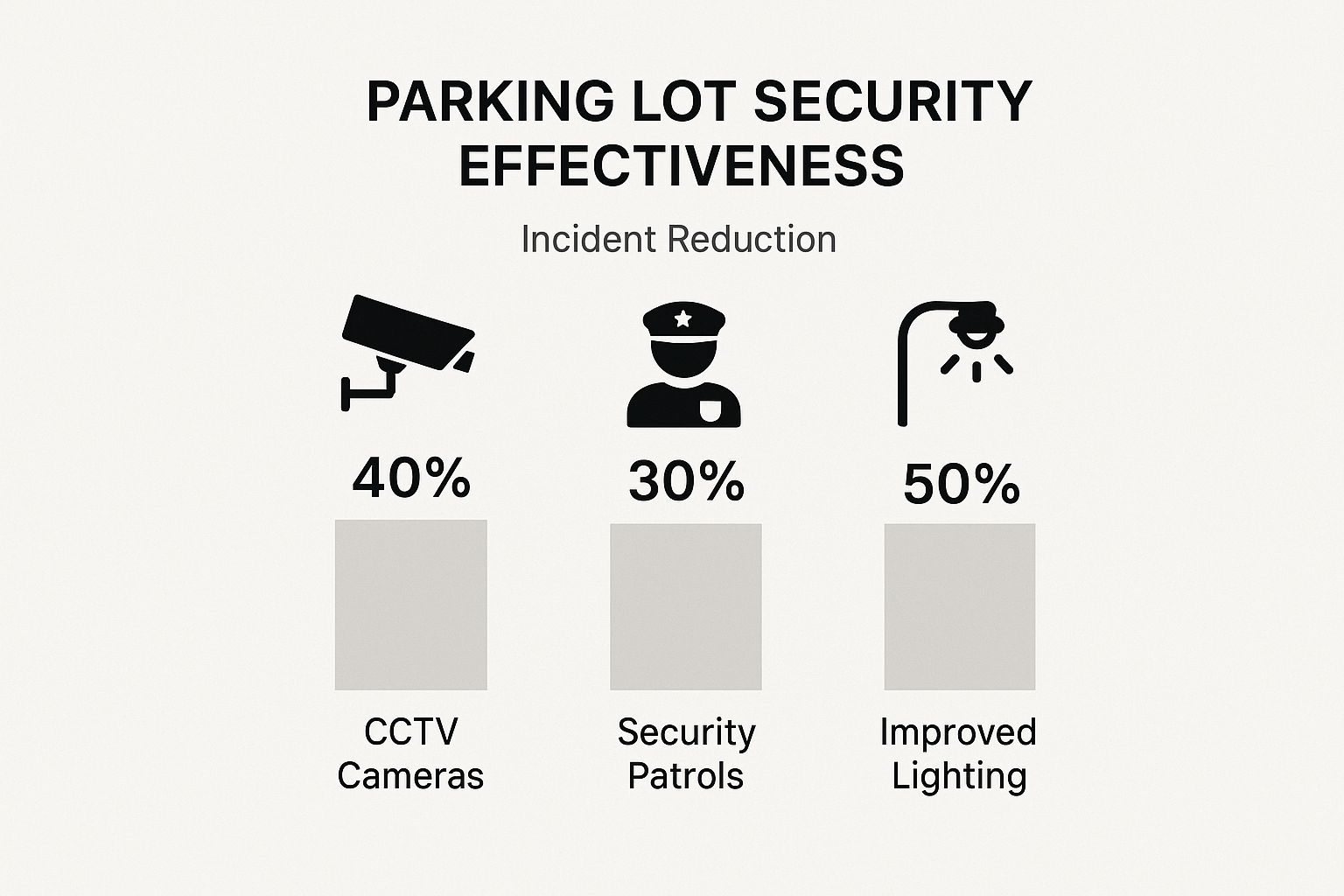
The data makes it crystal clear: while cameras are powerful, simply improving your lighting offers the biggest single boost in reducing incidents.
Strategic Placement for Complete Coverage
Where you put your cameras is just as critical as which models you buy. Your main objective is to eliminate blind spots entirely by creating overlapping fields of view. This simple strategy ensures that if a person or car moves from one camera’s sightline to another, you never lose them.
Here’s a straightforward way to plan it out:
Map Your Lot: Grab a pen and paper or a digital layout of your parking area.
Identify High-Risk Zones: Mark the hotspots—entrances, exits, pedestrian walkways, and those dark, isolated corners.
Plan Overlapping Views: Sketch out your camera positions so their viewing cones slightly overlap. This creates a seamless security blanket with no gaps.
Consider Height and Angle: Mount your cameras high enough to be out of easy reach for vandals, but angle them down just right to capture useful details, not just the tops of people's heads.
This kind of careful planning is what turns a handful of individual cameras into a cohesive and powerful parking lot security network.
Of course. Here is the rewritten section with a more natural, human-expert tone.
The Human Element in Your Security Plan
It's easy to get caught up in the tech—cameras, smart lighting, access control—and assume you've checked all the boxes for parking lot security. But technology is only half the story. The most advanced system in the world is just a collection of expensive hardware without the right people and procedures backing it up.
Think of it this way: your security tech is your surveillance network, but your people are your first responders. They provide the judgment, immediate action, and visible presence that a camera simply can't. It's their involvement that transforms a passive recording system into a truly active and responsive security operation.
The Power of a Visible Presence
One of the most powerful crime deterrents isn't a gadget at all. It's a person in a uniform. When a potential thief or vandal sees a security guard on patrol, the mental calculation changes instantly. The message is clear: this place is being watched, right now, and the odds of getting caught are high.
Sure, cameras are great for evidence after the fact, but a guard on the ground can spot trouble before it starts.
Active Deterrence: Most criminals are looking for an easy score. The sight of a patrol often convinces them to move on and find a softer target.
Immediate Response: When an emergency happens, a guard on-site can provide aid, control the situation, and coordinate with police or paramedics far faster than someone watching a screen miles away.
Customer Assistance: Patrols do more than just deter crime. They offer a friendly face, help people find their cars, and can even assist with minor issues like a dead battery. This creates an atmosphere of genuine safety and care.
Technology is fantastic at documenting what happened. A person on-site can influence what's about to happen. That proactive ability is why human oversight will always be essential.
Training Your Staff to Be Your Eyes and Ears
Don't overlook the security potential of your own team. Your cashiers, maintenance crew, and other employees are already out on your property, and they can be an incredible resource. They don't need to be security experts, but with a little training, they can become an effective early-warning system.
The key is teaching them what to look for and what to do. Train them to notice things that are out of place—someone lingering too long by a row of cars, peering into windows, or systematically testing door handles. Most importantly, give them a dead-simple and discreet way to report it to a manager or security without putting themselves in a risky situation. This simple step turns every employee into an extra set of eyes on your property.
Emergency Preparedness and Response
When an incident kicks off, the difference between a controlled response and total chaos comes down to one thing: a well-rehearsed plan. This is especially true for large, sprawling parking lots. The challenge is so significant that even major governing bodies are focused on it; the European Union, for example, has invested heavily to certify Safe and Secure Parking Areas for truckers along its main routes. You can learn more about the EU's strategy to enhance parking security for professional drivers and see how those high-level principles apply right in your own lot.
To make sure you're truly prepared, your plan needs two non-negotiable elements:
Emergency Call Stations: These are literal lifelines. When someone is in a panic, fumbling for a phone and trying to dial is a huge ask. A big, brightly lit call station with a single push-to-talk button cuts through the fear, connecting them directly to help and providing immediate peace of mind.
A Rehearsed Action Plan: What happens after that button is pushed? Everyone on your team needs to know the answer. You need a clear, step-by-step playbook for different scenarios, from a medical issue to a criminal threat. Practice it, drill it, and make sure everyone can act with confidence when the pressure is on.
Got Questions About Parking Lot Security? We’ve Got Answers.
Even after you’ve done your research, it’s natural to have questions when you start digging into parking lot security. Most business owners I talk to are weighing the same things: the real-world cost, what they're legally required to do, and how to choose the right tools for their unique space. Let's tackle some of the most common questions head-on.
Think of this as a quick chat with an expert. We'll cut through the jargon and give you the straightforward advice you need to feel confident in your decisions.
How Much Does Parking Lot Security Really Cost?
This is always the first question, and the honest answer is: it really depends. There's no single price tag. Your costs will hinge entirely on your lot's size, the specific risks you're facing, and the level of technology you decide to bring in.
For a small retail shop, for instance, a solid starting point might be a few thousand dollars. That could cover a professional upgrade to bright LED lighting and a few well-placed 4K cameras. It's a foundational investment that goes a long way toward discouraging casual theft and vandalism.
On the other hand, a large multi-level garage or a busy logistics hub is playing a different game. A comprehensive project with automated security gates that use license plate recognition, a full network of AI-driven cameras, and prominent emergency call stations could easily reach tens of thousands of dollars. The price is always driven by the amount of hardware, the smarts of the software, and whether you add ongoing services like professional monitoring or guards.
The smartest way to frame this is as a capital investment, not just another line-item expense. A secure parking area cuts down on your liability, prevents expensive property damage, and can genuinely increase your property's value by making it a more desirable place for customers and tenants.
To get a real number for your property, you absolutely have to get multiple, detailed quotes from trusted security installers. That's the only way to find a solution that truly fits both your security goals and your budget.
Are Fake Security Cameras a Good Idea?
In a word: no. I know the rock-bottom price of a dummy camera is tempting, but they are a huge liability and, frankly, a waste of money. It's the classic case of getting exactly what you pay for.
Seasoned criminals can spot a fake a mile away. They know to look for the tell-tale signs—no wiring, a cheap plastic body, or that one, unconvincing blinking red light. The second they realize it's a fake, any deterrent effect you hoped for is gone.
Even worse, a fake camera creates a false sense of security for your staff and visitors. When an incident does happen, you'll have absolutely no footage to give to law enforcement, leaving everyone vulnerable. That illusion of safety could even put you in legal jeopardy if someone is hurt on your property, believing they were being watched over. The tiny amount you save just isn't worth the massive risk and the complete lack of function when it counts. A small, real system is always the better investment.
What Are My Legal Responsibilities for Security?
From a legal standpoint, property owners have something called a "duty of care." This means you are obligated to provide a reasonably safe environment for anyone who comes onto your property. This concept is a cornerstone of premises liability law, though the specifics can change from state to state.
Here’s where it gets real: if your property has a known history of crime—say, a series of car break-ins—and you don't take reasonable steps to fix the problem, you could be found negligent if someone gets hurt. The key term here is "reasonable steps." The law doesn't expect you to build Fort Knox, but it does expect you to not ignore obvious dangers.
What do "reasonable steps" usually look like?
Making sure your lot has adequate, working lights.
Placing security cameras in high-risk zones.
Quickly repairing things like broken fences or gates.
Posting clear signs about surveillance and property rules.
This is exactly why conducting regular risk assessments, keeping a record of your security upgrades, and acting on known threats is so crucial. My best advice? Have a conversation with a legal professional and your business insurance agent to get a crystal-clear picture of your obligations.
How Can I Secure Parking for a Temporary Event?
Securing a parking area for something short-term like a festival, a weekend market, or a construction site calls for a different playbook. You need to focus on solutions that are highly visible, effective immediately, and easy to set up and tear down.
First, rent portable light towers. They can flood a huge area with light in minutes, getting rid of the dark corners that invite trouble. You can also bring in mobile surveillance trailers. These units are fantastic—they're often solar-powered and use cellular networks, so you get live monitoring without needing to run a single permanent wire.
Next, use physical barriers like traffic cones, barricades, and temporary fencing to create obvious entry and exit points. This is all about channeling traffic and controlling how people and cars move. But the most important element? People. Staff the area with highly visible event personnel or security guards. For a temporary setup, their active presence is by far your strongest and most effective deterrent.
Comments