


A Guide to Neighborhood Surveillance Cameras
- Бонус за регистрацию онлайн казино
- Jul 8, 2025
- 16 min read
Think of neighborhood surveillance less as a single camera on a doorbell and more as a digital version of the classic Neighborhood Watch. Instead of just one person keeping an eye out, it's about connecting technology to create a community-wide safety net. It’s a powerful shift from individual security to a collective, collaborative effort.
The Modern Neighborhood Watch
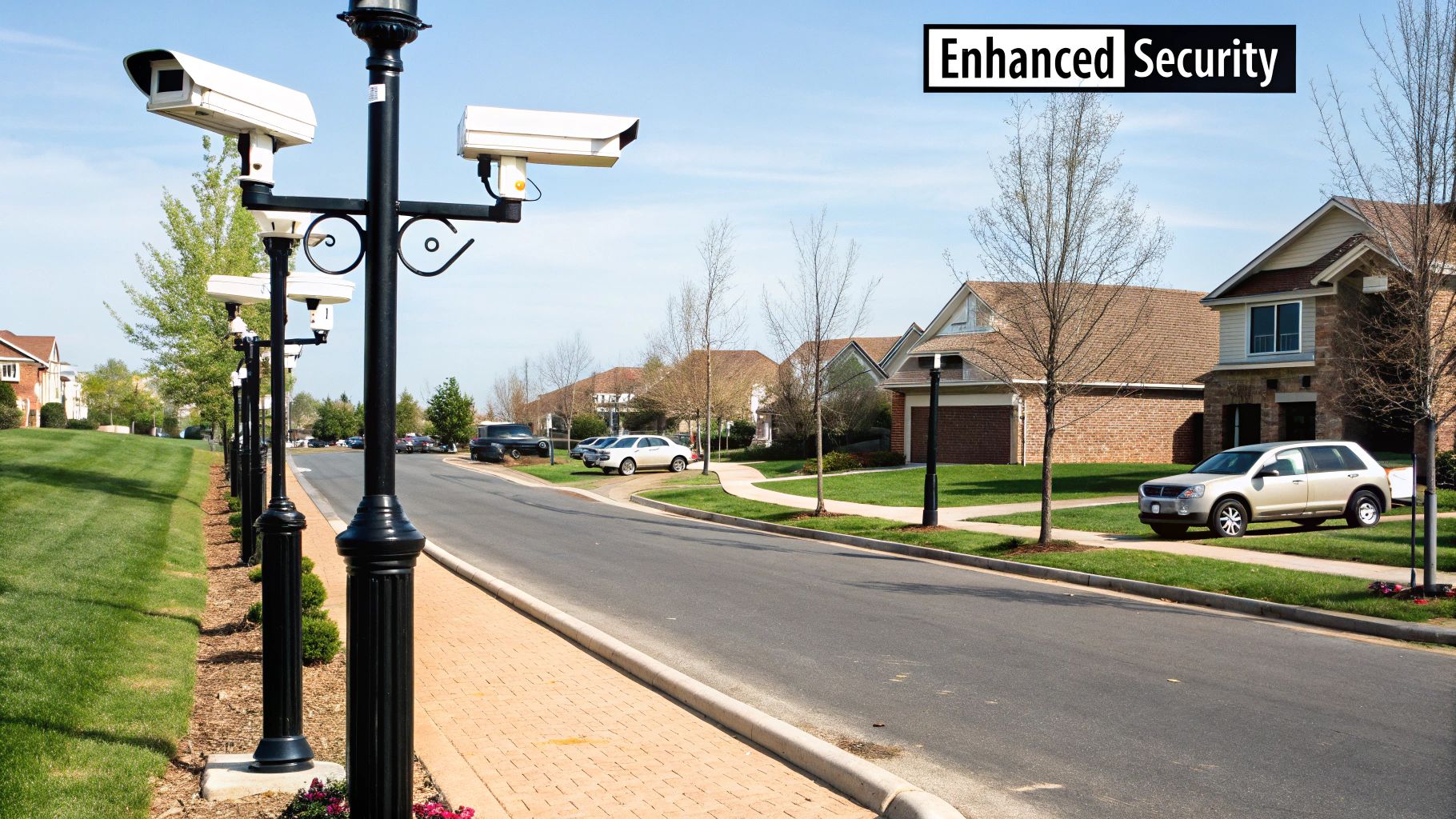
We all know the traditional image of a neighborhood watch—volunteers patrolling with flashlights and walkie-talkies. While the community spirit remains the same, the tools have gotten a serious upgrade. Today, entire neighborhoods are adopting interconnected neighborhood surveillance cameras, turning a passive approach into a proactive security shield.
This isn't just about protecting your own front porch anymore. It’s about creating a shared sense of safety. A single doorbell camera is great for your packages, but a network of cameras covering key entry points, common areas, and streets provides a much broader view. It’s the difference between having a single puzzle piece and seeing the whole picture.
Why Communities Are Uniting for Safety
So, why are residents and homeowner associations (HOAs) moving in this direction? The reasons are practical and directly impact everyone's quality of life.
Deterring Crime: Simply put, visible cameras make criminals think twice. Few will risk targeting an area where they know their every move is being recorded from multiple angles.
Gathering Evidence: When a package thief, vandal, or burglar does strike, shared footage is gold for law enforcement. One camera might catch a clear shot of a suspect’s face, while another down the street captures their getaway car and license plate.
Boosting Peace of Mind: There's a real comfort in knowing your community is actively monitored. It provides a tangible sense of security for your family, your home, and your property.
This community-focused approach has grown naturally from the massive boom in personal smart cameras. The numbers tell the story: what started with about 108 million households using smart security in 2016 skyrocketed to nearly 586 million by 2021. And it's not slowing down, with projections suggesting that number could hit 1.81 billion by 2027. If you're interested, you can read more about this explosive growth in camera adoption and its impact.
A successful neighborhood program is built on more than just technology. It requires a foundation of trust, clear communication, and a shared commitment to responsible management.
Balancing Benefits with Responsibility
Of course, putting a shared surveillance system in place isn't as simple as just buying cameras. The incredible benefits of improved safety have to be carefully weighed against the need for privacy and ethical management. A program that works is about much more than hardware; it's about building a framework of trust that everyone buys into.
This guide is designed to walk you through it all. We'll cover everything from picking the right cameras and understanding key features to navigating the legal fine print and launching a program your whole community can get behind. The ultimate goal is a system that’s both effective and ethical—one that makes your neighborhood safer while respecting everyone's rights.
2. Choosing the Right Cameras for Your Community
Once everyone in the community is on board with the goal, the real work begins: picking the right equipment. The sheer number of security cameras out there can feel overwhelming, but the process gets much easier when you break it down. Think of it like stocking a toolbox—you need the right tool for the right job, and surveillance is no different.
You'll mainly come across three types of cameras: Dome, Bullet, and PTZ (Pan-Tilt-Zoom). Each has its own strengths and is designed for a specific purpose. Understanding what makes each one tick is the secret to building a comprehensive security system that truly protects your neighborhood without overspending.
Bullet Cameras: The Focused Sentry
When you imagine a classic security camera, you're probably picturing a bullet camera. Their distinct, elongated shape is hard to miss, which is a big part of their power. Just seeing one can be enough to make a potential thief think twice.
Bullet cameras are specialists. Their job is to watch one specific, fixed area with unwavering focus. Need to keep an eye on the main road into your subdivision, the gate to the community pool, or a specific alleyway? A bullet camera is perfect. You aim it, lock it in place, and it delivers a constant, clear view, making it ideal for capturing crucial details like license plates or faces at key choke points.
Dome Cameras: The Discreet Guardian
For a more subtle approach, dome cameras are the way to go. Housed in a dark, rounded casing, it’s nearly impossible for someone on the ground to know exactly where the lens is pointed. This built-in ambiguity makes them a fantastic choice for common areas or places where a more obvious camera might feel intrusive or become a target for vandals.
Picture a community clubhouse, a shared mailroom, or a playground. A dome camera can monitor these wide areas effectively without putting people on edge. Plus, their tough housing offers solid protection against tampering, making them a durable option for any public space where they might be within reach.
"Choosing the right camera isn’t about finding the 'best' one overall. It's about finding the 'right fit' for each specific spot. A smart mix-and-match strategy, using different cameras for different needs, almost always results in the most effective and efficient security coverage for a community."
PTZ Cameras: The Active Observer
Some spaces are just too big and dynamic for a fixed camera. This is where Pan-Tilt-Zoom (PTZ) cameras come in. Just like the name says, these cameras can be controlled remotely to pan across a scene, tilt up and down, and zoom in on anything that catches your eye.
Think of a PTZ camera as having an active security guard on patrol 24/7. It’s the perfect tool for watching over a large community park, a sprawling parking lot, or a busy intersection. An operator can follow a suspicious individual, track a vehicle as it moves through the neighborhood, or zoom in to get a crystal-clear look at an incident as it happens. This active monitoring capability makes PTZ cameras the most powerful—and typically most expensive—option for wide-open areas.
While cameras are a huge part of the puzzle, remember they work best as part of a larger security plan that can include a range of security solutions.
To help you start thinking through your options, this chart shows how different factors might guide your decision.
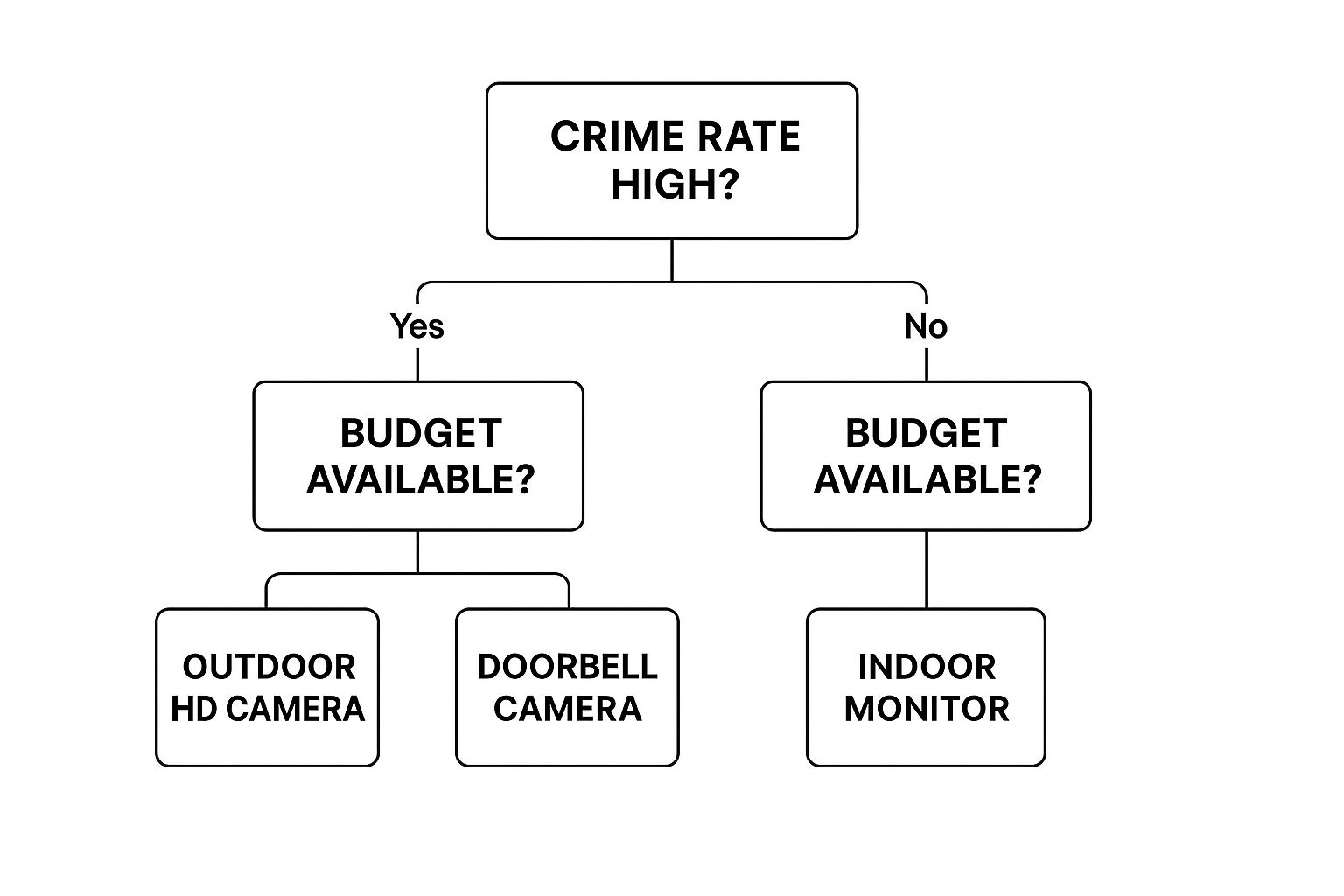
As you can see, a higher-risk area with a larger budget might lead you toward more powerful outdoor HD cameras. On the other hand, a lower-risk spot or a tighter budget can still be effectively monitored with simpler tools like smart doorbell cameras.
Comparing Common Types of Surveillance Cameras
To make a final decision, you'll need to weigh the pros and cons of each camera against your neighborhood's unique layout and budget. This table offers a quick comparison to help you find the ideal fit.
Camera Type | Best Use Case | Field of View | Visual Presence | Typical Cost |
|---|---|---|---|---|
Bullet Camera | Monitoring fixed points like entrances or driveways | Fixed, directional | High (obvious deterrent) | $-$$ |
Dome Camera | Wide coverage in common areas; vandalism-prone spots | Wide, fixed | Low (discreet) | $$-$$$ |
PTZ Camera | Actively monitoring large, open spaces like parks or parking lots | Variable, user-controlled | High (large and visible) | $$$-$$$$ |
Ultimately, the best systems often use a strategic mix of these cameras. By carefully mapping out your community’s vulnerable spots and defining what you want to achieve, you can confidently build a security network that delivers real peace of mind.
Essential Features for Effective Surveillance
Picking the right type of camera is a great first step, but what’s inside that camera is what really counts. The features packed into the hardware are what separate a camera that captures a blurry, useless blob from one that records clear, actionable evidence. Think of this as your performance checklist—these are the specs you can't afford to ignore if you want your neighborhood surveillance system to deliver real results.
It's a booming market, too. The global surveillance camera market is currently valued at around $38.89 billion and is on track to hit over $62.57 billion soon. This growth is being fueled by huge leaps in the very features we're about to cover, especially in AI and video analytics. You can discover more insights about the security market growth to get a sense of how quickly this technology is evolving.
Knowing what to look for will help your community choose a system that actually works, not just one that provides a false sense of security.
Video Resolution and Clarity
At its core, a camera's most basic job is to see clearly, and that all comes down to video resolution. This is what determines the level of detail it can capture. Low resolution is like looking at an old, pixelated photo—you get the general idea, but the critical details are lost. High resolution gives you a crisp, sharp picture where those details pop.
Here’s a simple way to understand the numbers:
1080p (Full HD): Consider this the absolute minimum for any serious surveillance today. It's clear enough to identify people and see what’s happening in good lighting.
2K (1440p): This is a noticeable step up. It makes it much easier to pick out smaller details from a distance, like a logo on a shirt or more distinct facial features.
4K (Ultra HD): This is the top tier. The level of detail is exceptional, allowing you to digitally zoom in on recorded video to read a license plate or other key identifiers with far greater accuracy.
For a neighborhood-wide system, especially for cameras watching key spots like entrances or intersections, investing in at least 2K or 4K resolution is a very smart move.
Seeing in the Dark with Night Vision
Crime doesn't clock out when the sun goes down, and your cameras shouldn't either. Good night vision is non-negotiable for 24/7 protection. Without it, your cameras are essentially blind for half the day.
You’ll generally find two types of night vision. Infrared (IR) is the classic black-and-white view that can see in complete darkness. Color night vision is a newer technology that uses ambient light—from streetlights or porch lights—to record in full color. Seeing the color of a car or a suspect's clothing can be incredibly valuable. Many of the best cameras offer both, automatically switching based on how much light is available.
A camera's ability to capture clear footage at night is just as important as its daytime performance. An incident at 2 AM requires the same level of detail as one at 2 PM.
Smart Motion Detection with AI
We’ve all seen it—older motion detectors that go off every time the wind blows a tree branch or a cat wanders by. Modern neighborhood surveillance cameras have a much more intelligent solution: AI-powered motion detection.
This technology is a game-changer because it allows the camera to tell the difference between people, vehicles, and pets. This intelligence drastically cuts down on false alarms, so you get alerts that actually matter. When your phone buzzes, you know it's because something important is happening, not just a raccoon digging through the trash. Some systems even let you draw virtual "tripwires" on the screen, only alerting you when someone or something crosses that specific line.
This feature transforms your cameras from being passive recorders into active, thinking security tools that filter out the noise so you can focus on what's important.
Understanding Privacy Laws and Community Ethics
While everyone wants a safer neighborhood, setting up surveillance cameras brings up a really important conversation about privacy and legal lines. This isn't just a box to tick; it's the bedrock of a program that actually works and doesn't make people feel spied on. Getting this right means your community feels protected, not watched, and keeps everyone on the right side of the law.
Think of it like this: you know where your property line is in the real world. Similar boundaries exist for surveillance. The whole game is knowing where public space ends and your neighbor's private life begins. This one idea should guide every single decision you make, from where you mount a camera to how you use the footage. Getting it wrong can spark legal battles and, even worse, destroy the trust you share with your neighbors.
A great program is all about striking a balance—achieving security goals while respecting everyone's rights. It's totally doable with a bit of planning and a lot of clear communication.
Public Spaces Versus Private Expectations
The single most important rule in surveillance law comes down to a concept called the "reasonable expectation of privacy." It sounds technical, but it’s pretty simple. We all expect privacy inside our homes, in our fenced backyards, or when someone is looking into our windows. Public spaces? That's a different ballgame.
Any area that’s open for a random person to see—like streets, sidewalks, and the front yards of houses—is generally fair game. This means you are typically well within your rights to record these spaces from your own property.
What's Okay: Pointing a camera at the public sidewalk to see who's walking by or at the street to catch license plates is generally fine.
What's Not Okay: Aiming a camera over a fence to see into a neighbor's pool or directly into their living room window. That's a huge invasion of privacy and likely illegal.
The goal is to watch over shared spaces for the good of the community, not to peek into the private lives of others. Keep that principle in mind, and you'll sidestep most potential problems.
The Special Case of Audio Recording
Video rules are one thing, but recording audio is a whole other level of legal complexity. Many places have what are called "two-party" or "all-party" consent laws. In simple terms, this means it’s illegal to record a private conversation unless every single person in that conversation knows they are being recorded and agrees to it.
Because it’s practically impossible to get consent from every person who might walk past your camera having a chat, the advice from nearly all security and legal experts is the same: turn off the audio recording feature on outdoor cameras.
Honestly, the legal headaches and risks that come with recording audio just aren't worth it. Stick to video-only. It's the safest and most ethical choice for any neighborhood camera initiative.
Building Trust Through Transparency
Beyond just following the law, you need to think about community ethics. The fastest way to get your neighbors on board is with total transparency. People are much more comfortable with cameras when they know exactly why they're there, what they can see, and how the footage is handled.
One of the easiest and most effective ways to do this is with good old-fashioned signs. Posting clear, visible signs at the entrances to your neighborhood that say the area is under video surveillance does two key things:
It Deters Criminals: The signs alone can be a powerful deterrent, making your cameras even more effective.
It Informs Everyone: It gets rid of any "secret squirrel" vibe and shows that the program is being run openly and honestly.
Before you buy a single camera, it's crucial to understand your local laws. For instance, you should look into the specific privacy obligations related to CCTV in New Zealand if you live there, or research the equivalent for your own region. While the details vary, the big ideas of respecting privacy and being upfront are universal. If you make these ethics a priority from day one, you’ll build a program the whole community can get behind.
How to Launch a Neighborhood Camera Program
So, you're ready to move from talking about shared security to actually setting up a camera system. It’s a big step, but with a clear roadmap, it’s entirely achievable. A successful program isn’t something that happens overnight; it’s built on a solid foundation of careful planning, genuine community buy-in, and a real commitment to managing it responsibly.
Think of it like building a deck. You wouldn't just start cutting wood without a blueprint. The same logic applies here. A structured approach helps you sidestep common mistakes and ensures the end result actually delivers the peace of mind everyone is hoping for.
Before you get too far, it's wise to start by conducting a comprehensive operational risk assessment. Taking the time to think through potential challenges upfront can save you from major legal and financial headaches later on.
Form a Committee and Define Your Goals
First things first, you need a team. Pull together a small group of dedicated residents to act as the project's steering committee. This group will handle the research, keep everyone informed, and guide the process from beginning to end. This is not a one-person job—you need different perspectives and a way to share the workload.
The committee's first priority? Figure out exactly what you're trying to accomplish. A vague goal like "making the neighborhood safer" isn't going to cut it. You need to get specific.
Think in terms of concrete problems you want to solve:
Goal 1: Reduce the recent string of package thefts on Oak Street by getting clear footage of front porch areas.
Goal 2: Deter the late-night vandalism happening at the community playground.
Goal 3: Install LPR cameras at the main entrance to identify cars involved in speeding or hit-and-run incidents.
These kinds of sharp, well-defined goals will steer every decision you make, from which cameras to buy to where you put them. They also give you a clear benchmark for success and help justify the cost to your neighbors.
Create a Budget and Select a Vendor
With clear goals, you can start talking numbers. A realistic budget for your neighborhood surveillance cameras has to cover more than just the price of the cameras themselves.
Make sure your financial plan accounts for everything:
Hardware Costs: The cameras, mounts, cables, and any other physical gear.
Storage Solution: Are you buying a Network Video Recorder (NVR) upfront or paying a monthly cloud storage fee?
Installation Fees: Unless you have skilled volunteers, professional installation is almost always worth it for a clean, reliable setup.
Ongoing Maintenance: Set aside a bit for future repairs, replacements, or software updates.
Once you have a budget, it’s time to find a vendor. Look for reputable installers with experience on community-wide projects. Ask for references, get multiple quotes, and compare them based on the quality of the equipment and the level of support they offer, not just the bottom-line price.
Draft a Comprehensive Usage Policy
This is, without a doubt, the most important step. Your usage policy is the rulebook for the entire program. It’s a formal document that sets firm boundaries, manages expectations, and protects everyone involved—the community, the committee, and individual residents. This is how you build trust.
Your usage policy is the key to responsible management and community-wide support. It transforms your program from a loose collection of cameras into a structured, accountable security system.
Your policy needs to provide crystal-clear answers to these key questions:
Who can view footage? Keep this list small. Access should be limited to two or three pre-approved committee members, period.
When can they view it? Footage should only be reviewed in response to a specific, reported incident—ideally one that has an official police report number attached.
How is data stored and for how long? Define a strict data retention period. 30 days is a common and reasonable standard. After that, footage should be automatically deleted.
How is footage shared? Create a formal process for giving evidence to law enforcement. This should never involve posting clips on social media or sharing them with the entire neighborhood.
By establishing a strong, transparent policy before a single camera goes up, you tackle privacy concerns from the start and show a serious commitment to ethical oversight. That’s the key to getting the community on board.
Frequently Asked Questions
As your community starts exploring a neighborhood surveillance camera program, you're bound to have questions. That's a good thing. It shows everyone is thinking critically about how to do this right. Answering these common concerns openly is the best way to build trust and get everyone on the same page.
Here are some of the most common questions that pop up, with practical answers to help guide your decisions.
Can We Legally Point a Camera at a Neighbor's Property?
This is probably the most important question, and it gets right to the heart of the privacy debate. In general, you're free to record what happens in public spaces from your own property—think streets, sidewalks, and your own yard.
The legal and ethical line gets crossed when a camera is set up to peer into an area where someone has a reasonable expectation of privacy. This means places like:
Inside their home through a window
Their fenced-in backyard or private patio
A pool area that’s screened from public view
The whole point of neighborhood surveillance should be to monitor public streets or shared community assets like a park or the main entrance. While a camera watching the street might incidentally catch the edge of a neighbor’s lawn, that's typically fine. But deliberately aiming it at their private living spaces is a huge privacy violation and can land you in legal trouble. When in doubt, always check your local and state laws.
What Is the Best Way to Store Our Footage?
Deciding where to keep your video recordings is a major decision, balancing cost, security, and how easily you can access the footage. You’ve really got three paths to choose from.
Local Storage: This means using a physical device like a Network Video Recorder (NVR) right on-site. The big plus is you buy the hardware once and you're done—no monthly fees. The major downside? If that device is stolen or destroyed in a fire, your video evidence is gone for good.
Cloud Storage: Here, your video is sent over the internet and stored securely on remote servers. You’ll pay a subscription fee, but it protects your footage from being physically lost or damaged and lets you view it from anywhere. Its biggest weakness is its complete reliance on a strong, stable internet connection.
Hybrid Storage: Many pros see this as the sweet spot. A hybrid setup records everything to a local NVR but also sends important clips—like when motion is detected—to the cloud. It gives you the reliability of local recording with the secure backup and remote access of the cloud, making it an excellent choice for a community-wide system.
"A hybrid storage model provides the best of both worlds. It gives you the immediate access and continuous recording of local storage, paired with the disaster-proof security and remote access of the cloud."
How Do We Get Our Entire Neighborhood to Agree?
Getting an entire community on board with a project like this is definitely a challenge, but it's far from impossible. Success really boils down to transparency, communication, and a clear plan. This can't be one person's pet project; it has to be a genuine team effort.
A great first step is to form a small committee to do the homework and lead the outreach. Then, hold open meetings where you can lay everything out: the program's goals, where cameras might go, and a totally transparent breakdown of the costs.
Most importantly, you have to tackle privacy concerns from day one. The best way to do that is by drafting a clear, public usage policy. This document should spell out exactly who can see the footage, the specific reasons they can access it, and how long it's kept before being deleted. You might also use community surveys to see how people feel and identify their biggest worries. Sometimes, starting with a small pilot program in one high-traffic area is the perfect way to show the system's value and build the trust you need for a bigger rollout.
Are Wireless Cameras as Reliable as Wired Ones?
The old wired vs. wireless debate isn't really about which one is "better" overall, but which is the right tool for the job. Each has its own strengths in a smart neighborhood security plan.
Wired cameras, especially those using Power over Ethernet (PoE), are the workhorses. They get power and send data through one physical cable, so you never have to worry about a dead battery or a dropped Wi-Fi signal. This makes them the clear winner for critical spots like neighborhood entrances and key intersections where you absolutely need 100% uptime.
Wireless cameras, on the other hand, offer incredible flexibility. They’re perfect for spots where running a cable would be a nightmare—either too expensive or just plain impossible. Their reliability, however, depends entirely on a strong Wi-Fi signal and a power source, whether that's a battery you have to change or a nearby outlet.
For a truly solid neighborhood system, a mix is usually the best strategy. Use dependable wired cameras for your most important choke points, then fill in any coverage gaps with wireless ones.
At PCI Audio-Video Security Solutions, we specialize in designing and installing security systems that offer both peace of mind and operational excellence. From advanced 4K and LPR cameras to comprehensive access control, we provide the tools your community or business needs to stay secure. Learn how we can help protect what matters most to you.
Comments