


Best Battery Powered Security Cameras Guide
- Бонус за регистрацию онлайн казино
- Aug 27, 2025
- 18 min read
So, why go with a battery-powered security camera? The answer is simple: flexibility. Unlike their wired cousins, these cameras give you the freedom to put an eye almost anywhere, without needing to drill holes or call an electrician.
The True Freedom of Wire-Free Security
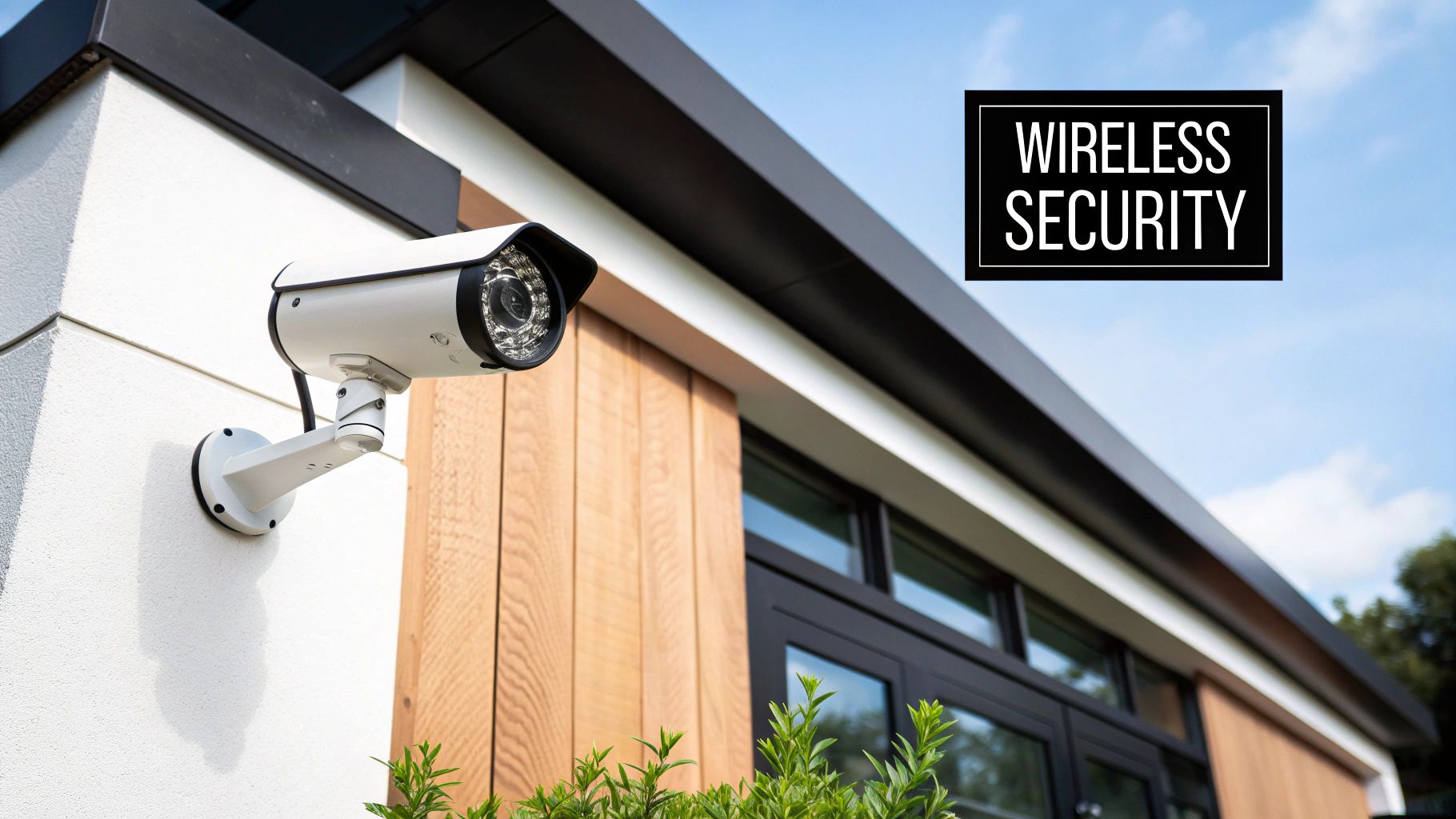
When we talk about "wireless" security, most people think about the Wi-Fi connection. But cutting the data cable is only half the story. The real game-changer is cutting the power cord. That's what makes battery-powered security cameras such a great fit for modern homes and businesses.
It’s a lot like the jump from landline phones to cell phones. Remember being stuck in one spot, tethered to the wall? The mobile phone, with its battery, let you talk from anywhere. Battery-powered cameras bring that same kind of liberation to home security.
Placing Security Exactly Where You Need It
The biggest win from ditching the power cable is being able to install a camera in spots that used to be off-limits. Traditional cameras are leashed to the nearest power outlet, and getting them to the perfect vantage point often means calling in an electrician for some expensive, messy work.
With a battery-powered camera, the possibilities open up.
Mount it on a garden fence to watch over the backyard.
Strap it to a tree to keep an eye on a long driveway.
Place it on a detached shed or garage without trenching wires.
Use it for temporary surveillance at a job site or a weekend event.
This kind of adaptability lets you cover your property's most vulnerable areas, not just the spots that are easy to wire. You get to design your security around your actual needs, not your home's electrical layout.
True wireless security is all about power independence. It turns surveillance from a fixed, static system into a dynamic tool that fits your life and your property—not the other way around.
Simplified Installation and Maintenance
Getting a battery-powered security camera up and running is refreshingly straightforward. Since you don't have to drill through walls to run power lines, the whole setup usually takes just a few minutes. Most come with simple mounting brackets that you can put up with a couple of screws.
This simplicity doesn't just save you time and hassle; it makes these cameras ideal for renters or anyone who doesn't want to make permanent changes to their property.
Plus, with modern battery tech, you might only need to recharge the camera every few months. Many models even have optional solar panels, giving you a truly hands-off, set-it-and-forget-it system. This mix of easy setup and low maintenance puts powerful security within reach for just about anyone.
How These Cameras Work Without Wires
So, how exactly do battery-powered security cameras deliver on their promise of wire-free convenience? It’s not magic, but it is a pretty clever blend of efficient hardware and smart software working together. The secret lies in how these devices manage their limited power source.
Think of your camera's battery like the one in your phone. If you're constantly streaming videos or playing games, it drains quickly. But if you just leave it on standby, it can last for days. The same logic applies here; the camera's battery life is a direct result of how much work it's asked to do.
This need for simple, flexible security is driving huge growth in the market. The global wireless security camera industry, where battery-powered models are a major player, hit a value of $7.45 billion in 2024. Projections show it could soar to nearly $19.13 billion by 2032. This boom is all thanks to the rise of smart homes, where people want security solutions that are easy to install and use. You can learn more about the factors driving this growth in the wireless camera market.
The Powerhouse: The Battery and Its Limits
Most of today's cameras run on rechargeable lithium-ion batteries—the same reliable tech that powers your smartphone. They pack a lot of power into a small space and can be recharged hundreds of times. While you might find some budget models that use disposable batteries, they're becoming less common because they just aren't as practical or cost-effective in the long run.
On paper, a single charge can last anywhere from two to six months, but that's under ideal conditions. In the real world, several things can chew through that battery life much faster:
High-Traffic Areas: If your camera watches over a busy sidewalk or your front door, it's going to wake up constantly to record, which is a major power drain.
Frequent Live Streaming: Want to check in on your pets? Go for it, but just know that watching the live feed is one of the quickest ways to deplete the battery.
Cold Weather: Batteries hate the cold. Just like your car battery on a frosty morning, a camera's battery can lose 20% or more of its capacity when the temperature drops.
Poor Wi-Fi Signal: A weak connection forces the camera's Wi-Fi radio to work overtime just to stay online, using up precious energy in the process.
The Brains Behind Efficiency: Motion Detection and Sleep Mode
To make a single charge last for months, these cameras have a brilliant trick up their sleeve: they spend most of their time asleep. They operate in an ultra-low-power standby mode, waiting for something to happen. The hero of this story is the Passive Infrared (PIR) sensor.
A PIR sensor doesn't "see" like a camera lens. Instead, it detects changes in heat. When a person, animal, or car moves into its field of view, the sensor picks up on that thermal signature and instantly wakes the camera up.
The camera spends most of its life in a deep sleep, consuming minimal power. It only wakes up for a few seconds to record and send an alert when the PIR sensor detects motion, then goes right back to sleep.
This "wake-on-motion" approach is the key to their incredible efficiency. Rather than running 24/7 and recording hours of useless footage, the camera conserves all its energy for the moments that truly matter. The whole process happens in a split second, so you still capture the event right from the start.
Connecting to Your World: The Wi-Fi Link
Once the camera has captured a motion event, it needs to get that video clip to you. That's where the built-in Wi-Fi radio comes in. It powers on, connects to your home network, and quickly uploads the footage to a secure cloud server or directly to the app on your phone.
As soon as the upload is complete, the Wi-Fi shuts back down, and the camera goes back to sleep.
This constant, intelligent cycle of sleeping, waking, recording, and transmitting is what allows a battery-powered security camera to stand guard for months without ever needing a plug. It’s a sophisticated dance between hardware and software, all designed to give you powerful security with total flexibility and zero fuss.
Essential Features Every Smart Buyer Looks For
Picking the right battery-powered security camera can feel like you're trying to crack a secret code. But it's not as complicated as it seems. Once you know what to look for, you can easily find the perfect camera for your home.
Think of it like choosing a new car. A high-performance sports car is a thrill to drive but guzzles gas. On the other hand, an economy car sips fuel but isn't going to win any drag races. Cameras are similar—a model with crystal-clear 4K resolution and all the bells and whistles will give you amazing footage, but you'll be charging it a lot more often than a basic 1080p camera.
Let's break down what really matters.
The image below shows how adding a solar panel can make your security setup almost completely self-sufficient—a smart move for long-term, hassle-free monitoring.
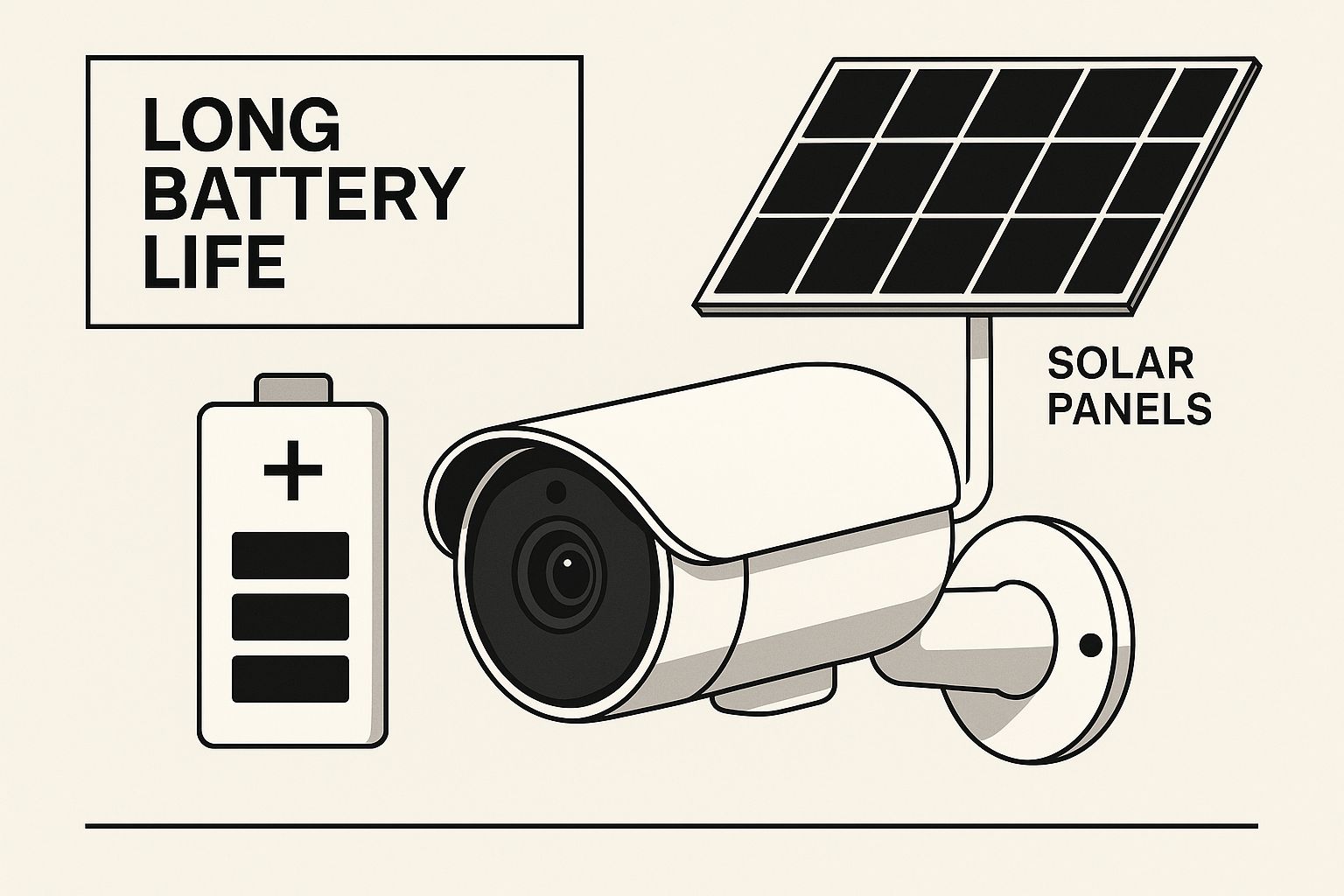
This setup essentially gives your camera a constant trickle charge, turning it into a security guard that never needs a day off.
Video Resolution and Clarity
Video resolution is all about the details. Higher resolution means you can zoom in on things far away—like a license plate at the end of your driveway or a person's face across the yard—without the image dissolving into a pixelated mess.
Here are the most common resolutions you'll find:
1080p (Full HD): This is the standard for a reason. It's clear enough for general surveillance and is the easiest on your battery.
2K (Quad HD): A nice upgrade from 1080p, 2K offers significantly sharper images. It's a fantastic middle-ground, giving you excellent detail without draining the battery as quickly as 4K.
4K (Ultra HD): This is the top of the line, delivering incredibly sharp and detailed video. While the quality is unmatched, it's also the most demanding on battery life and storage space.
So, which one is for you? For a small front porch, 1080p is probably all you need. But for covering a large backyard where you need to see details in the distance, it’s worth investing in a 2K or 4K model.
Night Vision and Field of View
Let's be honest—a lot of suspicious activity happens after dark. That makes night vision an absolutely essential feature. Most battery-powered cameras give you two main options here.
The first is infrared (IR) night vision. This technology uses invisible IR lights to illuminate the area, creating a crisp black-and-white video. It’s incredibly effective and doesn't use much power.
Some of the more advanced cameras also offer color night vision. They use hyper-sensitive sensors and sometimes a small, built-in spotlight to record footage in full color, even when it's dark. This can be a game-changer for identifying key details, like the color of a car or a person’s jacket.
While you're looking at night vision, don't forget the field of view. Measured in degrees, this tells you how wide of an area the camera can see. A wider field of view (think 130° or more) lets you monitor more of your property with a single camera, which means fewer blind spots.
Durability and Weather Resistance
If your camera is going to live outside, it has to be tough enough to handle whatever Mother Nature throws at it. That's where the IP (Ingress Protection) rating comes in. This two-digit number tells you exactly how protected the camera is from dust and water.
An IP65 rating is a great standard to look for in an outdoor camera. The "6" means it's totally sealed against dust, and the "5" means it can withstand jets of water from any direction. Rainstorms and sprinklers are no problem.
This kind of durability ensures your camera will keep working reliably, whether it's a scorching summer day or a freezing winter night.
Storage Options and Smart AI Detection
Where does your video footage go? This is a bigger deal than you might think. You generally have two choices, and each has its own trade-offs.
Cloud Storage:
The Good: Your video is saved securely online, so it’s safe even if someone steals or smashes your camera. You can also access it from anywhere.
The Bad: It almost always requires a monthly subscription fee.
Local Storage:
The Good: You store footage on a microSD card right in the camera, so there are no recurring fees.
The Bad: If the camera is stolen, your footage is gone with it. Cards can also fill up or eventually fail.
Finally, you absolutely want a camera with smart AI detection. Basic motion detection is a recipe for frustration—you'll get an alert every time a branch sways, a car drives by, or the neighbor's cat wanders into your yard.
Smart AI is much more intelligent. It can tell the difference between people, animals, vehicles, and even packages left at your door. This means you only get notified about the things that actually matter, which makes your security system a helpful tool instead of a constant annoyance. As a bonus, it saves a ton of battery life because the camera isn't recording every rustling leaf.
To help you sort through these options, here's a quick comparison table.
Comparing Key Features of Battery Powered Cameras
This table breaks down the most important features to consider, helping you understand the trade-offs between performance, battery life, and cost when making your choice.
Feature | What to Look For | Impact on Battery & Cost |
|---|---|---|
Video Resolution | 1080p for basic needs, 2K for a balance, 4K for maximum detail. | Higher resolution consumes more battery and requires more storage, often increasing the camera's cost. |
Night Vision | Infrared (B&W) is standard. Color night vision offers more detail. | Color night vision, especially with a spotlight, uses more power than standard IR. |
Field of View | A wider angle (130°+) covers more area, potentially reducing the need for more cameras. | No direct impact on battery, but wider-angle lenses are often found on more premium, costly models. |
Weather Resistance | A minimum of IP65 for outdoor use ensures protection against dust and rain. | Higher IP ratings usually correlate with more durable (and slightly more expensive) cameras. |
Storage | Cloud (subscription) for remote access or Local (microSD card) for no fees. | Cloud storage is an ongoing cost. Local storage is a one-time purchase for the card. |
Smart AI Detection | Look for person, vehicle, and package detection to reduce false alerts. | This is a huge battery saver. Cameras with advanced AI may cost more upfront but save you headaches. |
Ultimately, the best camera is one that fits your specific security needs without creating new hassles. By focusing on these key features, you can find a reliable, efficient, and smart solution to protect your home.
How to Choose the Right Camera for Your Home
Picking the right battery powered security camera isn't about finding some magical, one-size-fits-all device. It’s about matching the tech to your actual life. The features that make a camera perfect for a sprawling suburban house just aren't the same as what someone in a city apartment needs. So, let's forget the spec sheets for a minute and think about this in terms of real-world scenarios.
This approach is more important than ever. Homeowners and renters are snapping these cameras up at an incredible pace. The smart home security camera market in North America hit a value of about $3.78 billion in 2024, and get this—wireless cameras accounted for a whopping 68.46% of that. It's easy to see why. Their dead-simple installation and flexibility make them a go-to, especially for renters who can't just start drilling holes. If you want to dive deeper into the numbers, you can explore the full market analysis from Grand View Research.
By zeroing in on your own living situation, you can figure out which features will actually give you peace of mind, instead of just paying for bells and whistles you'll never use.
Scenario 1: The Apartment Renter
Living in an apartment means your priorities are probably simplicity, privacy, and getting your security deposit back. You need a camera that you can set up in minutes, take down just as fast, and that doesn't require a single screw or a long-term contract.
For this situation, here's what you should look for:
Drill-Free Mounting: This is huge. Look for cameras that ship with strong adhesive strips or magnetic mounts. You can stick them on a bookshelf, a door frame, or a wall without leaving a trace.
Local Storage: To sidestep those pesky monthly cloud fees, a camera with a microSD card slot is your best friend. It keeps your footage private and saves you from another subscription.
Compact and Discreet Design: A smaller camera won't stick out like a sore thumb. It'll blend into your decor, which is great for aesthetics and keeping your security setup low-key.
A renter simply doesn't need a camera with an IP67 weather-resistance rating or a battery built to last six months outside. You're better off focusing on solid indoor performance, ease of use, and value.
Scenario 2: The Suburban Homeowner
If you've got a house with a yard, a driveway, and maybe a back deck, you're facing a whole different set of challenges. Your mission is to build a complete security perimeter, keeping an eye on every key entry point and outdoor area, rain or shine, day or night.
Your feature checklist is going to look a lot different:
Robust Weatherproofing: An IP rating of IP65 or higher is non-negotiable. You need to know your cameras can handle everything from a downpour to a blizzard and keep on recording.
Excellent Night Vision: Your property has plenty of dark corners. Prioritize cameras with advanced infrared (IR) or, even better, color night vision to capture clear, usable footage long after the sun goes down.
Solar Panel Compatibility: This is a game-changer for cameras watching over a big backyard or a detached garage. A small solar panel accessory keeps the battery topped off, turning your camera into a truly set-it-and-forget-it system.
For a homeowner, it's all about durability and long-term performance. Investing in weather-resistant cameras with powerful night vision and a sustainable power source like a solar panel creates a reliable security shield for your entire property.
Thinking in terms of these scenarios helps cut through all the marketing noise. Instead of getting lost in a sea of technical jargon, you can focus on the features that solve your specific problems. Once you know if you're more of a renter or a homeowner, you can confidently choose a battery powered security camera that feels like it was made just for you.
Smart Installation and Maintenance Tips
Getting your new battery-powered security camera set up is one of those satisfying DIY projects you can knock out in an afternoon. Forget drilling through walls or messing with wiring—this is a much simpler affair. But a little bit of smart planning can make the difference between a good setup and a great one.
Think of it like a photographer setting up the perfect shot. You’re looking for the best angle, the right lighting, and a clear view of what’s important. Nailing this part from the get-go means your camera will perform exactly how you want it to, capturing crisp footage while making that battery last.
Finding the Perfect Spot
Where you put your camera is easily the most critical decision you'll make. It determines what you see, how many pointless alerts you get, and how easy it is for someone to mess with it. Don't just pick a spot because it's convenient; choose it because it's effective.
Here’s what you need to keep in mind for killer placement:
Height is Your Friend: Mount your camera about 8-10 feet off the ground. This is the sweet spot—high enough to be out of easy reach, but low enough to get a clear look at faces and other details.
Angle for Coverage, Not Sky: Always aim the camera down a bit. Pointing it up captures a lot of sky and swaying trees, which is a recipe for false motion alerts and sun glare. None of that is useful for security.
Avoid Direct Sunlight: This is a big one. Never point your camera straight into the sun, especially during sunrise or sunset. The intense glare will completely wash out your video, and the constant light changes will trigger a storm of false alerts that will drain your battery in no time.
Cover Key Entry Points: Think like a burglar. Focus on the most likely ways someone would try to get in: your front door, back door, any ground-floor windows, and the driveway.
The goal of smart placement is to maximize coverage of critical areas while minimizing environmental factors that cause false alerts. A well-placed camera works smarter, not harder, which is the key to extending battery life.
Your Quick-Start Installation Guide
Once you've scouted the perfect location, the actual installation is usually a piece of cake. Most battery-powered security cameras are built for a quick and painless DIY setup that you can finish in minutes.
Just follow these simple steps:
Fully Charge the Battery: Before you do anything else, plug in the battery and let it charge to 100%. Starting with a full tank gives you a solid baseline for performance and saves you from climbing that ladder again in a week.
Connect to Your App: Power up the camera somewhere close to your Wi-Fi router. Follow the app's instructions to get it connected to your home network. This is the best time to tweak the basic settings before it's mounted high up on a wall.
Test the Wi-Fi Signal: Walk the camera over to its final mounting spot. Use the live view in the app to check the Wi-Fi signal. A weak or spotty connection is a major battery killer and can cause you to miss important events. Make sure you have at least two bars of signal strength.
Mount the Camera Securely: Use the template and hardware that came in the box to attach the mounting bracket. Once it's solid, pop the camera on and adjust the angle, using the live feed on your phone as your guide to get the view just right.
Pro Tips for Maximum Battery Life
Installation is just the first step. To keep your camera running for months on a single charge, you'll want to dive into the settings and make a few smart tweaks. The best part? You can do all of this right from your phone.
Customize Activity Zones: This feature is a game-changer for battery life. You can literally draw boxes on the screen around the areas you care about, like your porch or walkway, and tell the camera to ignore everything else. No more alerts for cars driving down the street or the neighbor's cat.
Adjust Motion Sensitivity: Not every rustling leaf needs to trigger a recording. Turn down the motion sensitivity to prevent the camera from waking up for minor things like swaying branches or small animals. This alone can save a huge amount of power.
Consider a Solar Panel: If your camera is going in a spot that gets a few hours of direct sun each day, a solar panel accessory is an incredible upgrade. It provides a constant trickle charge that can pretty much eliminate the need to ever take the battery down for charging. It’s true set-it-and-forget-it security.
Where Are Wire-Free Cameras Headed?
If you think battery-powered security cameras are impressive now, just wait. The technology is moving at a breakneck pace, and what we're seeing today is really just the groundwork for a much smarter, more connected future in home security. The sheer convenience of a wire-free setup was the first big leap, but the next wave of innovation is even more exciting.
First up, let's talk about power. Battery life is already getting better, but the next generation of cameras will be in a different league entirely. We're talking about models that can run for a year or even longer on a single charge. That kind of longevity opens up a ton of possibilities for placing cameras in remote or tricky spots, giving you true set-it-and-forget-it security.
Smarter Brains and Deeper Connections
The real game-changer, though, is the push toward on-device Artificial Intelligence (AI). Right now, most cameras send video footage to the cloud to figure out what's happening. The next wave will do that thinking right on the camera itself.
This shift to "edge computing" has two huge benefits:
Speed: You'll get faster, more accurate alerts because there's no delay sending data back and forth.
Privacy: Your sensitive video footage doesn't have to leave your property, which is a massive win for privacy.
We'll also see these cameras integrate more deeply into our smart homes. Imagine your camera not just seeing a delivery driver, but recognizing them and telling your smart lock to open just enough for them to slide a package inside before locking back up. That’s the kind of seamless automation that’s coming.
Getting a battery-powered camera today isn't just about convenience. It’s about stepping into a future-proof system where security is smarter, more private, and works hand-in-glove with your everyday life.
The market is certainly betting on this future. Global demand for these cameras is on track to hit $5 billion by 2025. From there, it’s projected to grow at a steady clip of 15% each year through 2033, all thanks to these incredible leaps in technology. You can read more about this expanding market and its drivers. For a wider view, it's also worth exploring the broader innovation in the security sector.
Common Questions About Battery Cameras
When you're thinking about adding a battery-powered security camera to your home, a few practical questions are bound to pop up. It's only natural to wonder about the day-to-day experience of owning one. We've rounded up the most common queries we hear to give you clear, straightforward answers.
Getting these details sorted out will help you feel confident that you’re making the right choice for your home and family. Let's dig into what people ask most often.
How Long Do the Batteries Actually Last?
This is always the first question, and the honest answer is: it depends. Most manufacturers advertise a battery life anywhere from 2 to 6 months on a single charge, but what you get in the real world comes down to how you use it.
Think of it like your smartphone. If you barely touch it all day, the battery holds up. But if you’re streaming videos and making calls constantly, it drains fast. For a security camera, the biggest power hogs are:
Frequent Motion Alerts: A camera pointed at a busy street or a backyard where kids are always playing will be waking up and recording non-stop.
Live Streaming: Every time you pop into the app to check the live feed, you're using a good chunk of power.
Extreme Cold: Frigid temperatures are tough on batteries and can significantly reduce their efficiency.
Poor Wi-Fi: If the camera has a weak signal, it has to work much harder to stay connected, which burns through the battery.
If you want to stretch out the time between charges, try lowering the motion sensitivity a bit or, better yet, add a solar panel to give it a continuous trickle of power.
Do These Cameras Work Without Internet?
For the most part, a battery-powered security camera relies on a Wi-Fi connection. That’s how it sends you instant alerts when it spots motion and uploads video clips to the cloud so you can review them from anywhere.
But a spotty internet connection doesn't necessarily mean the camera is useless. Many models have a microSD card slot for local storage and will keep recording motion events even if the Wi-Fi goes down.
You just won't get any notifications or be able to check the live feed until your internet is back online. Once it is, the footage will be waiting for you on the card. For true off-grid security, like at a cabin or construction site, you’ll want to look at specialized 4G/LTE cameras that run on a cellular data plan instead.
Are Battery-Powered Cameras Secure from Hacking?
Any good camera company makes security a top priority. They build their systems with strong encryption protocols like WPA2 and WPA3 to make the connection between your camera and router secure. The videos they save to the cloud are also encrypted to keep them private.
That said, you have a big part to play in keeping your system locked down. Always follow these simple security habits:
Use a Strong, Unique Password: Don't just reuse the password from your email or another account.
Enable Two-Factor Authentication (2FA): This is probably the single most important step you can take. It adds a crucial second layer of protection.
Keep Firmware Updated: Manufacturers regularly release updates to patch security holes. Turn on automatic updates if you can.
Taking these basic precautions makes it incredibly difficult for anyone to gain unauthorized access and helps ensure your home stays private.
At PCI Audio-Video Security Solutions, we provide advanced, reliable security systems designed for your peace of mind. Explore our range of professional-grade cameras and access control solutions to find the perfect fit for your home or business. Learn more at pciavss.com.
Comments