


Business Continuity Planning Checklist for 2025
- Бонус за регистрацию онлайн казино
- Sep 16, 2025
- 15 min read
In an unpredictable environment, a disruption isn't a matter of 'if' but 'when'. The threats facing modern businesses, from sophisticated cyberattacks and supply chain failures to physical security breaches, are more complex than ever. A basic, boilerplate plan is no longer sufficient; you need a robust, actionable, and thoroughly tested strategy to ensure operational resilience.
This guide provides an in-depth business continuity planning checklist designed for the challenges of today and tomorrow. We will break down eight critical areas essential for building true organizational resilience. This isn't just a theoretical overview. It's a practical roadmap that moves beyond the basics, offering concrete steps, real-world examples, and a specific focus on integrating crucial technologies like advanced audio-video security solutions.
You will learn how to identify your most critical functions, establish clear communication protocols, and fortify your digital and physical assets. We'll explore how modern surveillance tools, such as 4K security cameras and remote camera monitoring systems, are no longer just for security but are vital components of a comprehensive continuity strategy. These tools provide critical real-time awareness during an incident, enabling faster response and better decision-making when it matters most. Following this checklist will empower you to not only survive a crisis but to maintain control and emerge stronger.
1. Risk Assessment and Business Impact Analysis (BIA)
The first and most critical step in any robust business continuity planning checklist is to conduct a thorough Risk Assessment and Business Impact Analysis (BIA). This foundational process systematically identifies potential threats to your organization and analyzes their potential effects on critical business functions. It's not just about listing what could go wrong; it’s about understanding the tangible consequences of a disruption.
A BIA quantifies potential losses, from financial and operational to reputational, helping you establish clear priorities for recovery. This isn't theoretical. After the 2011 tsunami, Toyota's detailed BIA revealed critical vulnerabilities in its supply chain, leading to a strategic diversification of suppliers that fortified its global operations. Similarly, Microsoft’s BIA identified significant dependencies on specific datacenters, prompting strategic investments in geographic redundancy to ensure service continuity.
How to Implement a BIA
To execute a successful BIA, start by creating a cross-functional team with members from IT, operations, finance, and HR to ensure a holistic view of potential threats.
Identify Critical Functions: Begin by mapping out high-level business processes (e.g., order fulfillment, customer support, payroll) and then drill down into the specific functions, applications, and resources that support them.
Assess Potential Impacts: For each function, determine the impact of a disruption over time. Quantify financial losses, customer dissatisfaction, regulatory penalties, and operational slowdowns at various intervals (e.g., 4 hours, 24 hours, one week).
Establish Recovery Objectives: Based on the impact analysis, define two key metrics: the Recovery Time Objective (RTO), which is the maximum tolerable downtime for a function, and the Recovery Point Objective (RPO), the maximum acceptable amount of data loss.
The following infographic illustrates the core workflow of a Business Impact Analysis, breaking it down into three essential stages.
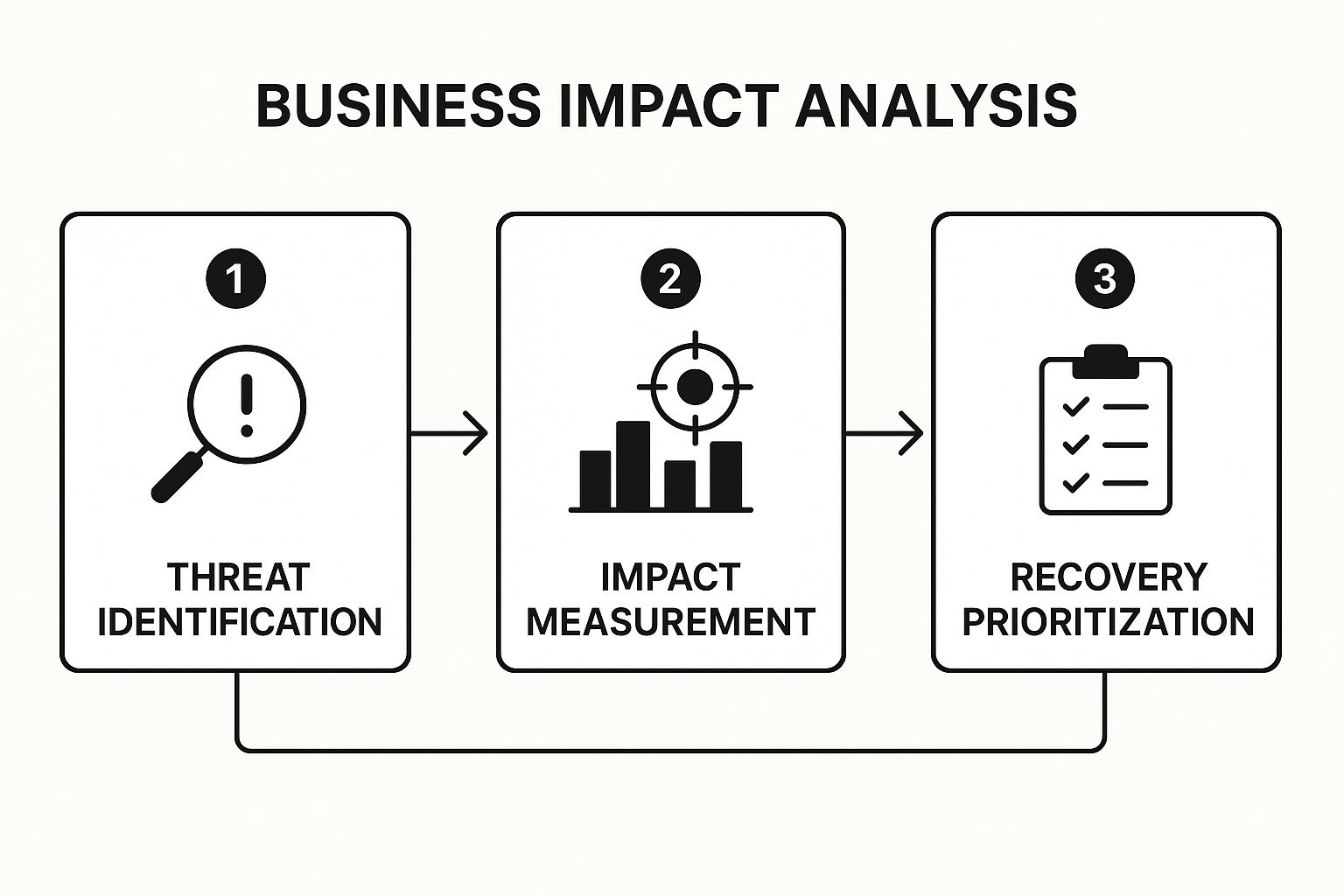
This process flow visualizes how identifying threats directly informs the measurement of potential impacts, which in turn enables the logical prioritization of recovery efforts for critical business functions.
2. Critical Business Functions Identification and Prioritization
Once you understand the risks, the next step in your business continuity planning checklist is to identify and prioritize your critical business functions. This process involves cataloging the essential activities that keep your business running and then ranking them based on their importance. The goal is to create a clear, strategic hierarchy for recovery, ensuring that the most vital operations are restored first after a disruption.
This isn't about saving everything at once; it's about a tiered and logical restoration. For example, a hospital will always prioritize patient care systems and life-support equipment (Tier 1) over administrative functions like billing or HR (Tier 2 or 3). Similarly, a financial institution like JPMorgan Chase focuses on restoring ATM networks and online banking access immediately, as these are critical customer-facing services, while marketing system recovery can wait. This prioritization is central to minimizing operational and financial damage.
How to Implement Function Prioritization
To effectively identify and rank your business functions, assemble department leaders who have a deep understanding of their daily operations and dependencies. This collaborative approach ensures accuracy and buy-in across the organization.
Map Core Processes: Work with each department to list their primary responsibilities and the processes required to fulfill them. Distinguish between revenue-generating activities (e.g., sales, order fulfillment), operational necessities (e.g., supply chain management, IT infrastructure), and support functions (e.g., marketing, internal training).
Conduct Time-Based Impact Analysis: For each function, analyze the consequences of it being down for specific periods. Ask critical questions: What is the impact after one hour? 24 hours? One week? This helps quantify the urgency of restoration.
Establish a Tiered System: Group functions into recovery tiers based on their impact analysis. Tier 1 functions are those that must be restored immediately to prevent severe financial or reputational damage. Tiers 2 and 3 can have longer Recovery Time Objectives (RTOs).
Consider Dependencies: Map how different functions rely on each other. A customer support team, for example, is dependent on the CRM system, which in turn relies on network infrastructure. Understanding these dependencies is crucial for creating an effective and realistic recovery sequence.
3. Emergency Response Procedures and Communication Plans
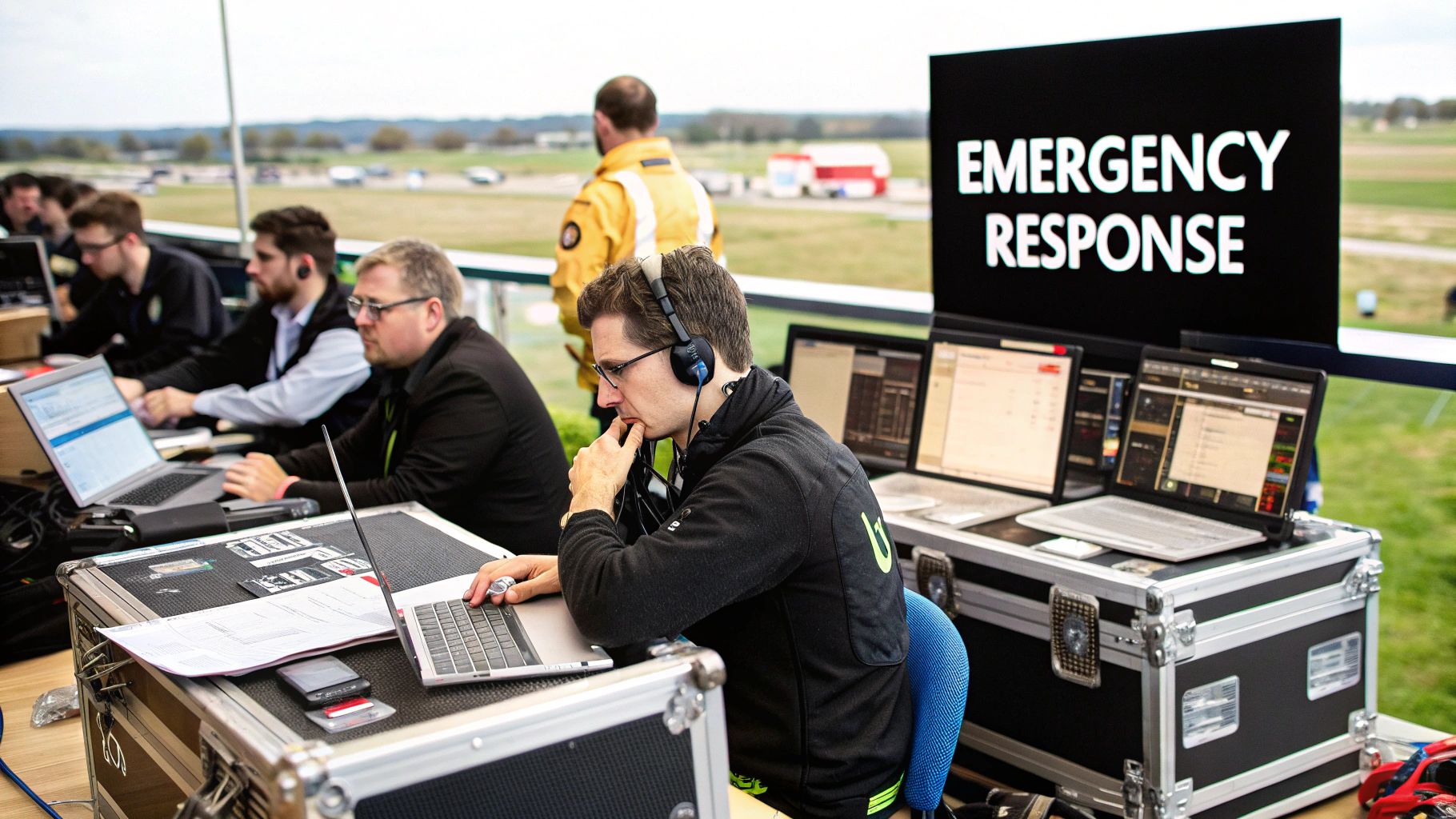
Once risks are assessed, the next essential element of any business continuity planning checklist is creating clear Emergency Response Procedures and a robust Communication Plan. These are the actionable playbooks your team will use in the critical first hours of a crisis. They define immediate actions, assign specific roles, and establish clear communication channels to ensure a rapid, coordinated, and effective response to any disruption.
The value of a pre-defined communication strategy cannot be overstated. Johnson & Johnson's swift and transparent communication during the 1982 Tylenol crisis is still considered the gold standard for crisis management, preserving public trust and brand integrity. More recently, Southwest Airlines' communication plan during its 2022 holiday meltdown leveraged social media, email, and mobile app notifications to keep stranded passengers informed, demonstrating the need for a multi-channel approach. These examples underscore how proactive communication can mitigate reputational damage and maintain stakeholder confidence.
How to Implement Response and Communication Plans
Effective plans are built on clarity, redundancy, and regular practice. Your goal is to eliminate confusion when stress levels are high and time is of the essence.
Activate a Crisis Team: Formally designate a crisis response team with clearly defined roles and responsibilities. This team should include leaders from key departments who are empowered to make decisions.
Develop Notification Procedures: Create detailed protocols for notifying employees, customers, suppliers, and other stakeholders. Determine who is responsible for each communication, what information needs to be shared, and which channels will be used. To strengthen your communication plans and ensure robust operations during disruptions, consider exploring AI-managed call forwarding solutions ensuring business continuity.
Establish Communication Redundancy: Don't rely on a single channel. Plan for primary, secondary, and even tertiary communication methods (e.g., email, SMS alerts, a company intranet, a phone tree, or a social media status page).
Pre-Write Message Templates: Save critical time by preparing message templates for various potential scenarios like a power outage, cyberattack, or natural disaster. These can be quickly adapted and deployed when an incident occurs.
4. Data Backup and IT Disaster Recovery Strategy
A cornerstone of any modern business continuity planning checklist is a comprehensive Data Backup and IT Disaster Recovery (DR) Strategy. This component moves beyond simple data storage, focusing on the systematic protection and rapid restoration of your entire digital infrastructure. It ensures that in the event of a cyberattack, hardware failure, or natural disaster, your critical data and IT systems can be recovered quickly to minimize downtime and maintain operational integrity.
This isn't just a technical exercise; it's a strategic imperative. Netflix famously employs "chaos engineering," where they intentionally disable production systems to proactively test their backup and recovery capabilities, ensuring resilience. Similarly, Capital One’s cloud-first DR strategy allows for near-instant scaling and failover during incidents, while Salesforce maintains high availability for its global customers through sophisticated multi-region data replication.

How to Implement a Data Backup and DR Strategy
To build an effective IT disaster recovery plan, you must combine robust technical solutions with rigorous, documented processes. The goal is to make recovery a predictable and repeatable procedure, not a frantic scramble.
Follow the 3-2-1 Backup Rule: This industry-standard practice, popularized by organizations like the Disaster Recovery Institute International (DRI), is a simple yet powerful framework. Maintain three copies of your data on two different types of media, with at least one copy stored offsite (e.g., in the cloud or a secure physical location).
Test Restore Procedures Regularly: Backups are useless if they can't be restored. Schedule and perform regular tests of your data restoration procedures to verify data integrity and confirm that your technical team can meet your established Recovery Time Objectives (RTOs).
Automate and Monitor: Implement automated backup solutions with real-time monitoring and alerting. This ensures that backup failures are identified and addressed immediately, preventing gaps in your data protection timeline.
Document Everything: Create detailed, step-by-step recovery documentation. This guide should be clear enough for any qualified IT professional to follow, ensuring a swift and orderly restoration of services even if key personnel are unavailable.
5. Alternative Worksite and Remote Operations Planning
A core component of any modern business continuity planning checklist is establishing a strategy for alternative worksites and remote operations. This step addresses a critical vulnerability: the loss of your primary physical location. It involves proactively identifying and preparing for how your business will continue to function if employees cannot access the main office due to a natural disaster, power outage, or public health crisis.
The goal is to ensure operational continuity by enabling a seamless transition to a distributed workforce or an alternate physical location. For example, during the COVID-19 pandemic, Shopify’s pre-existing “digital by default” policy allowed it to maintain operations without significant disruption. Similarly, professional services firm Ernst & Young maintains a "hot site" strategy, with fully equipped and ready-to-use alternate offices in major markets, allowing teams to relocate and resume critical functions with minimal downtime.
How to Implement Alternative Worksite Strategies
To effectively plan for an alternative worksite, you must build a flexible and resilient operational framework that doesn't depend on a single physical location.
Identify and Secure Alternate Locations: This could range from pre-negotiating agreements with co-working spaces or hotel conference centers for temporary use ("warm sites") to investing in fully mirrored "hot sites." The key is to have these arrangements in place before a disaster strikes.
Invest in Cloud-Based Infrastructure: Transition critical business applications, data storage, and communication tools (like VoIP phone systems and collaboration platforms) to the cloud. This ensures employees can access necessary resources from any location with an internet connection.
Prepare for Rapid Deployment: Create pre-packed "go-bags" containing essential equipment like laptops, chargers, mobile hotspots, and security tokens. For remote teams, ensure they have reliable home internet and the necessary peripherals to work effectively and securely.
Test Remote Operations Regularly: Don't wait for a real event to test your plan. Conduct quarterly drills where different teams or the entire organization works remotely for a day. These tests will reveal weaknesses in your infrastructure, communication protocols, and security measures, allowing you to address them proactively.
6. Supply Chain and Vendor Continuity Management
An often-overlooked yet vital element of a business continuity planning checklist is robust Supply Chain and Vendor Continuity Management. Your organization's resilience is not just about your internal operations; it's intrinsically linked to the resilience of your critical suppliers, vendors, and partners. This process involves systematically identifying dependencies, assessing third-party risks, and creating strategies to ensure essential goods and services remain available during a disruption.
A disruption anywhere in your supply chain can halt your operations entirely. After the 2011 Japan earthquake, Boeing’s meticulous supplier recovery coordination was put to the test, demonstrating the value of pre-planned supply chain resilience. Similarly, Apple’s renowned supplier diversification strategy, which uses multiple manufacturers across different geographic regions, prevents a single point of failure from crippling its production lines. These examples show that proactive vendor management is not a cost but a strategic investment in operational stability.
How to Implement Vendor Continuity Management
To build a resilient supply chain, you must extend your continuity planning beyond your own four walls. This requires collaboration, transparency, and clear communication with your key partners.
Map Your Supply Chain: Go beyond your direct suppliers (Tier 1) and identify critical dependencies in Tier 2 and Tier 3. A disruption to your supplier’s supplier can have a significant cascading effect on your business.
Assess Vendor Risk: Evaluate your critical vendors based on their own business continuity capabilities. Require them to provide their continuity plans as part of your contractual agreements. This ensures they are as prepared for a disruption as you are.
Develop Alternative Sourcing: Don't rely on a single supplier for critical components or services. Cultivate relationships with alternate vendors in different geographic locations to mitigate risks from localized disasters or political instability.
Maintain Strategic Buffers: For essential materials with long lead times or high volatility, maintain a strategic inventory buffer. This can provide the necessary cushion to continue operations while you activate alternative sourcing strategies.
Integrating these practices ensures that your business can withstand not only direct threats but also indirect shocks originating from your network of suppliers and partners, fortifying your entire operational ecosystem.
7. Testing, Training, and Plan Maintenance
A business continuity plan is only effective if it works under pressure and your team knows how to execute it. This is why the seventh step in your business continuity planning checklist is a continuous cycle of testing, training, and maintenance. This process transforms a static document into a dynamic, living strategy by validating its effectiveness, ensuring staff competency, and keeping it current with organizational changes.
Without regular validation, even the most detailed plan can fail. JPMorgan Chase exemplifies this principle by conducting over 500 business continuity exercises annually to test everything from data recovery to alternative worksite deployment. Similarly, Google's DiRT (Disaster Recovery Testing) program intentionally simulates failures across its systems to proactively find and fix weaknesses before real-world events expose them. This systematic approach ensures the plan is not just a theory but a proven, reliable roadmap for resilience.
How to Implement Testing and Training
A successful program for testing and maintenance involves more than just an annual review. It requires a structured, iterative approach to build muscle memory and identify gaps before a crisis occurs.
Schedule Regular Drills: Start with simple, low-impact exercises like tabletop discussions where key personnel walk through a hypothetical scenario. Progress to more complex functional drills and full-scale simulations that mimic real-world disruptions, such as a simulated cyberattack or a power outage at a primary facility.
Vary Scenarios: Test different aspects of your plan by using a variety of scenarios. One exercise might focus on a natural disaster, while another could test the response to a supply chain failure or a public relations crisis. This ensures all components of your business continuity plan are validated.
Implement a Feedback Loop: After every test or training session, conduct a thorough post-mortem. Document what went well, identify what didn't, and create an action plan to address the shortcomings. Implement these improvements promptly, ideally within 30 days, to continuously strengthen your plan.
A consistent schedule of testing and training, as championed by organizations like the Business Continuity Institute (BCI) and FEMA, is crucial. It ensures your team is not just aware of the plan but is confident and prepared to act decisively when a disruption happens, making this a non-negotiable part of any serious business continuity effort.
8. Regulatory Compliance and Legal Considerations
An often-overlooked yet critical component of any business continuity planning checklist is addressing regulatory compliance and legal considerations. This step involves ensuring your organization can maintain its legal and regulatory obligations even during and after a significant disruption. It goes beyond operational recovery to protect the business from fines, lawsuits, and reputational damage stemming from non-compliance.
Ignoring these obligations can create a secondary crisis. For instance, financial institutions are bound by regulations like Basel III, requiring them to maintain specific capital ratios and reporting standards even if their primary offices are offline. Similarly, healthcare organizations must uphold HIPAA standards for patient data privacy, even when operating from a temporary location or using backup systems. European businesses must also ensure their disaster recovery processes are fully compliant with GDPR, protecting data subject rights no matter the circumstances.
How to Integrate Compliance into Your BCP
To effectively manage legal and regulatory risks, you must embed compliance checks directly into your continuity strategy. Start by involving your legal counsel or a compliance officer from the very beginning of the planning process.
Identify All Applicable Regulations: Create a comprehensive inventory of all legal, statutory, and contractual obligations. This includes industry-specific mandates (e.g., SEC for finance, FDA for pharma), data privacy laws (GDPR, CCPA), and service-level agreements (SLAs) with clients.
Create Disruption-Specific Checklists: Develop tailored compliance checklists for different disaster scenarios. For example, a checklist for a data breach would prioritize notification requirements, while a checklist for a physical facility outage would focus on employee safety laws and environmental reporting.
Document Every Decision: Meticulously record the rationale behind every decision made during a disruption. This documentation is invaluable for demonstrating due diligence during post-event audits or legal reviews, proving that your actions were planned, reasonable, and compliant.
Pre-Negotiate Where Possible: In some industries, it may be possible to discuss potential scenarios with regulatory bodies beforehand to understand their expectations for compliance during a major crisis. This proactive communication can provide clarity and potentially secure pre-approved contingency measures.
8-Step Business Continuity Checklist Comparison
Item | Implementation Complexity 🔄 | Resource Requirements ⚡ | Expected Outcomes 📊 | Ideal Use Cases 💡 | Key Advantages ⭐ |
|---|---|---|---|---|---|
Risk Assessment and Business Impact Analysis (BIA) | High - Requires extensive stakeholder input and updates | High - Cross-functional teams and data collection | Data-driven recovery priorities and compliance support | Organizations needing thorough threat quantification and prioritization | Prioritizes recovery, supports compliance, enables cost-benefit analysis |
Critical Business Functions Identification and Prioritization | Medium - Mapping and regular reassessment needed | Medium - Involves multiple departments | Clear recovery priorities with impact metrics | Businesses focusing on quick recovery of revenue-critical functions | Enables focused resource allocation and executive decision-making |
Emergency Response Procedures and Communication Plans | Medium - Needs defined roles, communication channels, regular training | Medium - Crisis teams and communication tools | Rapid response with clear roles and consistent messaging | Immediate crisis situations requiring swift coordinated action | Reduces response time, ensures communication consistency |
Data Backup and IT Disaster Recovery Strategy | High - Complex technology setup and rigorous testing | High - Infrastructure and specialized staff | Minimized data loss and fast IT restoration | IT-centric operations requiring data protection and availability | Automated backups, regulatory compliance, rapid recovery |
Alternative Worksite and Remote Operations Planning | Medium to High - Technology and logistics planning | Medium to High - Remote infrastructure investment | Business continuity with workforce flexibility | Organizations supporting remote or distributed work environments | Enables flexible operations, reduces facility risk, cuts real estate cost |
Supply Chain and Vendor Continuity Management | High - Extensive supplier mapping and coordination | Medium to High - Managing multiple relationships | Reduced supply chain risks and diversified sourcing | Companies reliant on complex supply chains for critical inputs | Improves resilience, reduces single points of failure |
Testing, Training, and Plan Maintenance | High - Ongoing, multi-level exercises and updates | Medium to High - Staff time and exercise resources | Validated and current continuity plans | Organizations prioritizing preparedness and regulatory compliance | Identifies gaps early, builds confidence, ensures ongoing plan relevance |
Regulatory Compliance and Legal Considerations | High - Complex, evolving regulatory landscape | Medium - Legal expertise and monitoring systems | Avoidance of penalties, maintained trust, legal protection | Regulated industries with strict compliance requirements | Prevents fines, sustains stakeholder trust, supports recovery claims |
From Checklist to Culture: Making Resilience Your Competitive Advantage
Navigating the extensive business continuity planning checklist we've detailed is a monumental achievement. From conducting a thorough Risk Assessment and Business Impact Analysis to establishing robust protocols for testing and maintenance, you have laid the essential groundwork for organizational resilience. This isn't merely about surviving a crisis; it's about building a robust framework that protects your assets, secures your operations, and solidifies your reputation in an unpredictable world.
We've covered the eight pillars of a truly comprehensive plan: identifying critical functions, creating clear communication channels, securing your data, planning for remote operations, managing your supply chain, and ensuring legal compliance. Each step is a vital component in a larger system designed to keep your business moving forward, no matter the obstacle. The insights gained from this process are invaluable, transforming abstract risks into manageable, actionable challenges.
Moving Beyond the Document: The Shift to a Resilient Mindset
A plan on a shelf is just a document. True resilience is born when the principles of your business continuity plan are woven into the very fabric of your company culture. It’s a transition from a reactive, static checklist to a proactive, dynamic mindset. This means that preparedness is not an annual drill but a daily consideration, influencing decisions from the server room to the C-suite. Moving beyond a mere checklist, fostering a culture of preparedness involves implementing effective business resilience strategies that integrate seamlessly into daily operations.
This cultural shift is where your competitive advantage truly emerges. When your team instinctively knows their roles during a disruption, when your communication plan executes flawlessly under pressure, and when your stakeholders see you operate with confidence amidst chaos, you build unparalleled trust. Your business becomes known not just for what it does, but for its unwavering reliability.
The Role of Physical Security as the Unseen Guardian
A critical takeaway is the inseparable link between digital and physical resilience. Your data backups and IT recovery plans are only as strong as the physical environment protecting them. This is where modern audio-video security solutions become indispensable. For a construction site manager, a solar-powered mobile security trailer with LPR cameras isn't just a theft deterrent; it's a continuity tool that ensures expensive equipment remains on-site and operational, preventing project-derailing delays.
Similarly, an event organizer using temporary 360-degree surveillance cameras isn't just monitoring crowds. They are actively managing risks in real-time, allowing for swift responses to security or safety incidents that could otherwise shut down an event and cause significant financial and reputational damage. Remote access control and 4K security cameras give business owners the power to monitor critical assets and infrastructure from anywhere, ensuring that even when they can't be on-site, their business remains secure and operational.
Key Insight: Integrating physical security technologies like advanced surveillance and access control into your business continuity planning checklist is not an add-on; it is a foundational layer that protects your most critical operational assets and personnel.
Your Actionable Next Steps to Lasting Resilience
Completing the checklist is the beginning, not the end. Here are your immediate next steps to transform your plan into a living, breathing part of your organization:
Schedule the First Review: Don't let the plan gather dust. Book a quarterly review on your calendar now to assess any changes in your business, technology, or risk landscape.
Conduct a Tabletop Exercise: Gather key stakeholders and walk through a simulated disaster scenario. This low-stakes test will quickly reveal gaps in your plan and areas for improvement in a controlled environment.
Empower Your Team: Assign clear ownership for each component of the business continuity plan. When individuals are responsible for specific areas, the plan becomes more than a corporate mandate; it becomes a shared commitment.
By embracing this continuous cycle of planning, testing, and refinement, you are not just preparing for the worst-case scenario. You are investing in long-term stability, building stakeholder confidence, and creating an agile organization capable of turning challenges into opportunities for growth. Resilience is the ultimate competitive advantage, and your journey to achieving it starts today.
Ready to fortify your physical security layer? PCI Audio-Video Security Solutions specializes in integrating state-of-the-art surveillance and access control systems tailored to your unique continuity needs. From remote monitoring solutions to mobile security trailers, we provide the tools to protect your critical assets and ensure your operations continue uninterrupted. Secure your resilience with PCI Audio-Video Security Solutions today.
Comments