


Choosing a Surveillance Camera with Hard Drive
- Бонус за регистрацию онлайн казино
- Aug 18, 2025
- 15 min read
So, what exactly is a surveillance camera system that uses a hard drive? Think of it as a completely self-contained security setup. It records and stores all the video footage right there on a physical drive that you own and control.
This is a big departure from cloud-based cameras that beam your footage over the internet. Instead, your recordings are kept safe and sound on-site, typically inside a Network Video Recorder (NVR) or a Digital Video Recorder (DVR). The best part? You get complete control without those pesky monthly fees.
Why Local Storage Is Your System's Private Diary
Picture your security system keeping a detailed, private diary of everything it sees. That's precisely what a surveillance camera with a hard drive does. It creates a reliable, physical record of events that never leaves your property unless you want it to. This approach is really the foundation of a truly independent and tough security strategy.
Instead of sending sensitive video across the internet to some company's server, the footage is written directly onto a hard disk drive (HDD) tucked inside your recorder. The recorder acts like a secure lockbox, and the hard drive is the journal inside—and you’re the only one with the key.
The Power of On-Site Recording
This on-site, or "on-premise," method gives you some serious advantages, whether you're securing your home or your business. At its heart, local storage delivers:
Data Sovereignty: You own your footage, full stop. No third-party company can access your recordings, which is a huge win for privacy.
Operational Independence: Your system keeps recording 24/7, even if your internet goes out. This is absolutely critical during a storm or network outage when you need security the most.
Cost-Effectiveness: After you buy the hardware, that's it. There are no recurring monthly subscription fees to budget for, which makes it a much more predictable investment over the long haul.
It's clear that people are catching on. The demand for these robust systems is growing, with the global video surveillance storage market expected to jump from USD 15.65 billion in 2025 to nearly USD 27.83 billion by 2030. This boom is all about needing dependable, high-capacity storage to handle the flood of footage from today’s high-resolution cameras. You can get more insights on this growing market from Grand View Research.
In essence, a surveillance camera with a hard drive puts you in the driver's seat. You control who sees the footage, how long it's kept, and the physical security of your video evidence, all without depending on an outside service. This simple but powerful model is the bedrock of a truly self-sufficient security setup.
The Real-World Benefits of On-Premise Recording
When you're looking at security cameras, the debate between cloud storage and local storage always comes up. While the cloud has its place, choosing a camera system with its own hard drive offers some very real, very practical advantages. We're not just talking about tech specs here; these are benefits that give you more control, better security, and genuine peace of mind.
Let's break down the four key reasons why having a hard drive on-site can be a game-changer for both homeowners and businesses.
First and foremost is superior privacy. It’s simple, really: when your video footage is stored on a hard drive inside your home or business, it stays there. This creates a physical barrier from the wider internet, dramatically cutting the risk of online data breaches or someone else getting access to your recordings. You physically own and control your data.
Then there's the financial side. A system with on-premise storage is just a smarter long-term investment. Cloud storage might look cheap upfront, but it often traps you in a cycle of monthly or annual subscription fees that never end. Over the years, those fees really add up. A surveillance camera with hard drive is a one-time purchase, freeing you from recurring costs and giving you a security solution without a subscription.
Uninterrupted Security and Performance
Reliability is another huge win for local storage. Picture this: a big storm rolls through and your internet goes down. A camera that relies on the cloud just became a useless piece of plastic, leaving you unprotected right when you might need it most. A hard drive-based system, however, doesn't care if your internet is working or not. It just keeps recording.
A local hard drive ensures your cameras keep rolling 24/7, no matter what your network is doing. This is a massive advantage because your security is never at the mercy of an internet outage.
Finally, you get far better performance, especially if you're using high-definition cameras. Modern systems often use multiple 4K cameras, which produce an enormous amount of data. Trying to upload all that high-resolution video to the cloud can absolutely cripple your internet bandwidth, leading to laggy video, missed frames, or a serious drop in quality.
A system with a hard drive does all the heavy lifting on-site, easily managing multiple high-res video streams without slowing down your internet at all. This is crucial for businesses that need to watch several areas in sharp detail or for rural homes where the Wi-Fi isn't always reliable. It means your recordings are always smooth, clear, and complete.
Here’s how this plays out in the real world:
For a Small Business: A retail shop can record crystal-clear 4K video of the sales floor and stockroom around the clock. This won't slow down the Wi-Fi for customers or interfere with the payment systems. Plus, all that sensitive footage stays securely on the premises.
For a Rural Homeowner: If you live somewhere with spotty internet, you can still have a powerful, always-on security system. Frequent connection drops won't stop it from recording, ensuring your property is always being watched.
By choosing a surveillance camera with hard drive, you’re investing in a system that’s more private, cost-effective, reliable, and powerful. You’re putting yourself in direct control of your own security.
Decoding the Features That Truly Matter
Diving into the tech specs of a security system can feel like trying to read a foreign language. To cut through the noise, let's focus on the features that actually make a difference in your day-to-day security. Think of this as your practical checklist for picking the right surveillance camera with a hard drive.
The Heart of the System: The Hard Drive
First things first, let's talk about the hard drive—the core of your local storage. The most important spec here is capacity, which you'll see measured in terabytes (TB).
It helps to think of the hard drive like a bucket. The bigger the bucket, the more video it can hold before it gets full and has to start overwriting the oldest footage. How big of a bucket you need boils down to three things:
How many cameras are you running? More cameras means more video streams filling up the drive at the same time.
What’s the video quality? Crystal-clear 4K video creates files that are way bigger than standard 1080p HD.
How long do you need to keep footage? Do you need to go back a few days, a week, or a month?
Just to give you a ballpark idea, a 1TB drive might be enough to store a week of footage from four HD cameras. But if you’re running eight 4K cameras, you’ll probably need a 4TB drive—or even larger—to keep that same week's worth of video.
To help you get a clearer picture, here’s a quick estimate of how much space one camera might use in a single day, depending on its resolution.
Hard Drive Storage Needs by Video Quality
Video Resolution | Compression Type (H.265) | Estimated Daily Storage per Camera |
|---|---|---|
1080p (2MP) | H.265 | 20-30 GB |
4MP (2K) | H.265 | 40-60 GB |
8MP (4K) | H.265 | 80-120 GB |
Just remember, these are estimates. Your actual usage will change based on factors like motion, frame rate, and the complexity of the scene you're recording.
What the Camera Can Actually See
Next up is video resolution, which is all about clarity. How much detail can you make out in your recordings? For general monitoring, 1080p (Full HD) is often perfectly fine.
But if you need to be able to identify specific details from a distance—like a license plate number or a person's face—then 4K Ultra HD is the way to go. With roughly four times the pixels of 1080p, it gives you the power to digitally zoom in on recorded footage without it turning into a pixelated mess.
Night vision is just as critical, since a lot can happen when the sun goes down. Most cameras today use infrared (IR) LEDs to see in total darkness, which gives you that classic black-and-white night vision image. For even better detail, some of the newer cameras offer color night vision, using highly sensitive sensors to capture full-color video in very low light. The difference is huge when you're trying to identify the color of a car or a piece of clothing.
What’s the Difference Between an NVR and a DVR? You'll see these terms everywhere. The crucial difference is the type of cameras they work with. An NVR (Network Video Recorder) connects to modern, digital IP cameras over a network. A DVR (Digital Video Recorder) is for older, analog-style cameras. For any new installation today, an NVR is almost always the right choice.
Built for the Real World: Durability and Recorder Type
Finally, don't forget about durability. If you’re mounting cameras outdoors, you absolutely need to check for an IP rating, like IP66 or IP67. This little number tells you how well the camera is sealed against dust and water, so you can be confident it will survive a rainstorm or a blizzard.
Inside the recorder, make sure it’s equipped with a surveillance-grade hard drive. These aren't your standard computer hard drives; they are specifically engineered to handle the constant stress of recording video 24/7 without failing.
Hard drives are still the go-to for surveillance because they offer massive storage capacity at a great price. In fact, surveillance HDDs made up a whopping 60% of all internal hard drive shipments in early 2025, driven by security projects that demand reliable, non-stop recording. You can see the latest surveillance storage device trends to understand just how dominant they are.
By focusing on these key features, you'll be able to put together a system that’s not just powerful, but also perfectly suited to what you need to protect.
Hard Drive vs. Cloud Storage: A Clear Comparison
When you're figuring out where to keep your surveillance footage, it really comes down to two main paths: storing it on a local hard drive or using a cloud subscription service.
Think of it this way: a surveillance camera with a hard drive is like keeping your valuables in a high-security safe at home. Cloud storage, on the other hand, is like putting them in a bank's vault. Both can be secure, but they’re built on entirely different ideas about access, ownership, and what happens if the internet goes out.
The Upfront Cost vs. The Long-Term Subscription
The first thing most people notice is the difference in cost. With a hard drive, you have a one-time purchase. You buy the drive, you own it, and that’s the end of the hardware expense.
Cloud storage works on a subscription model. Those recurring monthly or yearly fees might seem small at first, but they can really add up over the lifetime of your security system.
Who Really Controls Your Footage? Privacy Matters
This is where the debate gets serious. A local hard drive keeps your sensitive video footage right there on your property, under your direct physical control. This setup massively cuts down the risk of someone hacking in through the internet or a third-party data breach. Your recordings are your business, and they stay on your premises.
With cloud storage, you're handing your data over to another company to store on their servers. While good services use strong encryption, your footage still has to travel over the internet and live on hardware you don't own or control. It's only natural to wonder who might have access to your most private moments.
When you store footage locally on a hard drive, you are the sole gatekeeper of your data. This level of control is the primary reason many users, especially businesses, opt for on-premise recording solutions.
To help you plan your initial hardware purchase, here's a quick look at how much continuous recording you can expect from different hard drive sizes.
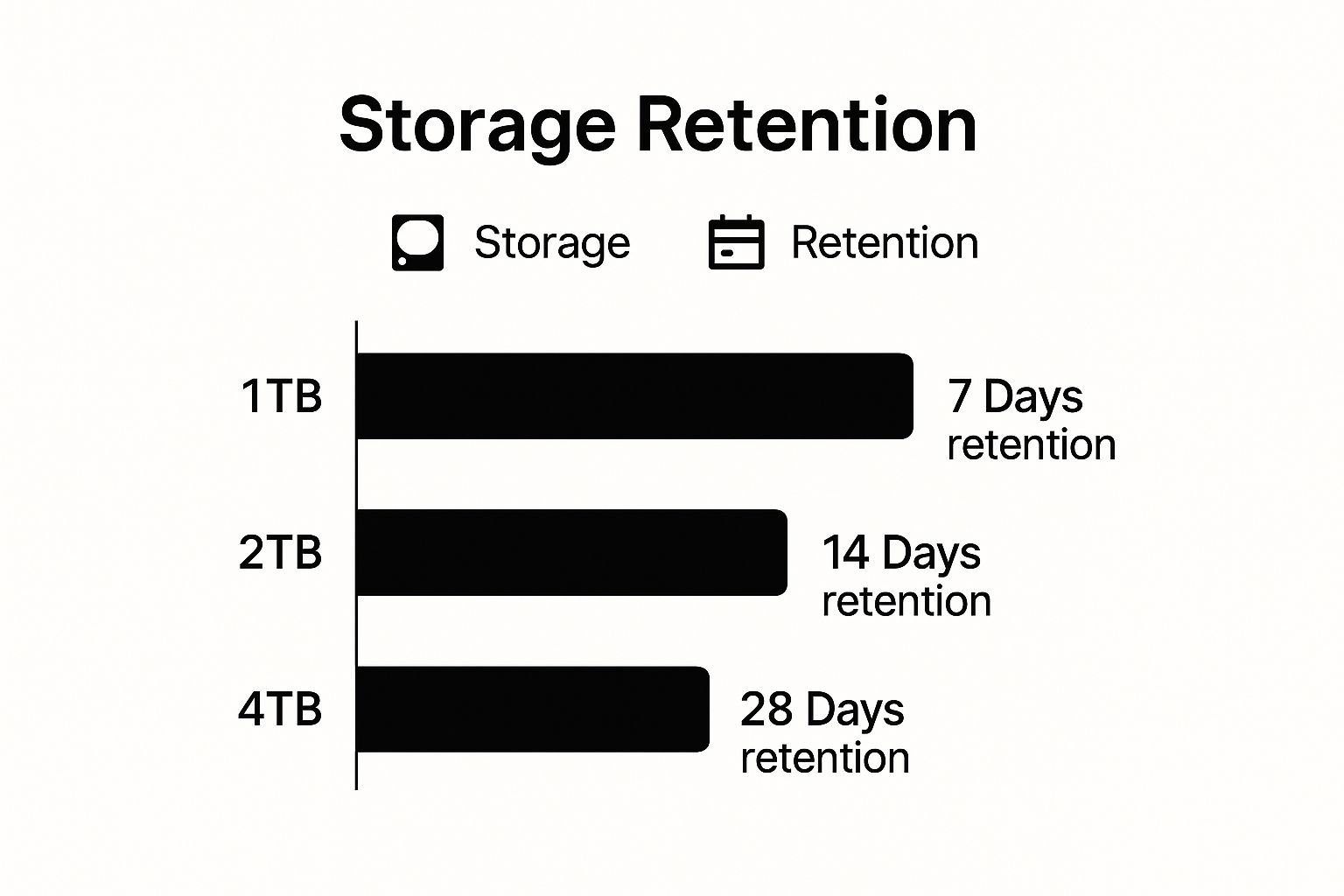
As you can see, jumping from a 2TB to a 4TB drive doubles your storage time, giving you a full month of recordings before the system starts overwriting the oldest files.
A Head-to-Head Look at Your Storage Options
Choosing between local and cloud storage isn't always straightforward. Each has its own set of strengths and weaknesses that can make it the right—or wrong—choice depending on your specific needs for security, budget, and convenience.
To make things clearer, let's put them side-by-side.
Local Hard Drive vs. Cloud Storage: A Head-to-Head Comparison
Feature | Hard Drive Storage (On-Premises) | Cloud Storage |
|---|---|---|
Cost Structure | One-time hardware purchase. | Recurring subscription fees (monthly/yearly). |
Privacy | High. Data stays on-site, under your control. | Lower. Data is stored on third-party servers. |
Data Control | Complete. You own the hardware and the data. | Limited. You are subject to the provider's terms. |
Internet Dependency | Low. Records even if the internet is down. | High. No internet means no recording for many cams. |
Remote Access | Yes, via NVR/DVR connected to the network. | Yes, by design, through an app or web portal. |
Data Security | Secure against online breaches; vulnerable to theft. | Secure against physical theft; vulnerable to breaches. |
Ultimately, the choice depends on what you value most. If total data ownership and offline reliability are your top priorities, a hard drive is tough to beat. If you prioritize off-site backup and convenience, the cloud might be a better fit.
What Happens When the Internet Goes Down?
Reliability is a huge deal in security. A system that records to a hard drive will keep on recording, uninterrupted, even if your internet connection dies. Since it doesn’t need an outside network to save footage, your security stays up and running during an outage.
In contrast, most cloud-dependent cameras turn into expensive paperweights the second they lose their internet connection.
And while you might think cloud storage wins on accessibility, modern hard drive systems have caught up. NVRs and DVRs connect right to your network, letting you view both live and recorded footage remotely from your phone or computer. You really can get the best of both worlds.
Even in professional settings, hard disk drives (HDDs) are the go-to for video archives. Their massive capacity and low cost per terabyte make them ideal for holding onto the large amounts of footage that security policies often require. You can find more details on the current state of the hard disk market and its applications to see why it remains a popular choice.
Your Smart Buyer's Checklist Before You Purchase
Picking the right surveillance camera with a hard drive isn’t just about comparing tech specs. It's really about knowing what you need to protect. Before you even look at a single product, having a clear plan will save you from buying features you'll never use or, even worse, getting a system that doesn't actually secure your property.
Think of this checklist as your game plan. Answering these questions first will turn a confusing decision into a simple one, making sure the system you end up with is the right fit for your home or business.
Defining Your Coverage and Clarity Needs
First things first, let's map out your space. Put on your security expert hat for a minute and walk around your property to pinpoint the most important areas to watch. A classic mistake is getting too few cameras and leaving glaring blind spots.
How many cameras do you need? Take a walk and count the essential spots: front and back doors, vulnerable windows, the driveway, or a storefront. It’s always better to have an extra port on your recorder than to be one camera short of full coverage.
Are they for indoor or outdoor use? This sounds basic, but it changes everything. Outdoor cameras need a tough weatherproof rating, like IP66 or higher, to handle whatever the weather throws at them. Indoor cameras can be a bit more subtle.
What level of detail do you actually need? Let's be real here. Are you just trying to see if a package was delivered, or do you need to be able to read a license plate from across the street? The answer decides whether a standard 1080p camera will do the job or if you need to step up to 4K for that crystal-clear detail.
Nailing down these first few points—camera count, placement, and video quality—is the bedrock of your entire system. Once you know this, you've already filtered out a ton of options and made finding the right gear so much easier.
Planning for Storage and Budget
Okay, so you know what you need to see. Now, how are you going to save all that video, and what's a realistic amount to spend? Your hard drive is where everything gets stored, and your budget will naturally guide the overall quality of your setup.
How many days of footage do you need to keep? Think about it—if something happens, will you know within a day, or might you need to look back at video from two weeks ago? The more footage you want to hang onto, the bigger the hard drive you'll need. A 2TB drive might get you a week of recordings, while an 8TB drive could hold a month's worth or more, all depending on your camera count and settings.
What is your total budget? Don't just think about the cameras. The total cost includes the recorder (NVR), the hard drive itself, and potentially any cables or professional installation fees. Setting a clear, all-in budget from the get-go helps you find that sweet spot between features and cost.
What to Expect During Installation and Setup
So, you’ve got your camera system. What happens next? Getting a handle on the installation process will help you map out your project and figure out whether to tackle it yourself or call in a professional. Moving from the box to a fully functioning security system involves a few key steps, starting with a fundamental choice: wired or wireless?
Wired systems, especially those using Power over Ethernet (PoE), are the gold standard for reliability. They use a single Ethernet cable to carry both power and data, so you don't have to worry about batteries or spotty Wi-Fi. The trade-off? You’ll be running cables through your walls and ceilings, which can be a significant undertaking.
On the other hand, wireless cameras give you a ton of flexibility. You can place them almost anywhere you have a power outlet and a decent Wi-Fi signal. Just remember that a weak connection can lead to dropped footage, so they aren't completely without their own set of challenges.
Strategic Placement and Configuration
Once you've settled on the hardware, the real fun begins: deciding where to put the cameras. Your mission is to cover the most important spots—think entryways, driveways, and main hallways—without leaving any obvious blind spots. Pay close attention to how the light changes during the day and look for anything that might block the camera's view.
Proper camera placement is more art than science. Aim for high vantage points that offer a wide field of view and make the camera difficult for intruders to tamper with.
With the cameras mounted, your focus shifts to the NVR or DVR. This is the brain of your operation, and getting it set up involves a few straightforward steps:
First, hook the recorder up to a monitor or TV for the initial setup.
Next, you'll need to format the hard drive, which gets it ready to start storing footage.
Then you can dive into the settings, tweaking things like motion detection zones and setting up recording schedules.
Finally, connect the recorder to your home network so you can access it from other devices.
The last piece of the puzzle is downloading the manufacturer's app to your phone or tablet. This connects you directly to your system, letting you check in on live feeds and review saved recordings from virtually anywhere. As you plan everything out, it’s also a good idea to familiarize yourself with the essential electrical fittings and materials you might need. Being prepared ensures your system is safe and reliable from the very beginning.
Still Have Questions About Hard Drive Security Systems?
Even when you've done your homework, a few questions about surveillance cameras with a hard drive can pop up. Let's tackle some of the most common ones so you can feel completely confident about your system.
What Happens When the Hard Drive Gets Full?
You might be picturing a "storage full" error message, but modern systems are much smarter than that. They use a process called loop recording.
Think of it like a car's dashcam—it's always recording. When the hard drive runs out of space, the system automatically starts overwriting the oldest video files to make room for new ones. This means your cameras never stop capturing what's happening right now. You can usually set how many days of footage you want to keep, and if an important incident occurs, you can easily save that clip to a USB drive before it gets overwritten.
The beauty of loop recording is that it delivers continuous, hands-off surveillance. It guarantees you're always recording the most recent events without ever having to manually clear space.
Can I Access My Footage Remotely?
Absolutely. "Local storage" doesn't mean "local access only." Nearly every modern NVR or DVR system is designed to plug directly into your internet router.
With the manufacturer's secure app on your phone or software on your computer, you can tap into your live camera feeds and review recorded video from anywhere in the world. It’s the perfect combination: the cloud-like convenience of remote access paired with the rock-solid security of having your footage stored safely on-site.
How Long Do Surveillance Hard Drives Last?
This is a great question because these aren't the same hard drives you'd find in a desktop PC. Surveillance-grade drives are built for a much tougher job: writing new data 24/7.
They are specifically engineered for durability and can handle the constant strain for years. While every drive is different, a quality one is often rated for over 1 million hours of operation. In the real world, you can expect a reliable drive to last 3 to 5 years under continuous use. For a deeper dive into protecting your recordings, it's worth exploring different secure storage solutions for your data.
Ready to secure your property with a reliable, subscription-free solution? At PCI Audio-Video Security Solutions, we design and install custom surveillance systems built around your unique needs. Get in touch with our security experts today!
Comments