


Commercial Security Camera Installation Near Me Guide
- Бонус за регистрацию онлайн казино
- Sep 3, 2025
- 13 min read
When you type "commercial security camera installation near me" into a search bar, you're not just looking for convenience. You're searching for a local partner who's genuinely invested in keeping your business and community safe. The difference between a local installer and a faceless national chain is night and day, especially when you need them most.
A local pro offers faster on-site support, a deep understanding of regional building codes, and a level of accountability you just can't get from a call center hundreds of miles away.
Why a Local Security Installer Is Your Best Bet
Choosing a local professional for your security camera installation is about building a relationship, not just completing a transaction. These are people who live and work in your town. They have firsthand knowledge of local crime trends and the unique environmental challenges your equipment will face, whether it's salty coastal air or brutal winter ice. That kind of on-the-ground insight is invaluable.
This idea of local expertise isn't just a security thing. For more on the value of hiring professionals in your area, it's worth understanding why choosing a local service matters. The lesson is universal: local pros bring a more personalized and responsive touch to the job.
Unmatched Responsiveness and Accountability
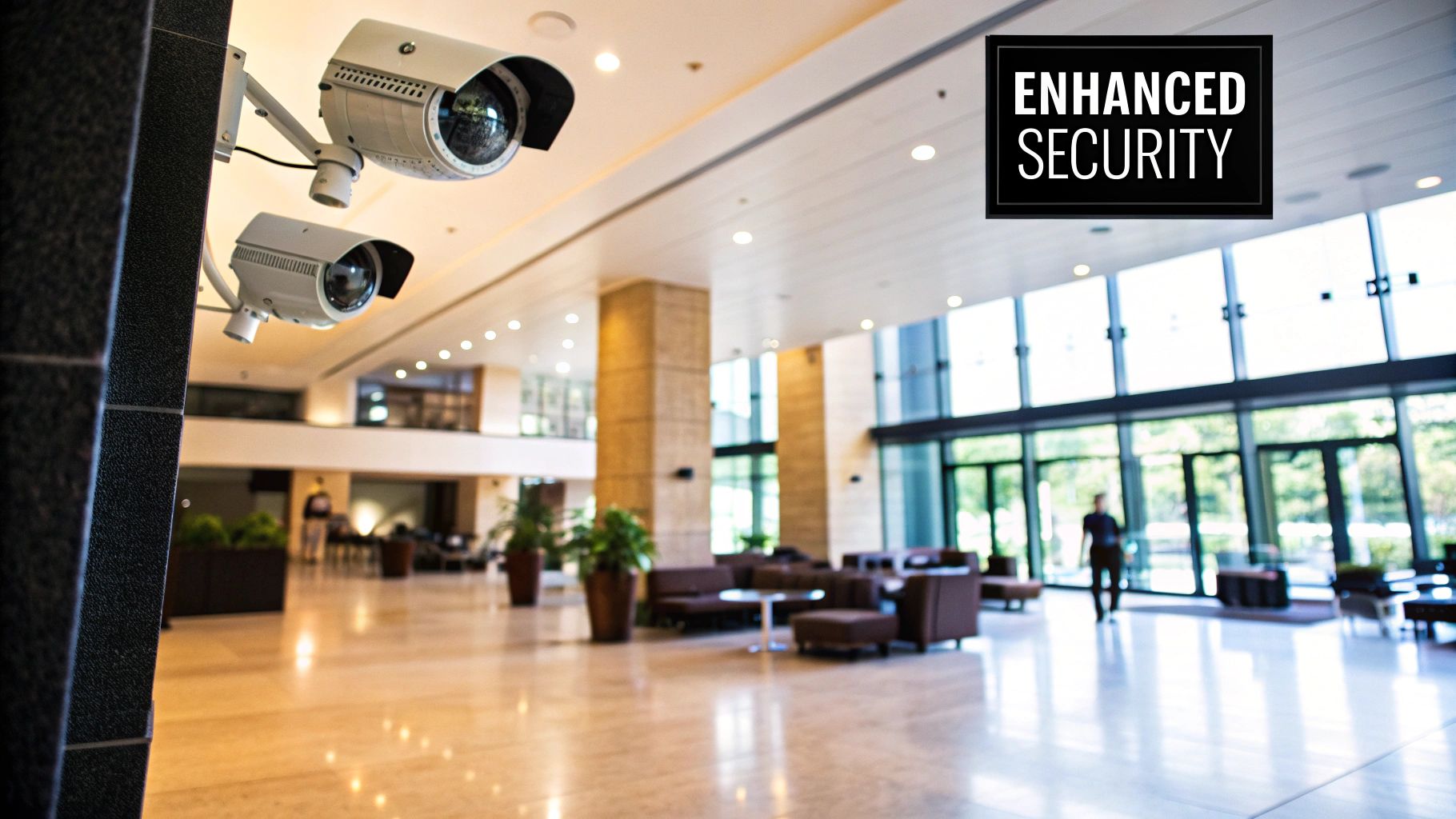
Picture this: it’s a holiday weekend, and one of your most critical cameras suddenly goes dark. Who do you think will get to you faster? A local installer can often be on-site for emergency service in a fraction of the time it takes a large, out-of-state corporation to even process your request. This rapid response is crucial for minimizing security gaps and giving you back your peace of mind.
On top of that, local businesses run on their reputation. A bad review can spread quickly through a community, which creates a powerful incentive for them to deliver high-quality work and maintain open, honest communication. Your satisfaction directly impacts their next job.
A local installer isn't just a vendor; they're a partner invested in your success. You get better service, faster support, and a system designed with your specific environment in mind.
The commercial security market is booming, expected to hit a global value of around USD 204.23 billion in 2024. This massive growth is fueled by sophisticated video surveillance technology. A skilled local installer is your guide to navigating these advancements, ensuring you get a system that truly protects your assets.
How to Properly Vet Local Security Installers
Picking the right partner to install your security cameras is, frankly, more critical than the cameras themselves. Top-of-the-line equipment in the hands of an inexperienced installer can leave you with glaring blind spots, unreliable recordings, and a dangerously false sense of security. You’re not just hiring someone to run cables; you’re looking for a security expert who can see the unique vulnerabilities of your business.
The first move is to look beyond a quick Google search. While it's a decent place to start, building a solid list of candidates takes a bit more legwork. I always recommend asking other local business owners or commercial property managers for referrals. A genuine recommendation from someone you trust is worth its weight in gold.
Essential Credentials and Non-Negotiables
Once you have a few names, the real digging begins. This isn't just about comparing quotes—it's about confirming their expertise and legitimacy. Any true professional will have their credentials ready to go and won't hesitate when you ask for them. The same basic principles apply here as when you learn how to choose a reliable builder; you're looking for proof of professionalism and stability.
Here are the absolute must-haves:
State and Local Licensing: Many areas require specific licenses for low-voltage work. Ask for their license number and take a minute to verify it with the state licensing board.
Proper Insurance: Never hire an installer without liability insurance and workers' compensation. A single accident on your property could be catastrophic. Ask for a certificate of insurance.
Manufacturer Certifications: This is a huge differentiator. Certifications from brands like Axis, Hanwha, or Avigilon mean they've received formal training on the products they're installing. It shows a commitment to their craft.
A pro's portfolio should reflect experience with businesses like yours. If all their photos are of residential homes, they probably won't grasp the complexities of securing a large warehouse, a busy retail space, or a multi-tenant office building.
A seasoned installer will be familiar with a wide range of camera types and technologies, ensuring they can recommend the right tool for each specific job.
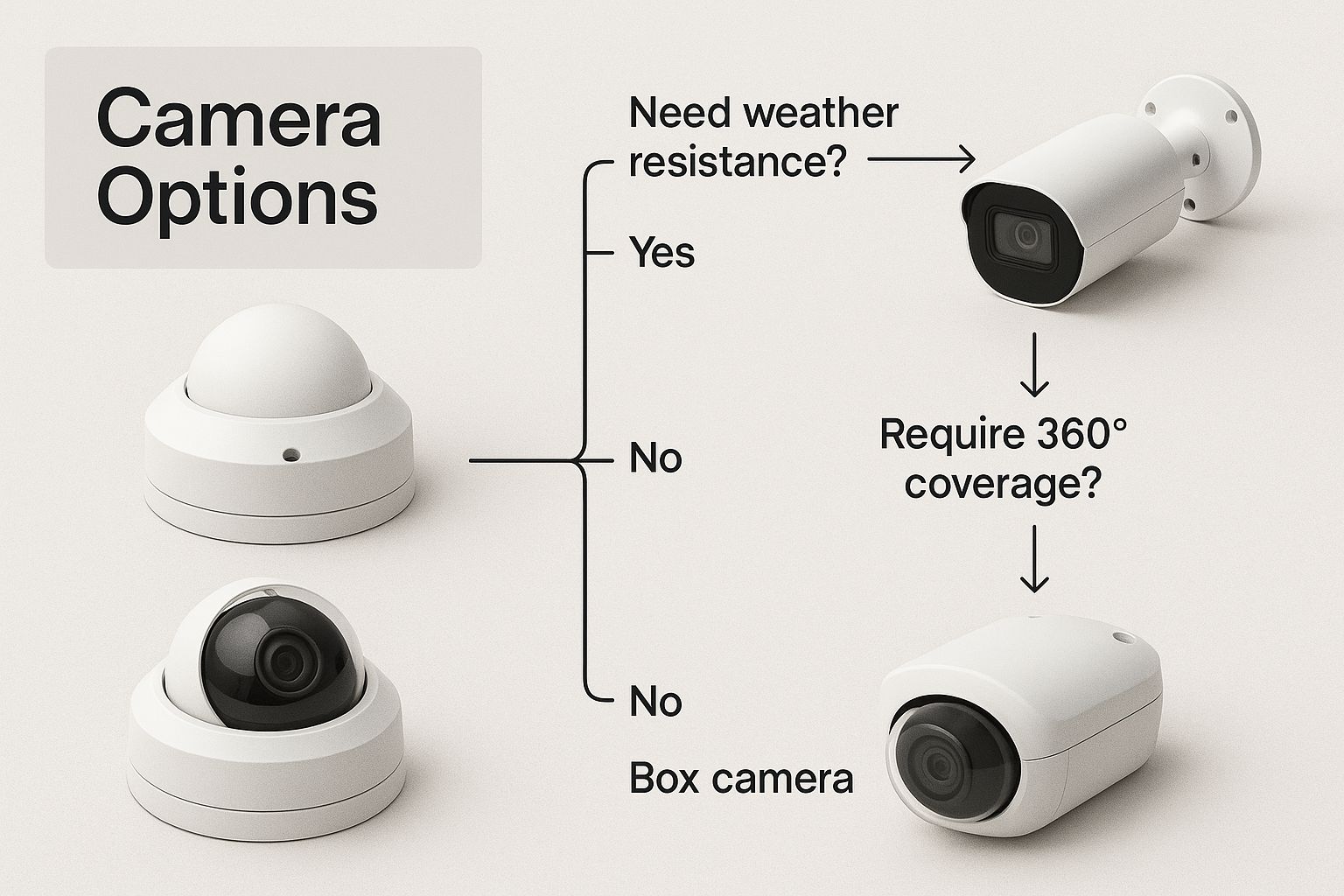
This kind of product diversity is exactly why you need an installer with broad, hands-on knowledge.
To make this process easier, use this checklist when you're talking to potential installers. It's a quick way to compare apples to apples and spot any red flags early on.
Installer Vetting Checklist
Qualification | What to Look For | Why It Matters |
|---|---|---|
Licensing & Insurance | Current, verifiable state/local licenses and a certificate of liability insurance. | Protects you from liability and ensures they meet legal operating standards. |
Relevant Experience | A portfolio with projects similar to yours (e.g., retail, warehouse, office). | Proves they understand the specific challenges and security needs of your industry. |
Product Certifications | Official training credentials from major security hardware manufacturers. | Indicates deep product knowledge and a commitment to professional development. |
Detailed Proposals | A quote that breaks down hardware, labor, and network considerations—not just a single number. | Shows transparency and a thorough understanding of the project's scope. |
Workmanship Warranty | A clear warranty on their installation work, separate from the manufacturer's warranty. | Demonstrates confidence in their own quality and protects your investment. |
This checklist isn't exhaustive, but it covers the core qualifications that separate the true professionals from the rest.
Reading Between the Lines of Reviews and Consultations
Online reviews can be a goldmine, but you have to know how to read them. Look past the star rating and search for patterns. Are multiple customers mentioning sloppy wiring, missed deadlines, or a lack of support after the job is done? Those are serious warnings. A detailed, three-paragraph review tells you a lot more than a generic "Great job!"
When you get to the consultation, go in with a list of sharp questions. Don't let them simply launch into a sales pitch.
Try asking things like:
"Can you walk me through a challenging installation you handled for a business similar to mine?"
"How do you calculate network bandwidth and video storage needs for a 16-camera system?"
"What's your process for training our staff on using the VMS after everything is up and running?"
"What kind of warranty do you offer on the installation itself, not just the hardware?"
The way they answer will tell you everything. A real pro will have confident, detailed responses that show they’ve been in the trenches and know their stuff. This level of vetting is what ensures you end up with a security system that actually works when you need it most.
Planning Your System with an On-Site Assessment
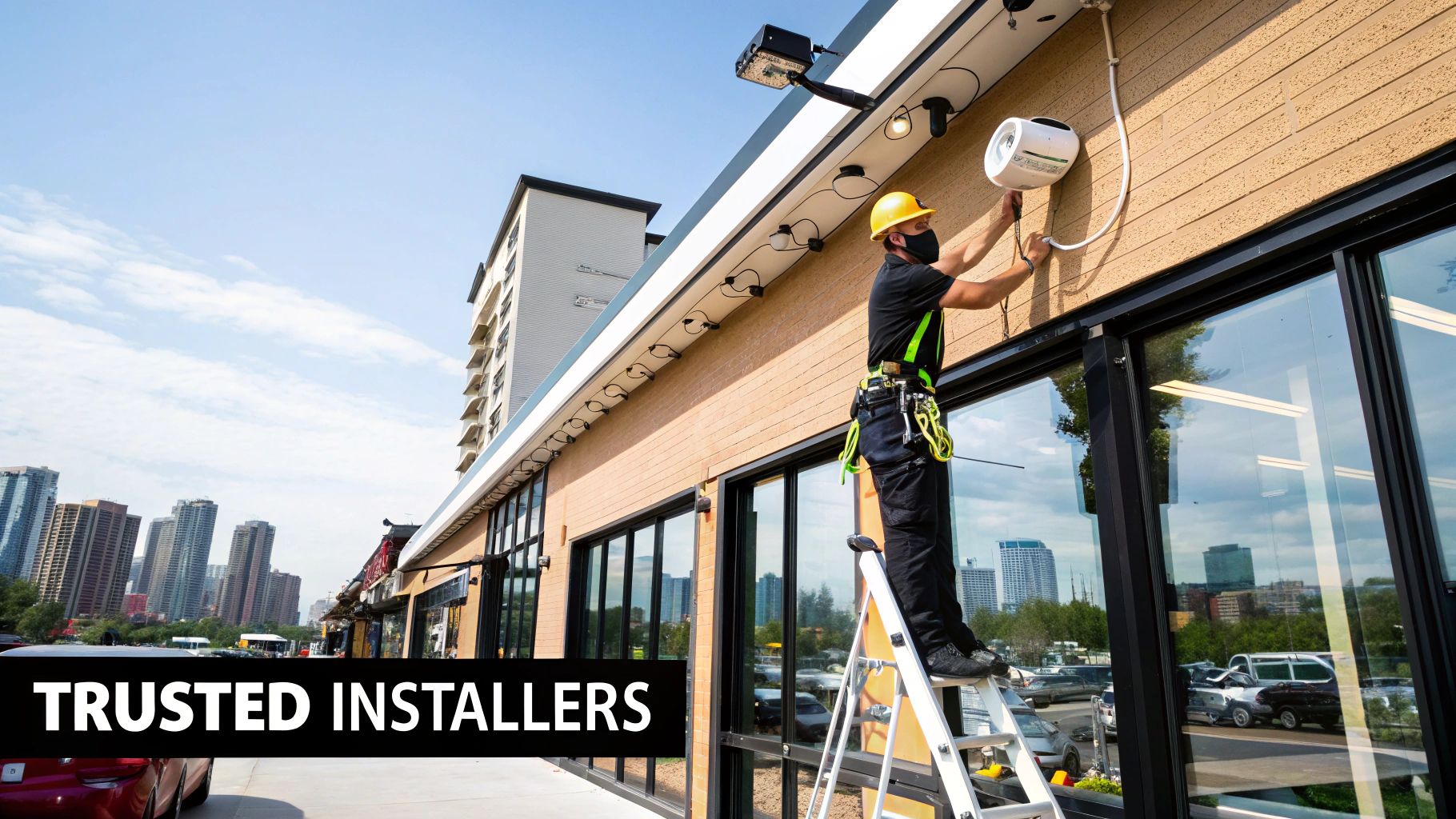
A truly effective security camera system isn’t something you can buy off the shelf. The real work—and the real value—of a professional installation happens during the on-site assessment. This is where you and an expert walk your property together, thinking critically about your business's unique layout and vulnerabilities.
This isn’t just a quick stroll to find good spots for cameras. A seasoned installer will analyze the flow of your entire operation. They’ll watch how employees, customers, and vehicles move through your space to spot risks you might not even see. Your input here is gold; you know your daily operations inside and out, and they bring the security expertise to the table. It's a partnership.
Identifying Your Key Vulnerabilities
Every single business has its own unique choke points and high-value areas that absolutely need to be monitored. The goal of the walkthrough is to map these spots and figure out the best technology to cover them. Essentially, you're learning to see your property through the eyes of someone with bad intentions.
During this process, your installer should help you identify:
Access Points: Think beyond the front door. We're talking loading docks, fire exits, first-floor windows, and any other way someone might get in.
High-Value Zones: Where's the good stuff? This could be your inventory storeroom, the server rack, an office with a safe, or even displays of your most expensive products.
Transaction Areas: Any place where money or credit cards are handled—POS systems, cash registers, reception desks—needs crystal-clear coverage.
Exterior Blind Spots: You need to walk the perimeter to find those hidden corners, poorly lit alleys, or sections of the parking lot obscured by trees or buildings.
This collaborative mapping creates a tailored blueprint for a system that actively protects your business, rather than just passively recording events.
Matching Camera Technology to a Specific Need
Once you know what you need to watch, the next question is how. This is where an expert's guidance really pays off, stopping you from wasting money on features you don't need or, even worse, skimping on a camera that won't perform when you need it most. The assessment should result in a detailed plan that matches specific camera types to their intended jobs.
The most common rookie mistake is slapping the same camera model everywhere. The small dome camera that’s perfect for your front lobby is useless for monitoring a dark loading dock. For that, you need a weatherproof bullet camera with powerful night vision.
Let's look at a few real-world examples:
The Sprawling Parking Lot: A massive, open area with cars coming and going needs more than a couple of static cameras. The right tool here is often a PTZ (Pan-Tilt-Zoom) camera mounted high up on a pole. It lets an operator follow a suspicious vehicle in real-time or zoom in to capture a license plate from hundreds of feet away.
The Busy Retail Floor: To get a bird's-eye view without any blind spots, a single fisheye or multi-sensor camera mounted in the center of the ceiling can provide a full 360-degree perspective. It’s far more effective and budget-friendly than installing four separate cameras to do the same job.
The Cash-Handling Office: For getting sharp, undeniable detail over a small, critical area like a cash-counting table, a 4K fixed turret camera is the perfect fit. It delivers forensic-level video evidence, which is far more valuable than a wider, less-detailed shot from a panoramic camera in this context.
Think of the on-site assessment as the strategic foundation for your entire security system. It ensures every dollar you invest is working hard to protect what matters, creating a setup designed for your business, not a generic template.
Choosing the Right Security Camera Technology
Once you’ve walked the property and mapped out your weak spots, it’s time to pick the hardware. What’s inside the camera is every bit as important as where you mount it. A good installation partner won't just throw technical jargon at you; they'll explain what actually provides security value versus what just sounds impressive on a spec sheet.
This isn’t about finding one "best" camera. It's about finding the right tool for each specific job. A big, visible bullet camera can be a powerful deterrent near a back entrance or loading dock. On the other hand, a sleek, low-profile turret camera is perfect for monitoring an indoor retail space without making your customers feel like they're being watched.
Decoding the Specs That Actually Matter
It’s easy to get lost in a sea of numbers and acronyms when you look at camera specs. In a business setting, though, only a few of them really move the needle on your security. A professional installer will help you cut through the noise and focus on what will give you clear, usable evidence if something happens.
Let's talk about the specs you should actually prioritize:
Resolution: For any commercial property, 1080p is the absolute minimum. But for your most critical areas—like cash registers or entryways—4K resolution is often worth every penny. That extra clarity can be the difference between a blurry shape and a license plate number you can actually read.
Lens and Field of View: A wide-angle lens is great for getting a general overview of a large area, like your main sales floor. But a varifocal lens gives an installer the flexibility to manually zoom and perfectly frame a high-value display or a specific doorway.
Infrared (IR) Capability: Don't just tick the "night vision" box. Pay attention to the effective IR range. For a dark parking lot or warehouse perimeter, you need a camera with at least a 100-foot IR range to ensure you're getting sharp images, not just a fuzzy, washed-out scene.
There’s a reason businesses are focusing on this. The global market for high-def commercial security cameras is expected to hit around USD 3.86 billion by 2032. This isn't just about recording; it's about businesses wanting crystal-clear video and smarter features to actively protect their properties. You can dive deeper into the growth of the commercial camera market at intelmarketresearch.com.
Moving Beyond Passive Recording with AI
Today's cameras are so much more than just recording devices. The biggest leap forward we've seen is the integration of artificial intelligence (AI), either in the camera itself or the recorder it connects to. This turns your whole system from a passive observer into an active security partner.
The old way was sifting through hours of footage after an incident. The new way is getting an alert about a potential threat as it's happening. AI is what makes that shift from reactive to proactive security possible.
For instance, a camera with person detection knows the difference between a person walking up to your door and a tree branch swaying in the wind. That alone eliminates a massive number of false alarms that used to plague motion-based systems.
And the analytics can get much more sophisticated:
Line Crossing: Get an instant alert if a car crosses a virtual line into a restricted zone after business hours.
Loitering Detection: The system can notify you if someone is lingering in a sensitive area—like near an ATM or a back fence—for too long.
License Plate Recognition (LPR): This is a game-changer. You can automatically log every vehicle that enters your lot, making it invaluable for investigations or managing access.
When you invest in the right technology, you're not just buying cameras; you’re building an intelligent security ecosystem. This is why getting a local pro for your commercial security camera installation near me is so critical. They have the hands-on experience to match these powerful features to what your business actually needs, giving you a system that works around the clock to protect you.
What to Expect on Installation Day and Beyond
When installation day arrives, knowing what’s going to happen helps you stay in the loop and ensures the final result matches what you signed off on. A professional installation is about more than just screwing cameras to a wall; it’s a methodical process that aims to minimize disruption to your daily operations.
The first thing a good crew will do is walk the site with you, confirming the camera placement plan one last time. This is your final chance to catch any potential issues before holes are drilled. From there, they'll get to work running cables cleanly through ceilings, walls, or conduit, making sure nothing is left exposed. A tidy wiring job isn't just for looks—it's a hallmark of a quality installation that prevents tampering.
The Installation and Handover Process
Once the wiring is done, the technicians will mount and aim each camera. This is a critical step, as they work to cover your identified vulnerable areas without accidentally creating new blind spots. Everything then gets connected to the central hub of your system, the Network Video Recorder (NVR).
With the hardware in place, the real magic begins—bringing the system to life. This involves a few key steps:
Network Integration: The crew will securely connect the NVR to your business network so you can access your cameras from anywhere.
Software Setup: This is where they fine-tune everything. They'll set up recording schedules, adjust motion detection sensitivity, and enable any special features you opted for, like AI-powered person detection.
User Training: Pay close attention here. The lead installer should give you and your team a full tutorial on how to use the system.
The job isn't done when the last camera is mounted. A truly professional installation concludes with a comprehensive handover, ensuring you feel confident and in control of your new security system.
Before the team packs up their tools, make sure you know how to view live video, find and export recorded footage, and manage basic settings. Don't be shy about asking questions—a good installer wants you to be comfortable with your investment.
Long-Term System Health and Maintenance
Think of your security system like a car; you can't just install it and forget about it. It's a long-term asset that needs regular attention to keep it running properly. Technology requires maintenance, from firmware updates that patch security vulnerabilities to simple physical upkeep.
This is where a service or maintenance agreement with your installer can be a real lifesaver. These plans typically cover the essentials:
Regularly cleaning camera lenses to keep the picture sharp.
Updating firmware to protect against new cyber threats and unlock features.
Performing system health checks to make sure every camera is online and recording.
Giving you priority support when technical problems pop up.
Taking a proactive approach to maintenance ensures your system remains a reliable tool for years, delivering a much better return on your investment. It’s the final, crucial piece for a security solution you can truly depend on.
Answering Your Top Questions About Business Security Cameras
Even with the best plan, you're bound to have a few lingering questions before you pull the trigger on a major security upgrade. This is completely normal. In fact, getting these final details sorted out is what separates a good decision from a great one when you're searching for "commercial security camera installation near me."
Let's walk through some of the most common questions we hear from business owners just like you.
What’s the Real Cost of a Commercial Security Camera Installation?
This is always the first question, and the honest answer is, "it depends." The final price tag is a direct reflection of your specific needs—the number of cameras, the technology inside them (like 4K resolution or AI-powered analytics), the sheer size of your property, and the difficulty of the installation itself.
For example, a small boutique might only need a handful of cameras for a few thousand dollars. But a sprawling warehouse with dozens of specialized cameras covering multiple entry points and inventory aisles could easily run into the tens of thousands.
My advice? Always get at least three itemized quotes. Make sure they break down the costs for hardware, labor, and any ongoing monthly fees so you can compare apples to apples.
Cloud vs. On-Premise Storage: Which Is Right for Me?
Figuring out where your video footage lives comes down to a classic trade-off between security, accessibility, and cost.
On-Premise Storage: This means having a physical Network Video Recorder (NVR) on-site. You buy the hardware once and you're done—no monthly fees. You have total control over your data. The big risk? If that NVR is stolen or destroyed in a fire, your footage is gone with it.
Cloud Storage: Going with the cloud gives you fantastic remote access and an automatic, secure off-site backup. The downside is the recurring monthly subscription fee and its complete dependence on your internet. If your connection drops, your recording stops.
The good news is that you don't always have to choose. Many of the best systems today offer a hybrid approach. They record everything locally to an NVR but also push critical, motion-activated clips to the cloud. You get the best of both worlds.
The foundational importance of this technology is clear. To understand this better, explore why modern business CCTV security is now considered indispensable for protecting assets and ensuring operational oversight.
Are There Legal Rules I Need to Follow for Business Cameras?
Absolutely. While laws can differ slightly by state, a core principle holds true everywhere: you can record video in any public-facing area of your business where there is no reasonable expectation of privacy.
Think about places like your sales floor, lobby, warehouse, or parking lot. Those are generally fair game.
However, you must stay out of private spaces. This means no cameras in restrooms, employee break rooms, or locker rooms. It’s also just good practice—and often legally required—to post clear, visible signs letting everyone know that video surveillance is active on the property. When in doubt, a quick chat with a local legal expert is the smartest move you can make.
Ready to secure your business with a professionally designed and installed system? The experts at PCI Audio-Video Security Solutions can create a solution that meets your specific needs and budget. Visit https://www.pciavss.com to schedule your free consultation today.
Comments