


Create a Flawless Workplace Emergency Action Plan
- Бонус за регистрацию онлайн казино
- Jul 31, 2025
- 18 min read
A workplace emergency action plan (EAP) is far more than a document you file away to satisfy a compliance requirement. Think of it as the muscle memory for your entire organization—a clear, practiced strategy that dictates exactly how your people will react when a crisis hits. The real goal is simple: protect your team, keep operational disruptions to a minimum, and ensure your business can bounce back from fires, medical emergencies, or natural disasters.
Why Your Business Needs an EAP That Actually Works
Let’s get real for a moment. Picture a small chemical spill happening in your warehouse. Without a solid plan, what happens? Confusion quickly turns into panic. Someone grabs the wrong fire extinguisher, accidentally making a bad situation worse. Another person wastes precious minutes trying to call a manager who isn't even on-site. When first responders arrive, there's no one designated to meet them and guide them to the scene.
This isn't a far-fetched movie scene. It's the reality for businesses that treat their workplace emergency action plan as just another box to check. A truly effective EAP isn't about compliance; it's a fundamental part of your operations that builds resilience from the ground up.
The Alarming Gap Between Planning and Preparedness
Here’s the thing: having a plan and having a plan that works are two entirely different things. The data shows a pretty scary gap in preparedness, even at companies that think they're ready. A recent global survey revealed that while most organizations have something in writing, the crucial follow-through—updates and training—often gets neglected.
In the United States, 76% of employees say their workplace has a written emergency plan. That sounds good, right? But hold on. Only 53% of those organizations update their plans annually, and a tiny 9% do it biannually. This means a huge number of plans are dangerously out of date.
This is where businesses are most vulnerable. An old, untested plan gives you a false sense of security that will crumble the second a real emergency unfolds.
Building a Resilient and Actionable Strategy
An EAP that actually works isn't a static document. It's a living framework that anticipates credible threats and lays out simple, logical steps for your team to follow when they're under immense pressure.
A strong plan is always built on a few key pillars:
Realistic Risk Assessment: You have to identify the threats that are specific to your location, your industry, and your day-to-day operations—not just generic "what ifs."
Clear Roles and Responsibilities: Who's in charge? Designate an emergency coordinator, evacuation wardens, and first aid responders, and make sure their duties are spelled out with no ambiguity.
Fail-Safe Communication: How will you alert everyone? You need multiple ways to get the message out, whether your team is in the office, working from home, or traveling. The global health crisis taught everyone some hard lessons learned from the COVID-19 pandemic about the need for adaptable communication.
Regular Drills and Training: This is where the plan comes to life. Practice turns procedures into instinct, ensuring that when it counts, people can respond automatically and effectively.
At the end of the day, investing time and resources into a robust workplace emergency action plan is a direct investment in your people, your assets, and your company's future. It’s about making sure that when the unexpected happens, your team has the confidence and the clarity to act decisively and safely.
Building Your EAP From the Ground Up
Let's be blunt: a generic, one-size-fits-all workplace emergency action plan is worse than useless. It creates a false sense of security that can be genuinely dangerous when a real crisis hits. To be truly prepared, you have to look past the boilerplate templates and build a plan that reflects the unique realities of your business.
This isn't a job you can hand off to a single HR manager and call it a day. The foundation of any good EAP is a dedicated, cross-functional team. Think of it as your own internal emergency response committee.
You'll want to bring together people who see your operation from different angles:
Facilities Management: These are the folks who know the building inside and out—from the utility shutoffs to the fire suppression systems. Their knowledge is indispensable.
Department Leaders: They understand the specific risks and workflows within their own teams, making their input crucial for department-level planning.
Frontline Employees: Never underestimate the value of on-the-ground perspective. Your frontline staff can point out daily hazards and logistical hurdles you might otherwise miss.
HR and Safety Officers: They provide the essential framework for compliance, communication strategies, and managing personnel during a crisis.
With your team assembled, the first order of business is a serious risk assessment. This means moving beyond the obvious things like fires and digging into the threats that are specific to your company.
Identifying Your Unique Risks
A software company in a quiet suburb has a very different risk profile than a chemical manufacturer on a major shipping route. A thorough risk assessment is all about context. You need to map out every potential scenario to ensure your plan is ready for what's most likely to happen.
OSHA's eTools offer a great starting point for this kind of thinking, helping you organize potential emergencies into clear categories.

This framework prevents you from overlooking entire categories of threats. Start your brainstorming by looking at three key areas:
Location-Specific Threats: Are you in a flood plain? An earthquake zone? A region known for tornados or hurricanes? What about proximity to other industrial sites that could pose a risk, like a nearby chemical plant?
Industry-Specific Hazards: Construction sites have inherent risks from heavy machinery and falls. A restaurant's biggest concerns might be kitchen fires or refrigeration failure. Pinpoint the dangers that come with the territory of your specific industry.
Facility-Specific Issues: Take a hard look at your actual building. Is the electrical wiring old? That’s a fire risk. Is your server room in the basement? That's a flood risk. The building's age, layout, and internal systems all play a part.
Thinking proactively can also uncover hidden dangers. For instance, scheduling a professional power quality auditing can identify electrical system weaknesses before they can spark a major fire or cause a critical system failure.
From Assessment to Actionable Plan
Once your team has a clear, documented picture of the risks, you can start drafting the plan itself. This is more than just mapping out fire escape routes; it's about creating a comprehensive playbook for your entire response.
From my experience, one of the most critical mistakes businesses make is having a single, generic response. The procedure for a shelter-in-place order during a tornado is completely different from evacuating for a fire. Your plan needs distinct protocols for each major risk you've identified.
Your draft should be built around the core components that form the backbone of any solid EAP. This structure ensures all the critical life safety and operational bases are covered.
Core Components of a Workplace EAP
Every effective EAP, regardless of the industry, must address a few fundamental areas. The table below breaks down these essential pillars. Think of this as the non-negotiable checklist for your plan.
Component | Description | Key Action Items |
|---|---|---|
Emergency Reporting | How employees report a fire or other emergency. | Designate an internal contact; establish clear methods (e.g., pulling a fire alarm, calling a specific extension). |
Evacuation Procedures | Clear, step-by-step instructions for getting everyone out safely. | Map primary and secondary escape routes; designate an off-site assembly point; establish a headcount system. |
Critical Shutdowns | Procedures for employees who must secure critical operations before they evacuate. | Identify essential equipment; train designated personnel on safe shutdown protocols. |
Rescue & Medical Duties | Actions for employees assigned to perform rescue or first aid tasks. | Assign and train first aid responders; clarify their roles and limitations to avoid putting them in harm's way. |
By addressing each of these components thoroughly, you ensure your plan is robust and covers the most critical actions needed during the chaotic first moments of an emergency.
With these foundational pieces in place—a diverse team, a detailed risk assessment, and a structured outline—you’ve officially moved beyond the generic template. You are now well on your way to building a customized, actionable emergency plan that is truly designed to protect your people and your business when it counts.
Establishing Clear Roles and Communication Protocols
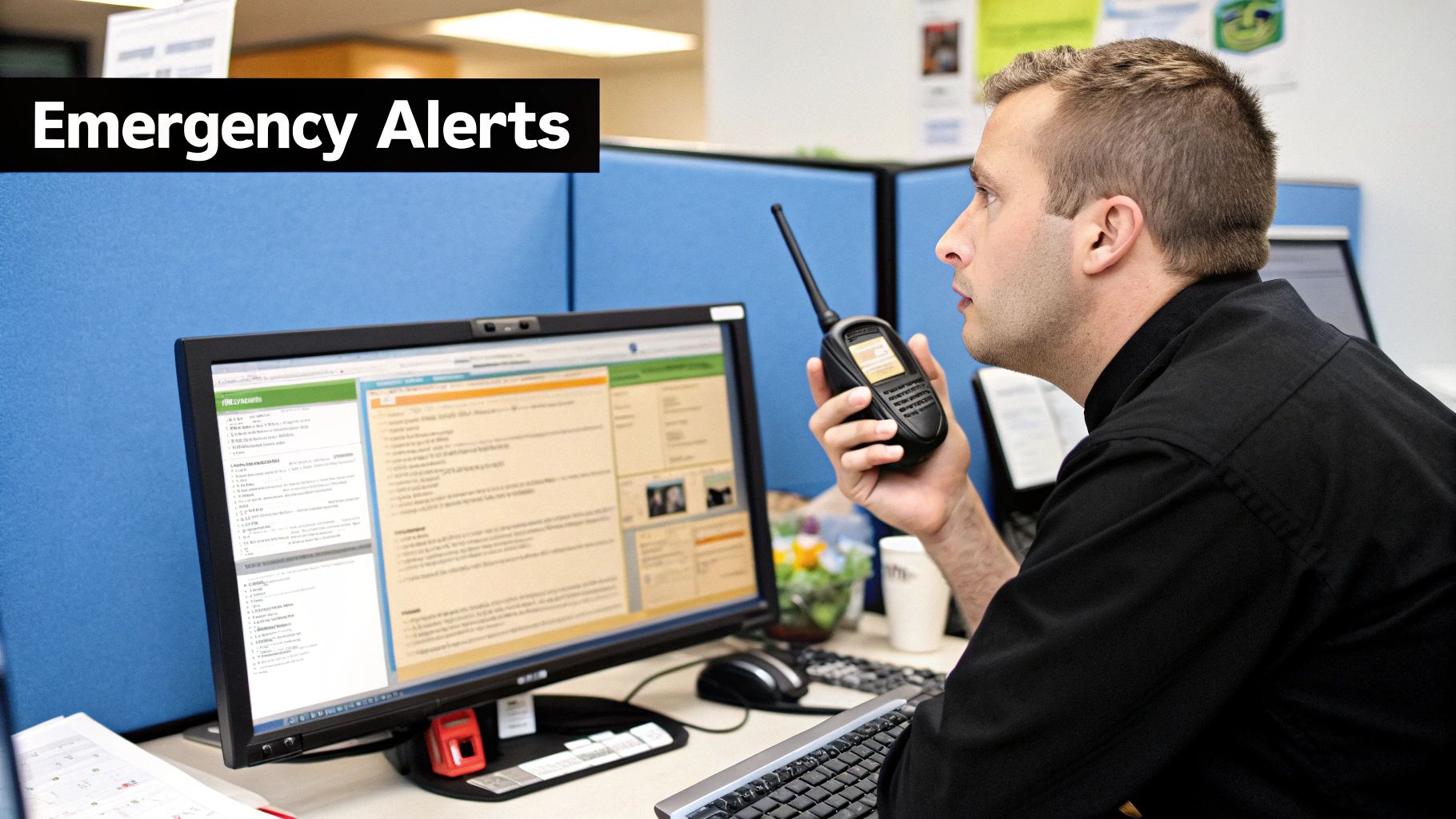
When an emergency hits, the last thing you want is confusion. Ambiguity is the enemy. People standing around wondering what to do or who's in charge can turn a manageable incident into a catastrophe. That’s why a core piece of your workplace emergency action plan is deciding ahead of time who does what and how critical information gets out.
This starts with putting together a dedicated emergency response team. These aren't just titles on an org chart; they're the people who need to step up and take decisive action when it counts. Every role needs to be spelled out clearly, with specific duties that are understood, trained, and practiced.
Defining Key Emergency Roles
Your response team is the absolute backbone of your EAP. While the exact positions will depend on your company’s size and specific risks, some roles are just about non-negotiable.
Emergency Coordinator (or Incident Commander) This is your point person, the one who has the final say during a crisis. They have the authority to activate the EAP, make the tough calls, and act as the main liaison for first responders. Think of them as the director of the entire operation, making sure everyone else on the team is doing their part.
A quick but vital tip: always designate at least two backups for this role. What happens if your main coordinator is on vacation, out sick, or directly impacted by the emergency? Without a clear line of succession, the whole response can grind to a halt before it even begins.
Evacuation Wardens These folks are your eyes and ears on the ground during an evacuation. You'll assign them to specific floors or departments, and their job is critical:
Make sure everyone in their area knows about the emergency.
Guide people to the closest and safest exits.
Sweep their area to check for anyone left behind, but only if it's safe to do so.
Help anyone who might have mobility issues or need extra assistance.
Report back to the Emergency Coordinator once they reach the assembly point.
First Aid Responders These are employees with current training and certification in first aid and CPR. Their role is to provide immediate care to the injured until professional help (EMS) arrives. It's crucial that their duties are limited to their level of training—you don't want well-meaning staff putting themselves in harm's way.
I’ve seen it firsthand: titles are meaningless without authority. Everyone in the company must understand that during an emergency, instructions from the response team are not suggestions. They must be followed immediately. This isn't about office politics; it's about life safety.
Building a Bulletproof Communication Strategy
Once you have your team, the next piece of the puzzle is communication. How do you get timely, accurate information to every single employee, whether they're at their desk, on the factory floor, or working from home? A modern strategy has to be layered.
Relying on a single method, like email, is a recipe for failure. What if the power is out or the network crashes? A multi-channel approach that values speed and reliability is the only way to go.
This is a bigger challenge than most businesses realize. A recent survey revealed a major disconnect: 56% of employees were notified of emergencies by email, while only 36% got alerts through mass text messages. This gap is alarming, especially when you learn that text is the preferred channel for workers. You can dig into more of this data on employee communication preferences during emergencies.
Your communication plan should weave together several methods:
Mass Notification System: Many modern security systems can send alerts via text, voice call, and push notifications all at once. This is the fastest and most reliable way to reach everyone, everywhere.
Internal Messaging Apps: Tools like Slack or Microsoft Teams are great for real-time updates, especially for office-based and remote workers who are already on the platform.
Building-Wide Alarms: Don't forget the classics. The fire alarm and a public address (PA) system are still essential for providing clear, unmistakable alerts to everyone on-site.
Phone Trees: While they feel a bit old-school, a well-maintained phone tree can be an invaluable backup if digital systems fail. It provides a human touchpoint for cascading information down the line.
By creating a clear chain of command and a robust, multi-channel communication plan, you build a framework that can actually withstand the pressure of a real emergency. This clarity gives your entire team the confidence to act correctly and decisively when seconds matter.
Mapping Out Evacuation and Shelter-in-Place Procedures
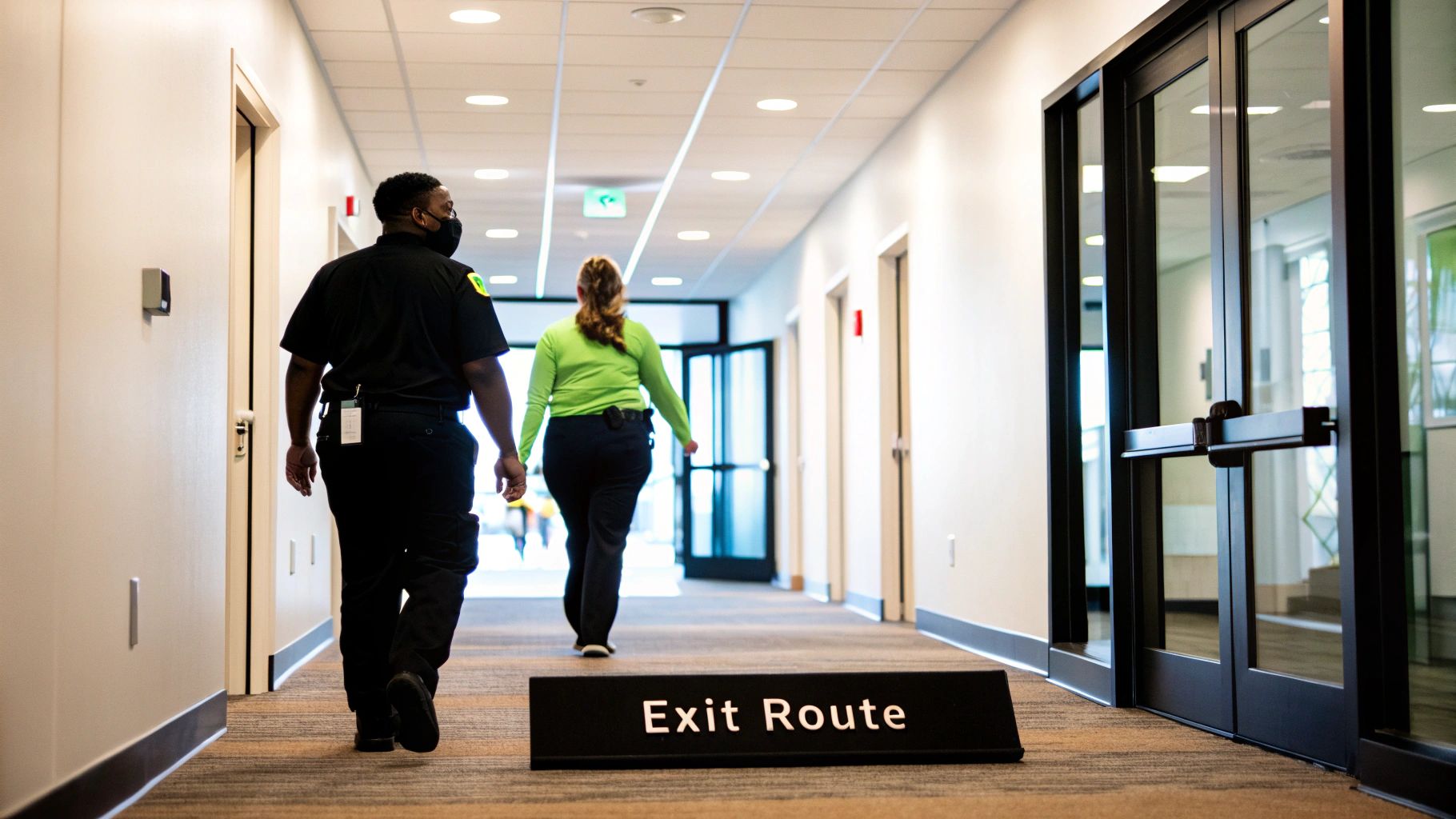
This is where the rubber meets the road. All the theory and planning for your workplace emergency action plan gets real when you start mapping out the physical movements of your people. Simply telling everyone to "evacuate" isn't a plan; it's a recipe for chaos and confusion.
To be effective, your procedures have to be second nature. The routes need to be clearly marked and designed for your specific building layout. It's not enough to just have one way out. Every single area of your workplace, from the front office to the back warehouse, must have both a primary and a secondary evacuation route. Think of it this way: the primary route is your best-case scenario—the quickest path to safety. The secondary route is your lifeline when that first path is blocked by fire, smoke, or debris.
Designing Clear and Accessible Routes
Your goal here is simple: make the evacuation routes so obvious that a visitor or a brand-new employee could follow them, even under the extreme stress of an emergency. This means using universal signage, clear floor markings, and emergency lighting that will kick on the second you lose power.
And let's be crystal clear: accessibility isn't optional. Your routes and procedures have to work for every single person in your building, including those with disabilities or even temporary injuries.
Wheelchair Accessibility: Are your designated routes and exits wide enough for a wheelchair? Do you have ramps where needed, or are there evacuation elevators available and clearly marked?
Assistance Protocols: You can't just hope someone will help a colleague who needs it. Formally designate "evacuation buddies" for employees who may need assistance. It has to be a defined role with clear expectations.
Visual and Auditory Alerts: A blaring siren does nothing for an employee who is deaf or hard of hearing. Your emergency alarms must include both loud, audible signals and bright, visual strobes.
The physical environment dictates the plan. A corporate high-rise is a completely different beast than a sprawling manufacturing plant. In a skyscraper, the stairwells are the escape routes, so they must be kept clear of any obstruction, period. In a large factory, a route might have to cross an active work zone, meaning you need a specific protocol to shut down machinery so that path is safe to use.
Evacuate or Shelter: The Critical Difference
Your emergency plan has to draw a bright line between different types of emergencies. What your team does during a fire is the polar opposite of how they should react to a tornado warning or a chemical spill happening down the street.
Evacuation Procedures (e.g., Fire, Gas Leak): The mission is to get everyone out of the building and away from the immediate danger as fast and as safely as possible.
Shelter-in-Place Procedures (e.g., Tornado, External Hazmat): Here, the mission is to find the safest spot inside the building, sealing everyone off from the external threat. This usually means an interior, windowless room, a basement, or a designated storm shelter.
I’ve run countless emergency drills over the years, and the most common point of failure is when people don't know which action to take. The triggers have to be unmistakable. For instance, a fire alarm always means evacuate. A specific announcement over the PA system or a company-wide text alert means shelter-in-place.
Shutdowns, Assembly Points, and Headcounts
In certain emergencies, a few key people might need to perform critical equipment shutdowns on their way out. This isn't for everyone; it's a specific task for trained personnel who might need to secure a production line or shut down data servers to prevent a bigger disaster. These individuals must be pre-identified, trained extensively, and know exactly when to abandon the task to save themselves.
Once everyone is outside, the chaos can easily continue without a pre-planned assembly point. This spot needs to be:
A safe distance from the building, away from the danger of fire or falling debris.
In an open area, clear of traffic and other potential hazards.
Spacious enough for your entire team to gather without being on top of each other.
As soon as people arrive at the assembly point, designated wardens must start a headcount to account for every single person. This information is absolutely vital for first responders—it tells them whether they need to risk their lives searching for someone inside. Using a reliable system, like physical rosters or a dedicated mobile app, is crucial for getting an accurate count when every second matters.
This structured, pre-planned approach mirrors what we see in large-scale global initiatives. The WHO European Region's adoption of plans like the Emergency Medical Teams (EMT) Regional Action Plan shows that organized, coordinated responses are what save lives. You can explore more on how these landmark health emergency plans are boosting preparedness to see these principles in action on a larger scale.
Turning Your Plan into Action with Drills and Training
Let's be blunt: a workplace emergency action plan gathering dust on a shelf is worse than having no plan at all. It gives you a false sense of security that can be genuinely dangerous. The real measure of your plan isn’t how well it’s written, but how your team performs when things get chaotic.
That’s where practice comes in. Drills and training are what transform that static document into muscle memory. Without it, even the most carefully crafted procedures can fall apart. The whole point is to build confident, automatic reflexes so your team can act decisively when every second is critical.
Building a Training Program That Actually Works
A quick memo once a year isn't training. A brief slide in an onboarding deck isn't training, either. For this to work, you need a living, breathing program that gives every single employee the confidence and skills to respond correctly. We're talking about more than just pointing out the fire exits.
A solid training program needs to hammer home a few key areas:
Emergency Signals: What does the fire alarm sound like versus a shelter-in-place announcement? People need to instantly recognize the signal and know exactly what it means for them.
Roles and Responsibilities: Who is the Emergency Coordinator? Who are the floor wardens? Everyone must know who's in charge during a crisis and understand their authority.
Safety Equipment Locations: Team members should be able to walk to the nearest fire extinguisher, AED, or first-aid kit with their eyes closed. And, of course, designated personnel must be fully trained on how to use them.
Specific Procedures: This is the "what to do" part. Training must cover the exact steps for evacuation, sheltering in place, or executing critical equipment shutdowns, leaving no room for guesswork.
To make this knowledge stick, you have to mix up your methods. Classroom-style sessions are fine for covering the basics, but you need to pair them with hands-on practice. For example, ask your local fire department to come in and run a live fire extinguisher demonstration. That kind of real-world engagement is what truly sinks in.
I’ve seen it time and again—the biggest failure in training is not making it realistic enough. You have to simulate the pressure and confusion. People need to feel a little bit of that adrenaline to understand how they’ll truly react when it counts.
From Talk to Action: Running Effective Drills
Drills are where the rubber meets the road. Think of them not as pass/fail tests, but as invaluable opportunities to find the weak spots in your plan in a safe, controlled way. A good program will use a variety of drill types, each with a specific purpose.
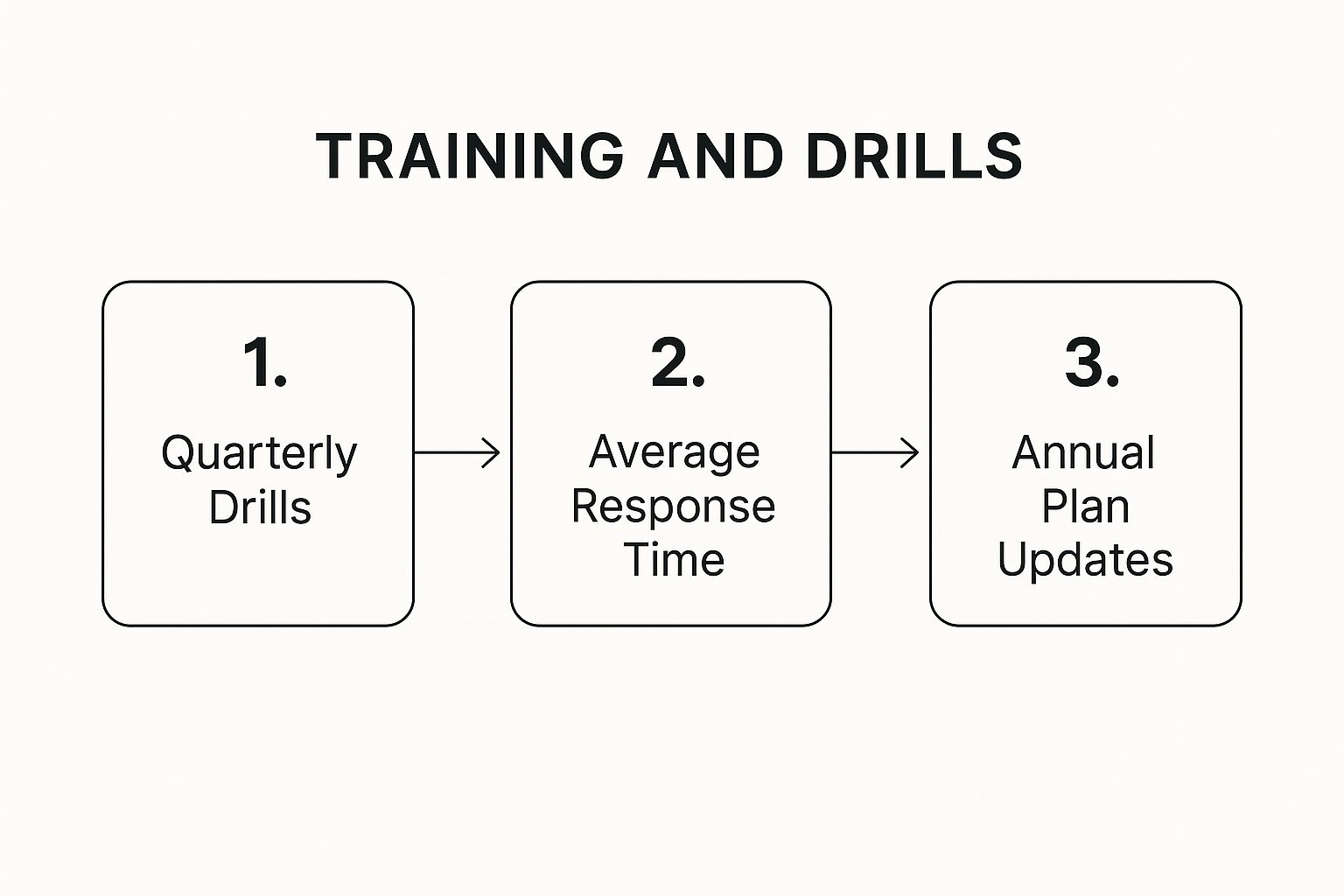
This cycle is crucial—practice and feedback are what make your emergency plan stronger and more reliable over time.
Selecting the right type of drill depends on what you want to achieve. Are you testing your leadership's decision-making or your team's on-the-ground execution?
Choosing the Right Emergency Drill for Your Team
Drill Type | Primary Objective | Best For |
|---|---|---|
Tabletop Exercise | Test the logic and clarity of the plan. | Discussing complex scenarios and aligning leadership's response without disrupting operations. |
Functional Drill | Verify a single component of the EAP. | Testing specific systems like your emergency notification software or a building-wide lockdown procedure. |
Full-Scale Simulation | Test the entire plan in a real-time, hands-on scenario. | Evaluating the complete, integrated response of your team, often with external first responders. |
Ultimately, a well-rounded program incorporates all three. You might start the year with a tabletop exercise to iron out the strategy, follow up with functional drills to test your tools, and cap it off with a full-scale simulation to see how it all comes together under pressure.
The Real Work Begins After the Drill
The most critical part of any drill happens once it’s over. You have to sit down with your team for an honest "after-action review" to figure out what worked and, more importantly, what didn't.
Foster an environment where people feel safe giving candid feedback. Don't be afraid to ask tough questions:
Did the alert reach you immediately? Was it clear?
Were the evacuation routes easy to follow, or were there bottlenecks?
Was there any point where you felt confused or unsure what to do?
What’s one thing we could do to make this smoother next time?
Take that feedback, compare it against your drill objectives (like a target evacuation time), and document everything. Those lessons are gold. They are what you'll use to revise and strengthen your workplace emergency action plan. This endless loop—practice, evaluate, refine—is what builds a truly resilient organization.
Common Questions About Workplace Emergency Action Plans
Even with a great plan on paper, questions always come up. The world of risk isn't static, and your emergency action plan can't be either. Let's walk through some of the most common questions I hear from business owners and safety managers.
Getting these details right is what makes the difference between a plan that just checks a box and one that actually protects your people when it matters most.
How Often Should We Review Our EAP?
Think of your emergency action plan as a living document. It’s not something you write once and file away forever. At a bare minimum, you should be doing a comprehensive review at least once a year—that’s the standard OSHA strongly recommends. But that’s just the baseline.
You need to pull that plan out for an immediate update whenever something significant changes. This could be:
A Change in Your Facility: Did you just complete a renovation, move a department, or reconfigure the office layout? Your evacuation maps are now wrong.
Introduction of New Hazards: Bringing in new machinery, chemicals, or work processes introduces new risks that your old plan doesn't account for.
Turnover in Key Roles: If your designated Emergency Coordinator or a floor warden leaves the company, those critical roles are now vacant. They need to be reassigned and the new people trained immediately.
Lessons from a Drill or Incident: Every time you run a drill—or worse, experience a real emergency—you will find gaps. Treat these discoveries as urgent, non-negotiable reasons to revise the plan.
An outdated plan can be more dangerous than having no plan at all because it creates a false sense of security.
EAP vs. Fire Prevention Plan: What’s the Difference?
This is probably the most frequent point of confusion I see, but the distinction is critical. They are close partners in creating a safe workplace, but they have very different jobs.
An Emergency Action Plan (EAP) is your all-hazards playbook. It’s the broad guide that tells employees what to do in any type of emergency. Yes, that includes fires, but it also covers medical crises, tornadoes, active aggressors, or even a hazardous material spill nearby. The EAP is all about the human response: how to get out, where to take shelter, and who to call.
A Fire Prevention Plan (FPP), on the other hand, is laser-focused. Its one and only job is to stop fires from starting in the first place. It gets into the nitty-gritty of:
Safe handling and storage of flammable materials.
Controlling ignition sources, from welding sparks to frayed electrical cords.
Properly maintaining fire suppression equipment like sprinklers and extinguishers.
Many businesses are required to have both. They’re designed to work hand-in-glove; the FPP works to prevent the fire, and the EAP provides the life-saving instructions if one breaks out anyway.
The biggest mistake I see is companies thinking their fire plan is their emergency plan. A fire plan won't tell you what to do during an active shooter event or a sudden flood. You need the EAP to cover the full spectrum of credible threats.
How Do We Adapt Our Plan for Remote and Hybrid Workers?
Your duty of care doesn't stop at the office walls. In today's world, your workplace emergency action plan is incomplete if it ignores employees working from home. Forgetting about them isn't just a blind spot; it's a major liability.
You need specific protocols built into your plan for your distributed team. This means having:
A robust, multi-channel alert system to notify them of emergencies that impact the business, like a server outage, cyberattack, or a regional event affecting their area.
Clear, simple guidance on what they should do and who to contact.
A reliable system for ensuring you have up-to-date emergency contact information for every single employee, no matter where they clock in from.
Hybrid workers are a unique challenge. They must be included in any on-site drills and training that happen on the days they’re in the office. They need to know the building's evacuation routes, assembly points, and shelter-in-place procedures just as well as your full-time staff.
What Are the Biggest EAP Mistakes People Make?
A truly effective emergency plan isn't just about what you include; it's also about what you avoid. Over the years, I've seen the same critical mistakes sink otherwise well-intentioned plans.
Here are the most common failures I’ve encountered:
Using a Generic Template: A fill-in-the-blank plan from the internet is a recipe for disaster. It isn’t tailored to your building, your people, or your specific risks.
Vague Responsibilities: A plan that says "The Emergency Coordinator will manage the response" is useless without defining exactly what that means and giving them the authority to act.
The "One and Done" Mentality: Writing the plan and sticking it in a binder is the same as not having one. Without drills and training, your team won't know what to do when panic sets in.
A Single Point of Failure in Communications: Relying only on email or the overhead PA system is a huge mistake. What if the power is out or the network is down? You need layers.
Forgetting to Review and Update: A plan from two years ago is dangerously out of date. It doesn't reflect your current staff, layout, or operational risks.
Avoiding these five common mistakes will put you light-years ahead of most organizations and turn your EAP from a document into a life-saving tool.
A robust emergency plan is often powered by integrated technology. Modern security solutions from PCI Audio-Video Security Solutions can become a cornerstone of your EAP, providing reliable video surveillance, access control for lockdowns, and alarm systems that act as your first line of defense. See how our integrated systems can strengthen your preparedness.
Comments