


How to Hide Security Cameras An Expert Guide
- Бонус за регистрацию онлайн казино
- Aug 21, 2025
- 13 min read
Knowing how to properly hide a security camera is all about making technology melt into its surroundings. The best tricks of the trade involve using everyday objects, clever angles, and even your home's own architecture to keep your cameras discreet yet effective. It's about securing your space without making it look like a fortress.
The Art of Discreet Surveillance
Hiding a camera isn't just about shoving it behind a plant. It's a strategic move that can seriously level up your security. Sure, a big, obvious camera can scare off some intruders, but it also screams, "Here I am! Come break me!" An unseen camera, on the other hand, keeps recording long after the visible ones have been spray-painted or ripped down.
This subtle approach has some major upsides:
Protecting Your Gear: A camera that can't be seen can't be easily targeted. Criminals are looking for the obvious stuff to disable first, and a well-hidden camera is naturally shielded from that initial attack.
Seeing What Really Happens: Sometimes you need to see how people act when they think no one is watching. Whether you're dealing with a suspicion of employee theft or checking on a caregiver, a hidden camera gives you the unfiltered truth.
Keeping Your Vibe: Let's be honest, nobody wants their home or business to feel like a prison. Discreet cameras let you keep that welcoming, comfortable atmosphere without sacrificing security.
A Quick Word on Ethics and the Law
Before you start drilling holes, you have to get clear on the legal and ethical side of things. Recording video on your own property is generally fine. But recording audio is a whole different ballgame—in many places, you need consent from everyone involved.
And this should go without saying, but never, ever place cameras where people have a reasonable expectation of privacy. Think bathrooms, locker rooms, or bedrooms. Crossing that line is a serious legal and ethical violation.
The whole point of discreet surveillance is to protect, not to pry. Keep your focus on securing common areas and entry points. Always stay on the right side of the law and respect personal privacy.
At the end of the day, mastering the art of concealment means your security system works smarter, not just harder. A well-hidden camera is your silent witness, ready to provide undeniable evidence when you need it most. It's a proactive step that ensures your system is more than a simple deterrent; it's a reliable tool for capturing the truth. If you're looking for a more robust setup, considering a professional security system installation can give you access to experts who know all the tricks for effective and discreet camera placement.
Mastering Indoor Camera Concealment
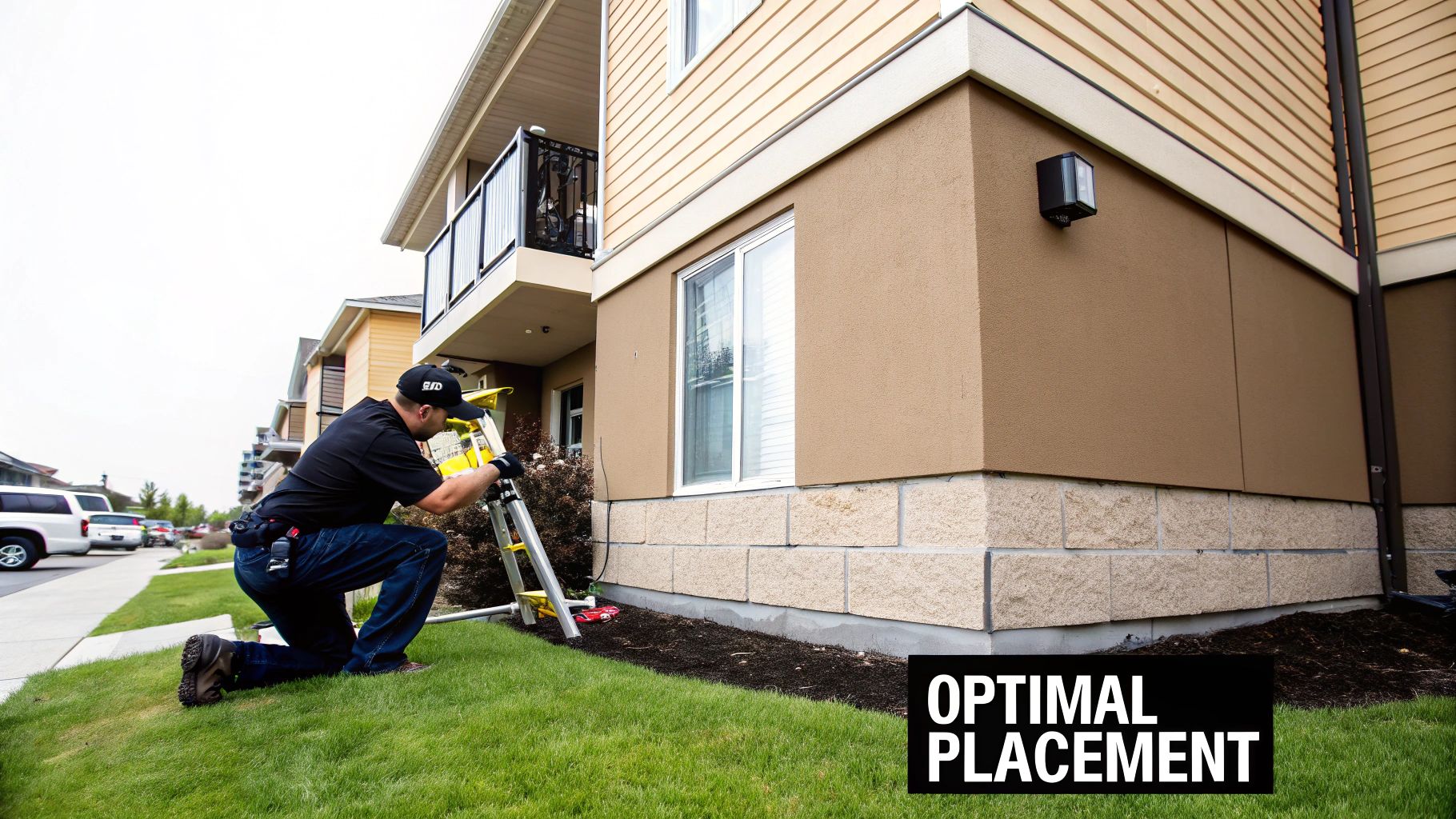
When you're installing security cameras inside, the real art is making them disappear. You want them to become just another part of the background, completely invisible to anyone who isn’t specifically looking for them. The trick is to stop thinking about hiding spots and start thinking about camouflage. The best locations are always right out in the open, disguised as something else.
Take a look around the high-traffic areas you need to watch—the living room, entryway, or main office space. Don't look for empty corners or bare walls. Instead, scan for the clutter. An exposed camera is an obvious camera, but one tucked between books on a crowded shelf or peeking out from behind a photo frame just vanishes.
Blending with Your Decor
Your first move is to pick a camera that doesn't clash with its new home. A glossy white camera is going to scream for attention on a dark-stained bookshelf, just as a black one will on a bright white windowsill. It sounds simple, but you’d be surprised how many people overlook this. Choose a camera color and size that matches its surroundings. Thankfully, many of the best cameras today are tiny, which makes your job a whole lot easier.
With the right device in hand, it's time to get creative. Some of the most effective hiding places are everyday objects you already have:
Faux Plants: The dense leaves of a fake plant are perfect. A small camera nestled deep inside the foliage is almost impossible to spot, as long as the lens has a clear line of sight.
Bookshelves: This is a classic for a reason. Place a camera between a couple of books, behind a clock, or next to a vase. The organized chaos of a bookshelf is your best friend.
Tissue Boxes or Decorative Baskets: It's easy enough to hide a camera inside a decorative tissue box cover or a small wicker basket. You just need to create a tiny, inconspicuous hole for the lens to see through.
I’ve also had great success placing cameras on top of kitchen cabinets. It’s a fantastic vantage point that gives you a wide view of the room, and people almost never look up there.
Don't Sacrifice Functionality
Hiding a camera is useless if it can’t actually do its job. Before you commit to a spot, you have to think about two things: the camera's line of sight and its connection. It's easy to get so focused on concealment that you forget to check if a plant leaf or the spine of a book is blocking half the view.
A weak Wi-Fi signal is another potential dealbreaker. Thick walls, metal appliances, or even dense wood can interfere with connectivity, leaving you with choppy or nonexistent footage. Always test the signal strength in your chosen spot before you finalize the installation.
Key Takeaway: The perfect hiding spot is a balance of invisibility and performance. The camera has to stay hidden while keeping a clear, unobstructed view and a solid connection to your network. Never let concealment compromise the camera's core function.
Getting a Little More Creative
Thinking outside the box is where you get some truly brilliant results. Have an old, thick hardcover book you’ll never read again? Hollow it out. It becomes a custom-built enclosure that no one would ever think to inspect on a bookshelf.
Here are a few other ideas I've seen work well in the field:
Inside Old Electronics: A tiny lens can be hidden in the speaker grille of an unused stereo or tucked into the vents of a desktop computer tower.
Within Wall Decor: You can place a camera behind a large wall clock or a canvas print. A small hole drilled through the clock face or canvas is all you need for the lens.
Near Ceiling Fixtures: For a bird's-eye perspective, try mounting a camera on top of a ceiling fan’s motor housing or camouflaging it near a recessed light.
Ultimately, hiding a camera well comes down to being observant. Walk through your space with a fresh pair of eyes and look for the spots that you—and everyone else—naturally ignore. Those overlooked nooks and crannies are where you'll create a truly effective and discreet surveillance setup.
Creative Outdoor Camera Hiding Techniques
Taking your security setup outdoors is a whole different ball game. Forget about hiding a camera on a bookshelf; now you’re battling the elements, shifting sunlight, and much wider spaces. The real trick is to make your home’s exterior and the surrounding landscape do the hard work for you.
You need to find spots that give you a great view of the important areas—your driveway, front door, back gate—but also offer some natural cover. This takes a bit more thought than just finding a spare shelf indoors.
Using Your Landscape as a Disguise
Your yard is probably full of great hiding spots you haven't even thought of. Trees, dense bushes, and even garden ornaments can be perfect places to tuck away a camera. You just have to start seeing your yard as an asset for camouflage.
Here are a few ideas I've seen work really well:
Deep in the Bushes: A thick hedge or a dense shrub near your porch is a fantastic hiding spot. Just push a small, dark-colored camera into the foliage, making sure you trim any branches that might block the lens later on.
High Up on a Tree Trunk: If you get a camera with a camo-style skin, it can disappear against tree bark. Mount it high enough to get a bird's-eye view and keep it well out of arm's reach.
Hidden Inside a Fake Rock: You can buy realistic-looking rocks that are actually hollowed-out camera enclosures. Stick one in a flowerbed or along a path, and no one will ever give it a second look.
This image shows a few clever ways to make your camera disappear into the background.
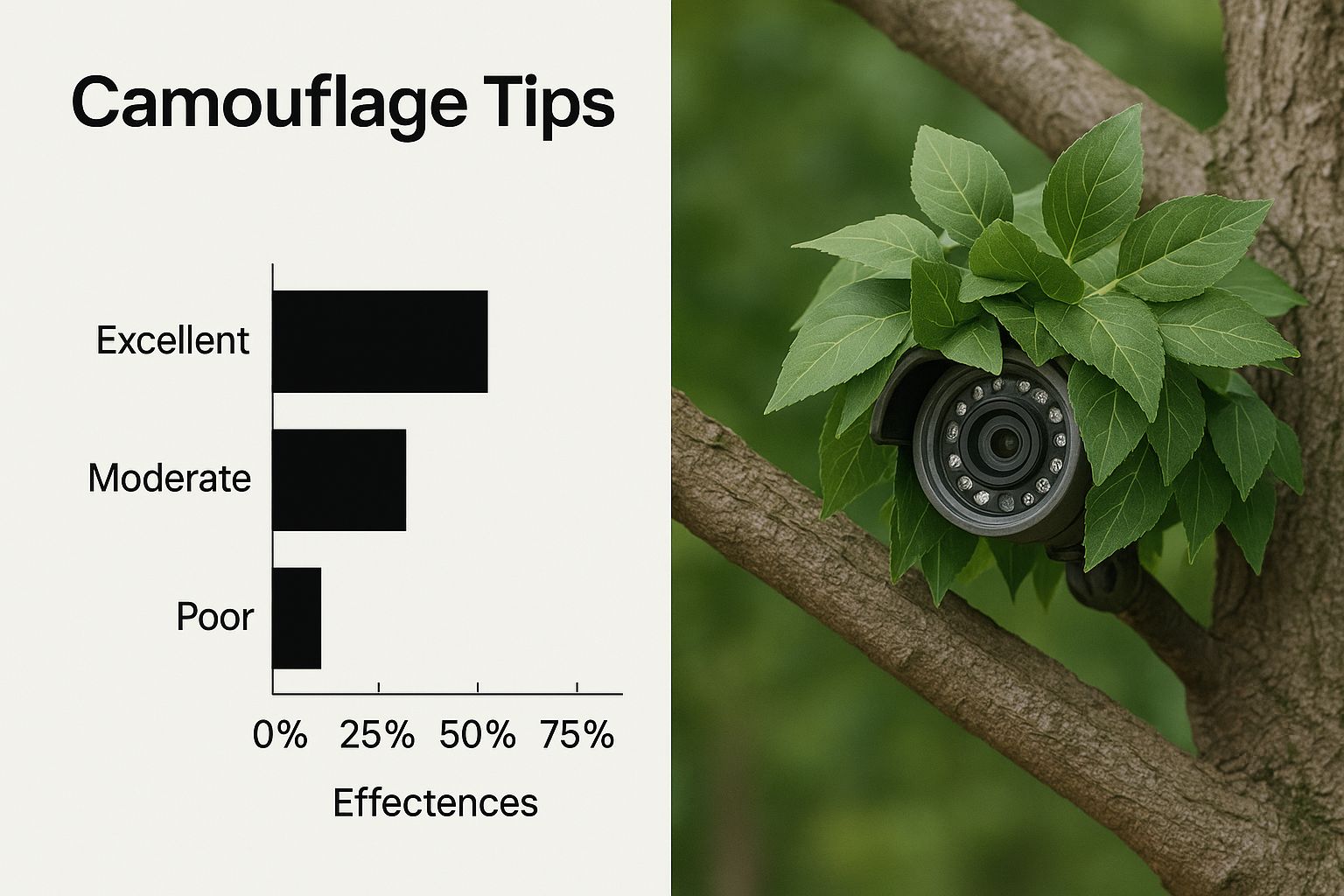
It's amazing what a difference it makes when the camera's color and texture match what's around it.
A Quick Tip from Experience: When you're using plants for cover, think about the seasons. A spot that’s perfectly concealed by a leafy branch in July might be completely exposed by December. Plan for year-round coverage.
Integrating Cameras into Your Home's Architecture
Sometimes the best place to hide a camera is in plain sight, right on your house. The exterior of your home is full of little nooks and crannies that are perfect for concealment. Bonus—these spots often protect the camera from bad weather and provide a great, high-angle view.
Look for places that are high up and naturally cast in shadow. Most people never glance up at the details of a roofline, which makes it prime real estate for a hidden camera.
Check out these common architectural hiding spots:
Tucked into a Birdhouse: This one’s a classic for a reason. A regular birdhouse can be easily modified with a tiny hole for the lens. It's a friendly-looking disguise that flies right under the radar.
Under Soffits or Eaves: The overhang of your roof is an ideal location. It offers great protection from rain and snow, and the shadows help hide the camera. A small dome camera mounted in the corner of a soffit is almost impossible to spot from the ground.
Inside an Old Light Fixture: Got a non-working porch light you haven't gotten around to replacing? Hollow it out! It creates a weatherproof housing that blends in perfectly with the rest of your home’s exterior lights.
To help you decide, let's break down some of the most common outdoor concealment methods.
Comparing Outdoor Camera Concealment Methods
Hiding Method | Effectiveness | Installation Difficulty | Best For |
|---|---|---|---|
In Shrubbery/Bushes | High, but season-dependent | Easy | Monitoring ground-level access points like front doors and windows. |
On a Tree Trunk | Moderate to High | Moderate (requires climbing/ladder) | Getting a wide, elevated view of a driveway, yard, or property line. |
Fake Rock Enclosure | Very High | Easy | Discreetly watching over gardens, walkways, or pool areas from a low angle. |
Inside a Birdhouse | Very High | Easy to Moderate | A friendly, non-intimidating way to monitor a front yard or porch area. |
Under Soffits/Eaves | Very High | Moderate to Hard (requires wiring) | A permanent, weatherproof solution for covering main entry and exit points. |
Ultimately, no matter which outdoor method you go with, the core goals are the same. You need a camera that’s shielded from the weather, has a clear shot of your target zone, and gets a strong Wi-Fi or power connection. The best outdoor setups are a mix of clever thinking and practical planning, giving you a powerful security tool that nobody knows is there.
Securing Your Cameras From Digital Threats
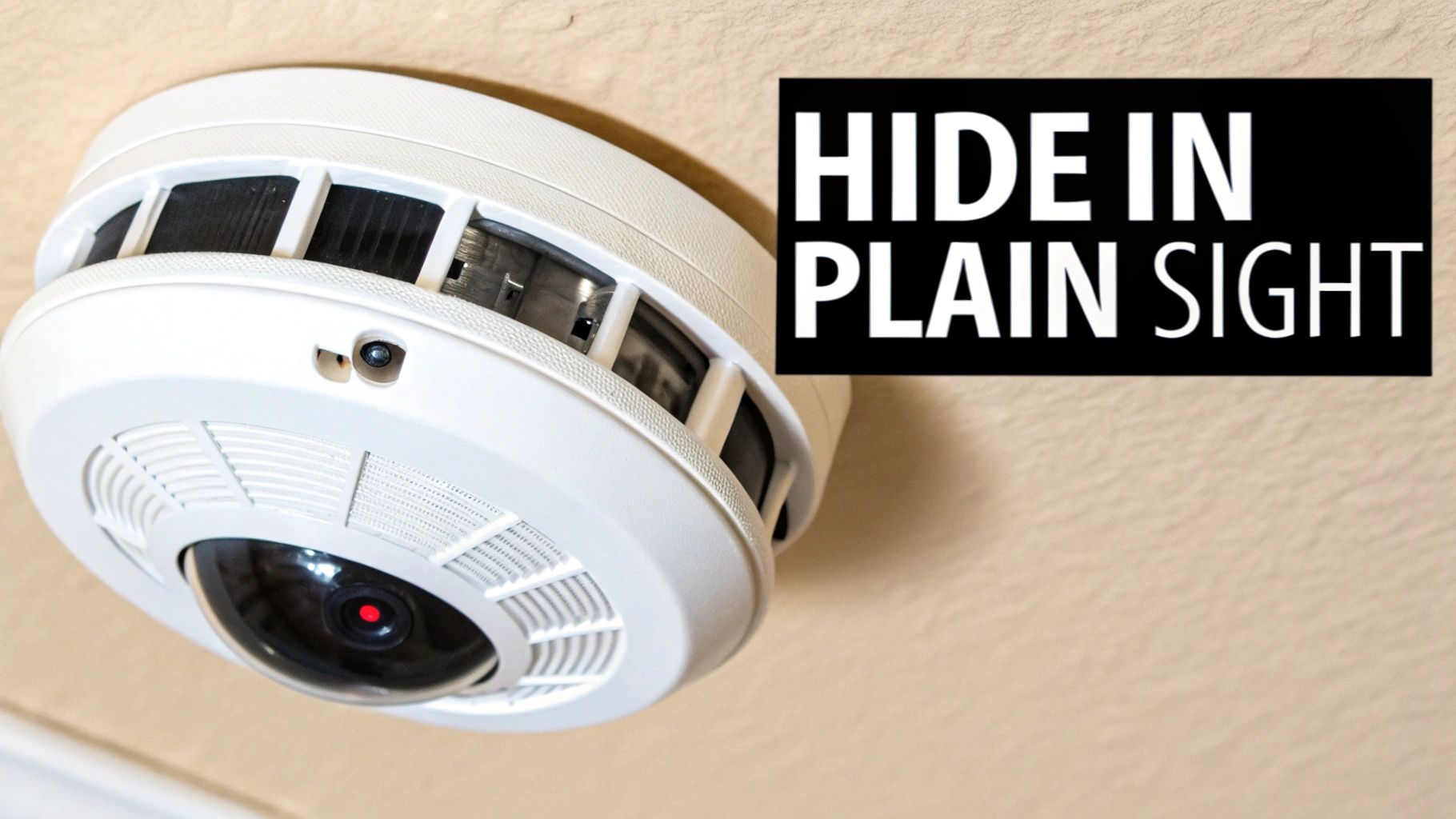
You can have the most cleverly hidden camera in the world, but its physical invisibility is worthless if a hacker can find it online. The digital world opens up a whole different can of worms, potentially turning your discreet surveillance tool into an open window for anyone to peer through.
True concealment means making your cameras invisible to both physical and digital intruders.
The scale of this vulnerability is pretty sobering. Recent reports found that around 40,000 security cameras have been compromised online. The United States alone accounts for about 14,000 of these exposed devices. We're not just talking about public cameras on street corners; these are devices in private living rooms, backyards, and offices. This makes it clear that hiding the camera is just half the battle. You can dive deeper into these findings and see how thousands of security cameras were exposed on bitsight.com.
Building Your Digital Defenses
First things first: change the default login credentials immediately. You'd be amazed how many cameras are set up with factory-default usernames and passwords like "admin" or "12345." Hackers know this, and it's the very first thing they try.
Create a Strong, Unique Password: I'm talking long, complex, and a random mix of upper and lowercase letters, numbers, and symbols. And please, don't reuse a password from another account.
Enable Two-Factor Authentication (2FA): If your camera has this feature, turn it on. Now. This adds a second layer of security, like a code sent to your phone, making it exponentially harder for someone to get in, even if they somehow guess your password.
These two steps alone will stop the vast majority of brute-force attacks in their tracks.
Isolate Your Cameras on the Network
Here’s a pro-level tip that’s surprisingly easy to implement: put your security devices on their own dedicated Wi-Fi network. Most modern routers let you create a "guest network," which is perfect for this.
This strategy is called network segmentation, and it acts like a digital quarantine zone. If a hacker manages to compromise your main network through a less secure device (like a smart TV or an old laptop), they won't even be able to see that your cameras exist. They're on a completely different, isolated network.
Expert Insight: Think of your main Wi-Fi as your home's front door and the camera's network as a locked safe room inside. Even if someone breaks through the front door, they're not getting into the safe room without a totally different key.
Keep Your Firmware Current
Last but not least, don't ignore those firmware update notifications. Manufacturers constantly release patches to fix security holes that researchers and hackers have discovered. Running on outdated firmware is the digital equivalent of leaving a window wide open with a sign that says "Come on in!"
If you can, set your cameras to update automatically. If not, make it a point to manually check for updates once a month. This bit of routine maintenance is one of the most effective ways to keep your cameras digitally secure and truly hidden from prying eyes online.
Keeping Your System Safe from Camera Tampering
So, you’ve meticulously hidden your cameras, and they’re perfectly out of sight. That's a huge win. But what if someone—a determined intruder, for instance—actually finds one? A hidden camera is only as good as its ability to keep recording.
A smart trespasser won’t just wave hello. They might try to cut a wire, hit the lens with spray paint, or just knock it offline. This is where your strategy needs to evolve from simple concealment to building a resilient system. You need a plan for when stealth isn't enough.
The real goal is a setup that screams for help the second someone messes with it. That way, a potential blind spot becomes an instant, actionable alert. Modern security tech is your best friend here, creating a safety net that combines smart software with your clever camera placement.
Smart Alerts for Physical Tampering
The most common ways people try to disable a camera are brutally simple. They might block the view, physically move it, or just try to break it. You can't stop them from trying, but you can make sure you know about it the second it happens.
This is where AI-powered tampering detection comes into play. A lot of high-quality security systems have this built-in, and it’s designed to spot when something is off with the video feed itself.
Blocked View: If a hand or a can of spray paint suddenly covers the lens, the system sees that abrupt, total blackout and immediately triggers an alert.
Moved Camera: The software knows what the camera is supposed to see. If it suddenly gets knocked and is staring at the ceiling, the system flags that as a tampering event.
Blurry Image: Someone trying to be clever might smear mud or grease on the lens. The AI is sharp enough to detect that sudden loss of focus and send an alert.
Think of this intelligent monitoring as your system's silent alarm. Even if a camera is found and taken out, its last act is to send you a critical warning, giving you a real-time heads-up.
Fighting Back Against Digital Tampering
Physical attacks are one thing, but more sophisticated threats can target the video data itself. As surveillance technology has gotten better, so have the methods to defeat it. We're now seeing things like data tampering, where someone alters a timestamp to create a fake alibi, or even pixel tampering, which involves manipulating the video to erase a person or object.
You can discover more insights about these emerging threats on hanwhavisionamerica.com to get a sense of what's possible.
Guarding against these digital attacks means building layers of security. It starts with locking down both physical and digital access so only the right people can even get to the system's backend. From there, encrypting your recorded footage and using secure cloud storage is essential. This makes the data incredibly difficult for anyone to modify without being caught.
When you pair smart physical alerts with strong digital defenses, you create a discreet security system that's incredibly tough to beat.
Answering Your Top Questions About Hidden Cameras
Even the most carefully planned installation can hit a snag. When you're figuring out how to hide a security camera, a few common questions always seem to pop up. Let's walk through them so you can get your setup right the first time.
The first thing people always ask about is the law. Is this even legal? For the most part, yes. You can absolutely install hidden video cameras on your own property, both indoors and out. Where you can get into hot water is with audio recording, which often requires two-party consent. The absolute golden rule? Never, ever place a camera where someone has a reasonable expectation of privacy. Think bathrooms, changing areas, or inside a bedroom.
Will Hiding My Camera Mess With How It Works?
It definitely can if you're not careful. Hiding a camera can sometimes introduce a few technical headaches, but they're easy to avoid once you know what to look for.
A weak Wi-Fi signal is probably the most frequent issue. If you tuck a camera inside a heavy metal object or behind a thick concrete wall, you're essentially putting a barrier between it and your router. The result? A choppy video feed, or worse, no connection at all. Always do a quick signal test in your chosen hiding spot before you permanently install anything.
Night vision is another common problem area. Security cameras rely on infrared (IR) LEDs to see in total darkness. The catch is that this IR light reflects off glass. If you point a camera out a window from inside, all you'll get at night is a glaring, washed-out image of the reflection. The lens and those little IR lights need a completely clear, unobstructed line of sight.
A Pro's Advice: To beat signal problems, keep hidden cameras as close to your Wi-Fi router or an extender as you can. For night vision, make sure nothing is right in front of the lens that could cause that IR glare—especially glass.
How Can I Power a Hidden Camera Without Giving It Away?
A dangling power cord is the fastest way to reveal your camera’s location. The whole point is discretion, so your power source needs to be just as stealthy as the camera.
Battery-Powered Cameras: These are the champs of covert placement. With no wires at all, you can put them virtually anywhere. The trade-off, of course, is that you'll need to access them every so often to swap or recharge the batteries.
Power over Ethernet (PoE): If you can snake a single, thin Ethernet cable to your spot, PoE is a fantastic solution. It sends both power and a rock-solid data connection through one wire, which is far easier to hide than a clunky power adapter and cable.
If you’re looking at a more complete setup for your property, getting a professional security system installation can make all the difference. An expert will know all the tricks for clever placement and wiring. Plus, modern systems are getting smarter. Many now include camera tampering detection, using algorithms to alert you if a camera is blocked, spray-painted, or moved. This ensures your hidden cameras actually stay effective. You can learn more about how tampering detection enhances security on trueye.io.
At PCI Audio-Video Security Solutions, we live and breathe this stuff. We design and install surveillance systems that are both powerful and practically invisible. Whether it’s one camera or a whole integrated network, our team can help you secure your space without ruining its look. Check us out at https://www.pciavss.com to see what we can do.
Comments