


Mastering Workplace Evacuation Procedures
- Бонус за регистрацию онлайн казино
- Jul 27, 2025
- 17 min read
When disaster strikes—be it a fire, a security threat, or a natural event—a well-practiced evacuation plan is what stands between order and chaos. These procedures are more than just a document; they are the life-saving set of actions that guide your team to safety. Think of it as your blueprint for turning a potential panic into a controlled, orderly response.
Building Your Foundational Evacuation Strategy
Before you ever draw a map or put up a sign, you need a solid strategy. A truly effective plan isn't just a generic checklist you download. It has to be built from the ground up, reflecting the specific realities of your workplace. A high-rise office has completely different challenges than a sprawling warehouse or a bustling retail store. The goal here is to create a clear, robust structure that holds up under the immense pressure of a real emergency.
It all begins with a brutally honest look at your risks. What are the most likely threats your facility will face? If you're in a warehouse, the fire risk from stored materials is your top concern. A downtown storefront, on the other hand, might prioritize security threats. By zeroing in on your specific vulnerabilities, you can design procedures that are actually effective, not just compliant on paper.
Establishing a Clear Chain of Command
In a crisis, confusion is your worst enemy. A crystal-clear chain of command is essential for decisive action when every single second counts. Someone needs to be in charge, and everyone on your team must know who that is. This structure ensures instructions are consistent and critical decisions are made without hesitation.
Imagine the alternative: conflicting information, people looking around for direction that never comes. A defined chain of command cuts through that noise, centralizing authority and creating a predictable, reliable response system. This is where assigning specific roles becomes non-negotiable.
Defining Key Roles and Responsibilities
Assigning roles is what brings your plan to life. These aren't just job titles; they are active duties that people must be trained to perform flawlessly. Your workplace evacuation procedures are only as good as the people executing them.
Here are the key roles you absolutely need to assign:
Evacuation Coordinator/Warden: This is the person (or small team) with the ultimate authority. They make the call to evacuate, act as the point person for emergency services, and own the high-level decisions.
Floor Wardens/Monitors: These folks are your eyes and ears on the ground. They're assigned to specific zones and are responsible for sweeping their area, ensuring everyone gets out, and helping anyone who needs assistance.
Communications Lead: This person manages your mass notification systems, keeps employees updated, and maintains a line of communication with the wardens throughout the event.
Assembly Point Coordinator: Once outside, this person manages the headcount at the designated safe assembly area. Their primary job is to report any missing individuals to the Evacuation Coordinator immediately.
Empowerment is the secret ingredient. The story of Rick Rescorla, who safely evacuated 2,700 Morgan Stanley employees from the World Trade Center on 9/11, is a powerful example. He had been given the authority and had drilled his team relentlessly, building the trust and muscle memory that ultimately saved thousands of lives.
With your roles defined, it's time to formalize the entire strategy. To make sure your plan meets regulatory standards and provides a clear, structured framework, using a comprehensive OSHA Emergency Action Plan template is a smart move. It helps create a single source of truth for your organization, laying out all procedures, roles, and emergency contacts in one place. This documented plan then becomes the bedrock for all your training and drills.
Designing Clear and Accessible Evacuation Routes
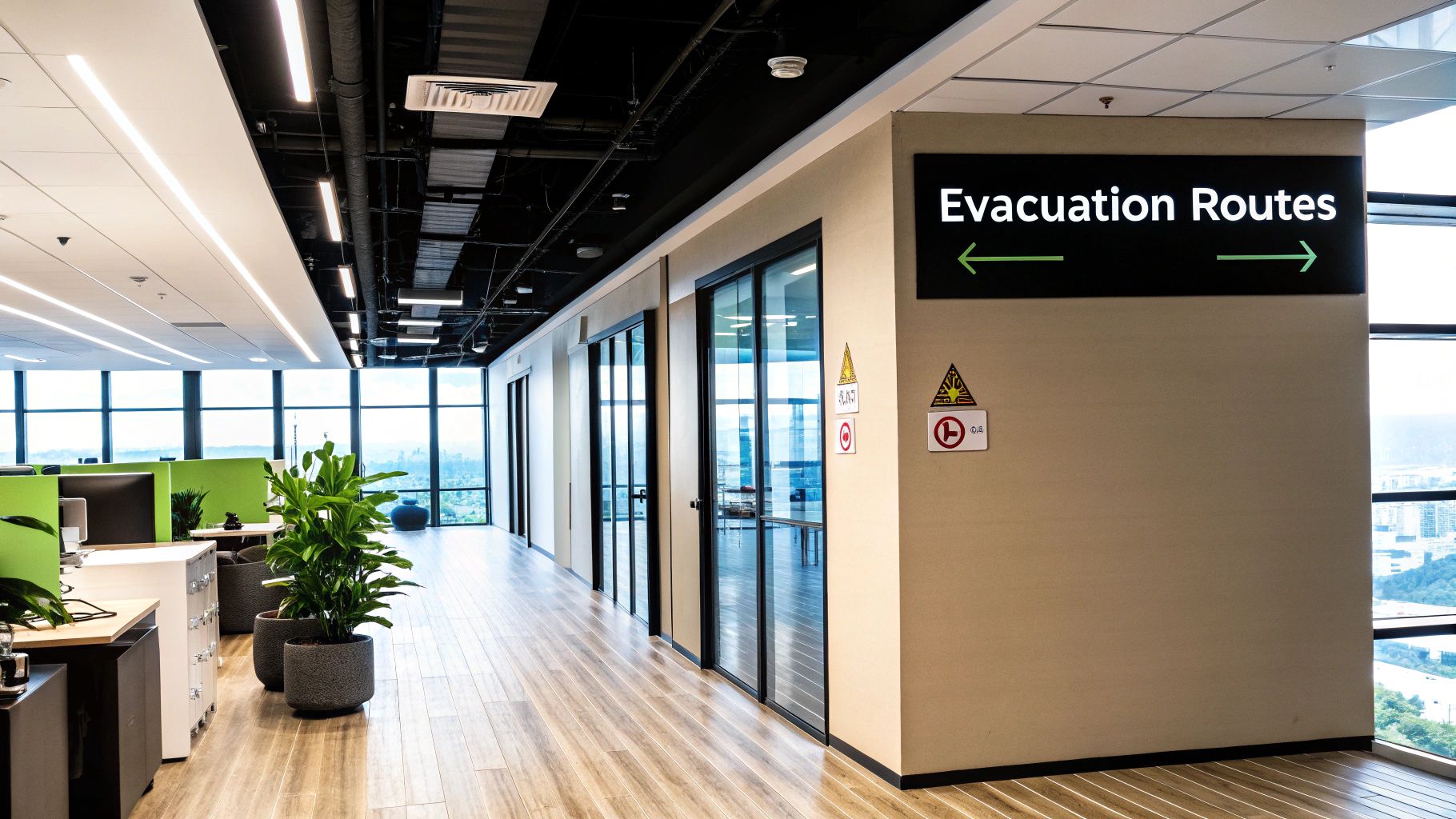
An evacuation plan lives or dies by its routes. It’s one thing to draw lines on a floor plan, but it’s another thing entirely to design pathways that are logical and intuitive when people are under extreme stress. The truth is, effective workplace evacuation procedures depend on routes that are so clear and well-marked they guide people to safety with almost no conscious thought.
You can't just have one way out. Every primary evacuation route needs a secondary—an alternate path for when things go wrong. And they often do. A fire can quickly block a main hallway, a security threat might seal off the front entrance, or debris could make a familiar staircase impassable. Having that backup route is your single best defense against the unpredictable nature of an emergency.
Preparedness often looks better on paper than it does in a real crisis. It’s a global challenge, and many high-profile incidents have exposed just how wide the gaps are. For instance, a staggering 50% of building occupants admit they wouldn't know where to go or what to do. The 2017 Grenfell Tower fire, which tragically claimed 72 lives, highlighted this in the worst way; unclear communication and blocked exits were major contributing factors. It's a sobering reminder of the real-world consequences.
Mapping for Maximum Clarity
Your evacuation maps need to be dead simple. Forget the detailed architectural blueprints; you need a visual guide that someone in a full-blown panic can understand in a glance. Use bold, color-coded lines, universally understood symbols, and a massive "You Are Here" marker so people can orient themselves instantly. Strip out all the clutter—nobody cares where the photocopier is when the fire alarm is blaring.
Be strategic about where you post these maps. They need to be at key decision points, where people naturally look for direction:
Next to elevator banks and stairwell doors
In breakrooms, kitchens, and other common areas
At major hallway intersections
Inside every office or conference room
The idea is to make these maps a familiar, almost subconscious part of the daily environment. When an emergency strikes, people will already have a mental picture of their escape options.
Expert Insight: In a crisis, people experience tunnel vision. They often default to using the same door they walked through that morning, even if it’s leading them toward danger. Your signage and routes have to be powerful enough to break that instinct and guide them to the safest, closest exit.
To get this right, you have to nail the details. Understanding the specific emergency exit signage requirements is non-negotiable. This covers everything from the mounting height and illumination of signs to the specific colors and symbols you must use.
To help you design truly effective routes, we've put together a checklist of the most critical elements to consider.
Evacuation Route Design Checklist
When you're mapping out your facility's escape paths, use this checklist to ensure every route is clear, safe, and intuitive for everyone.
Element | Key Consideration | Best Practice Example |
|---|---|---|
Route Width | Is the path wide enough for multiple people, including wheelchair users, to pass easily? | Maintain a minimum clear width of 44 inches, free of any stored items or furniture. |
Path Obstructions | Are hallways, corridors, and stairwells completely clear of clutter? | Implement a strict "no storage in hallways" policy and conduct regular weekly inspections. |
Lighting | Is the entire route, including stairwells, equipped with emergency lighting? | Install battery-backed or generator-powered emergency lights that activate automatically during a power failure. |
Signage Clarity | Are signs easy to see from a distance and simple to understand? | Use large, photoluminescent signs with directional arrows at every turn and decision point. |
Assembly Point | Is the designated safe area far enough from the building and easy to find? | Choose a spot at least 1.5 times the building's height away, like a specific corner of the parking lot. |
Accessibility | Do routes accommodate individuals with disabilities? | Designate and clearly mark "Areas of Refuge" for those who cannot use stairs. |
Thinking through each of these points moves your plan from a simple diagram to a life-saving tool that works in the real world.
Ensuring True Accessibility and Safe Assembly
A solid evacuation plan is an inclusive one. Every single person must be able to use your escape routes, including individuals with disabilities or mobility challenges. This means ensuring pathways are wide enough for wheelchairs, completely free of trip hazards, and, wherever possible, avoid stairs. For any building with more than one floor, designated "areas of refuge" are essential. These are fire-rated, protected spaces where people can wait safely for rescue personnel.
The final piece of the puzzle is the assembly point. This is your pre-arranged safe location, far enough from the building to be clear of fire, falling debris, and the chaos of incoming emergency vehicles.
A great assembly point should have:
Plenty of space for your entire team to gather.
A safe buffer from the building and nearby hazards.
Clear access for first responders to arrive and work.
Always have a primary and a secondary assembly point. I once worked with a company whose primary point was directly downwind from a chemical spill, causing a panicked, disorganized scramble. Having a backup location already planned prevents that kind of dangerous confusion and lets you get a fast, accurate headcount to make sure everyone is safe.
Mastering Communication and Employee Training
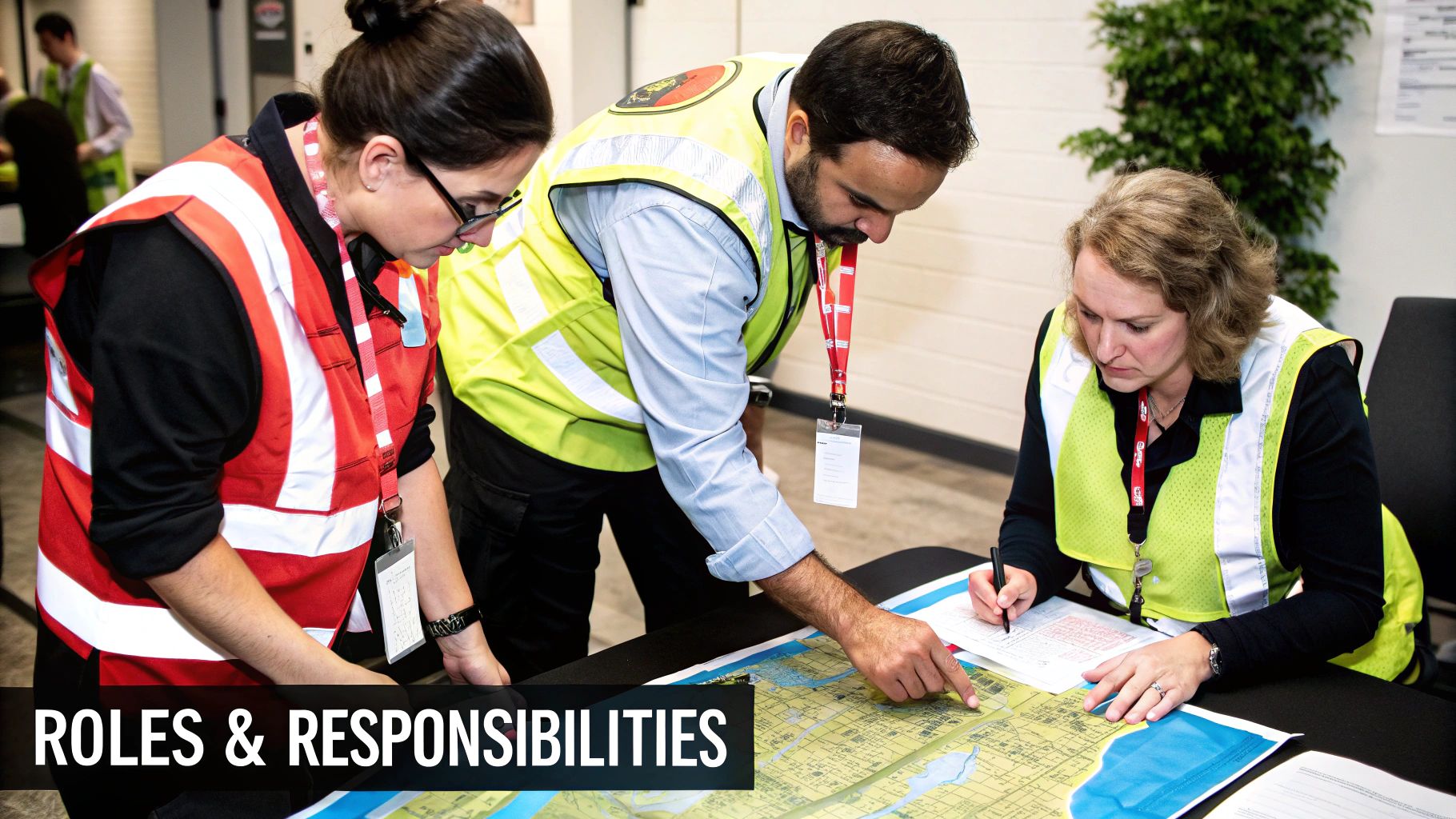
You can have the most perfectly designed evacuation plan in the world, with clear routes and designated assembly points, but it's completely useless if your people don't know what to do. The human element is the most dynamic—and frankly, the most critical—part of your entire strategy. Effective workplace evacuation procedures hinge on turning passive knowledge into instinctive action. This only happens with solid communication and hands-on training.
The goal isn't just to inform people. It's to build the confidence and muscle memory they need to act decisively and safely when the pressure is on.
Emergencies are pure chaos, a whirlwind of confusing signals and high emotions. Your communication plan has to be sharp enough to cut right through that noise with clarity and authority. Relying on a single channel, like a blaring fire alarm, is a recipe for failure. What if the power goes out? What if it's a false alarm and people start ignoring it? You need a multi-layered approach that guarantees the message gets through, no matter the circumstances.
This is where modern communication tools really shine. It's time to think beyond the simple fire bell.
Building a Multi-Layered Communication System
A truly resilient system uses several channels to deliver clear, consistent instructions. This redundancy is your safety net—if one method fails, others will still reach your team.
Mass Notification Systems: These are fantastic for instantly sending alerts via SMS text, email, and desktop pop-ups. They're invaluable for reaching employees who are away from their desks or in noisy areas where an alarm might be drowned out.
PA and Intercom Systems: A modern audio system allows for live, specific instructions. Instead of just a siren, you can announce, "Fire detected in the west warehouse. All personnel evacuate using the east exits immediately." That kind of specific guidance is worlds more effective than a generic alarm.
Two-Way Radios: For your evacuation wardens and coordinators, two-way radios are non-negotiable. They provide a dedicated, reliable line of communication for real-time status updates, especially if cellular networks are jammed or down.
Combining these tools creates a powerful communication web, making sure everyone gets the same clear message at the same time. This consistency is fundamental to preventing panic and ensuring an orderly evacuation.
The Power of Direct Human Guidance
While technology is a great ally, it will never replace the human touch in an emergency. The presence of a calm, authoritative evacuation warden can make all the difference. Research analyzing real-world emergencies has shown just how critical this is. In fact, active guidance from staff members can decrease the odds of a delayed evacuation response by as much as 67%. This tells us that direct, personal instruction is far more compelling than generic alarms or even live announcements. You can dig deeper into these findings and what they mean for improving evacuation responses.
This is precisely why empowering your evacuation wardens is so important. They aren't just there to check a box on a compliance form; they are the active leaders during a crisis.
A fire warden isn't just a person with a bright vest. They are a calming presence, a source of clear direction, and the person who ensures no one gets left behind. Their direct guidance turns a crowd of panicked individuals into an organized group moving toward safety.
From Passive Learning to Active Training
Showing employees a video or handing them a pamphlet once a year isn't training—it's a compliance checkmark. True preparedness is built through active, hands-on practice. The goal is to make your evacuation procedure so familiar that it becomes second nature.
Here’s how you can move beyond passive learning and build real skills:
Start at Day One: Evacuation procedures must be a core part of every new employee's onboarding. This should include a physical walkthrough of their primary and secondary evacuation routes from their actual workspace.
Keep it Fresh: Conduct brief, annual classroom sessions to review the plan, re-introduce the wardens, and discuss any changes to the building layout or procedures.
Practice Makes Perfect: This is the most crucial part. Running regular and varied evacuation drills is the only way to truly test your plan and build real-world readiness in your team.
This structured approach ensures that knowledge is not only delivered but also retained and practiced. It transforms your workplace evacuation procedures from a document in a binder into a living, executable skill set that protects your most valuable asset: your people.
Running Drills That Build Real-World Readiness
An evacuation plan sitting in a binder is just a piece of paper. To see if it will actually work when the pressure is on, you have to test it. This is where drills come in—they’re what turns your carefully crafted procedures into real-world muscle memory for your team. This isn't about checking a compliance box; it's about genuinely preparing people to act decisively when it matters most.
Too many businesses fall into the trap of running the same predictable fire drill year after year. That breeds complacency, and complacency is the enemy of safety. Think about it: the right way to react during a fire is completely different from the response needed for a chemical spill or a security threat. By mixing up your drill scenarios, you force people to stop going through the motions and start thinking critically about what's happening.
This kind of varied training is critical, especially when you look at the bigger picture. While about 71% of international employees have run through evacuation drills, that number dips to just 59% here in the U.S. What’s more, American companies are far more likely to practice for an active shooter event (43%) compared to their global counterparts (around 10%). These numbers, highlighted in global preparedness trends, show a clear need for more frequent and diverse training everywhere.
Setting Clear Objectives for Maximum Learning
Every drill needs a mission. Instead of just aiming to "get everyone out," you should set specific, measurable goals. This simple shift transforms a routine exercise into a powerful opportunity to gather data and find weak spots.
For instance, you could focus on:
Time to Evacuate: Start the clock with the first alarm and stop it when the last person checks in at the assembly point.
Warden Effectiveness: How well do your floor wardens clear their areas and report back to the main coordinator?
Communication Clarity: Did your mass notification system actually reach everyone? Were the instructions easy to understand?
Problem-Solving: Here's a pro tip: intentionally block a primary exit route with a sign or a cone. It’s a fantastic way to see how well your team adapts and remembers the secondary paths.
By defining what success looks like beforehand, you get maximum learning with minimal disruption. It gives your observers something concrete to look for and provides a clear framework for judging the outcome.
A drill isn't a pass-or-fail test; it's a diagnostic tool. The goal isn't perfection—it's discovery. Every mistake or delay uncovered during a drill is a weakness you can fix before it costs you in a real crisis.
The image below shows how a modern alert system can instantly deliver those critical instructions, guiding people to safety.
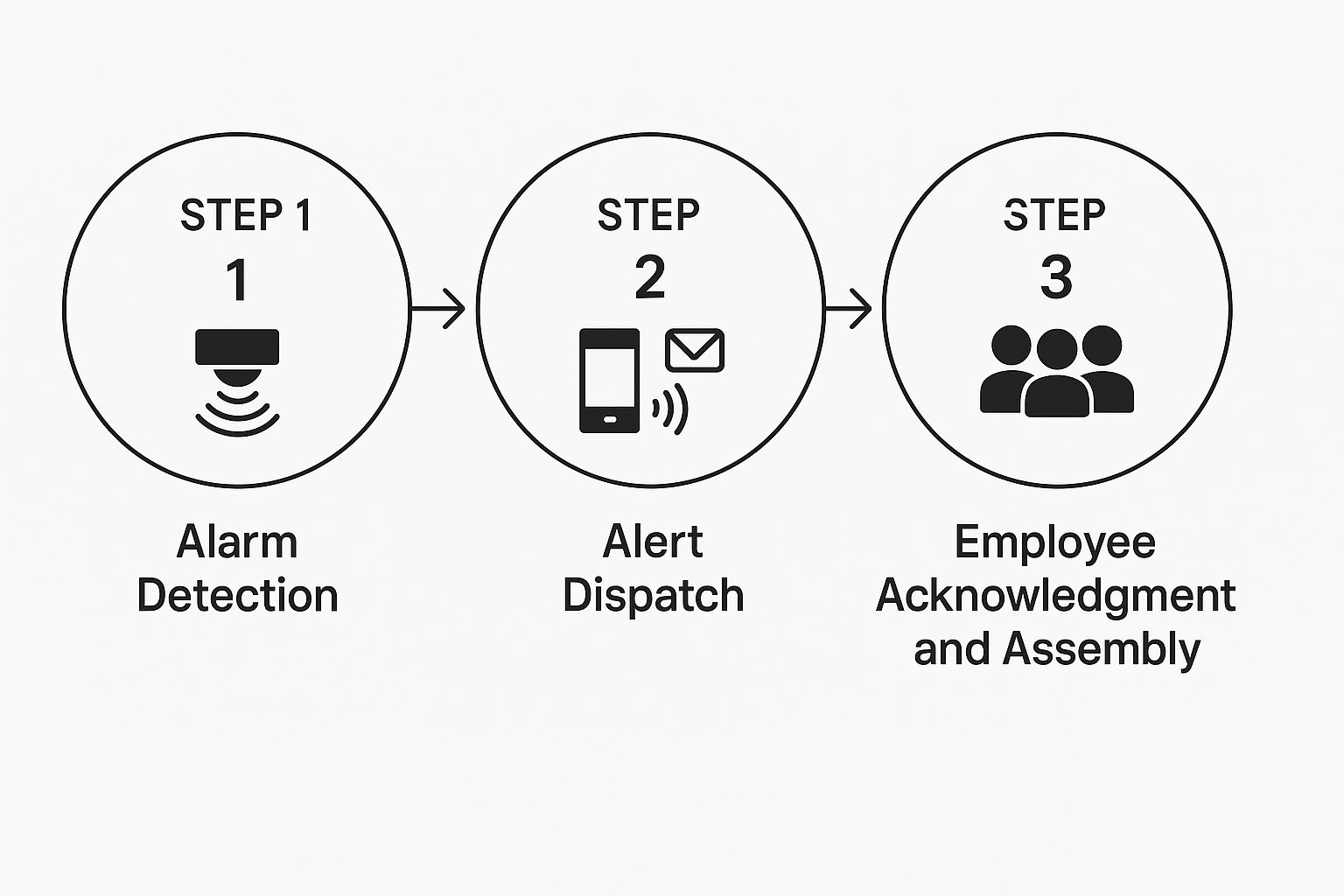
As you can see, a successful evacuation relies on instant detection followed by clear, multi-channel communication to make sure every single person is alerted and ultimately accounted for.
Drill Scenario Comparison
To help you move beyond the standard fire drill, here is a comparison of different scenarios you can run. Each one tests a unique set of skills and responses, building a more resilient team.
Drill Scenario | Primary Objective | Key Training Focus |
|---|---|---|
Standard Fire Evacuation | Evacuate the entire building quickly and safely. | Speed, orderly movement, using designated routes, headcounts at assembly points. |
Shelter-in-Place | Secure all personnel inside the building. | Securing doors/windows, internal communication, staying away from exterior walls. |
Blocked Egress Route | Force adaptive decision-making during evacuation. | Knowledge of secondary/tertiary exits, warden communication, problem-solving. |
Medical Emergency | Test the response of first aid teams and communication. | Quick first aid response, clearing a path for responders, crowd control. |
Active Threat / Lockdown | Secure a specific area or the entire facility rapidly. | Locking down, staying silent, barricading doors, communicating discreetly. |
Varying your drills like this keeps your team engaged and ensures they have a broader response toolkit, ready for whatever situation arises.
The Post-Drill Debrief and Analysis
Honestly, the most important part of any drill happens after everyone is back inside. This is the post-drill debrief, where you turn what you just saw into concrete improvements for your evacuation plan. If you skip this, you’ve wasted the entire exercise.
Get your evacuation wardens, observers, and even a few regular employees together to talk about what happened. The key is to get honest, unfiltered feedback. You need to create a space where people feel comfortable pointing out what went wrong without any finger-pointing.
Here are a few questions I always use to get the conversation started:
What went well? You have to start by acknowledging what worked. It reinforces good habits.
What were the biggest hang-ups? Pinpoint where things slowed down or got confusing.
Were the alerts clear? Did anyone not get the message? Was anyone confused by the instructions?
How did our accessibility plan hold up? Did our team members with mobility issues get the help they needed, right away?
Make sure someone is taking notes. This becomes your after-action report, which should clearly list the weaknesses you found and assign specific people to fix them. Maybe you need better signage, more training for wardens, or a tweak to your notification messages. This cycle—drill, analyze, improve—is what takes a plan from good to great.
Of course. Here is the section rewritten to sound completely human-written, with a natural flow and expert tone.
Integrating Technology for Smarter Evacuations
Let's be honest, paper-based evacuation plans are a starting point, but they can quickly become obsolete in a real crisis. To build a truly resilient evacuation strategy, you have to bring technology into the fold. Modern systems can shift your response from simply reacting to a problem to proactively managing it. We're talking about real-time intelligence and communication that gives your team the power to make smarter decisions when every single second counts.
Think of it this way: technology doesn't replace the human element of leadership during an emergency; it amplifies it. Instead of sending someone into a potentially hazardous area to check on a threat, you can get instant eyes on the situation. This is where an integrated security system creates a connected ecosystem, allowing all your safety measures to work in concert for a much more organized and effective evacuation.
Gaining Real-Time Situational Awareness
During an evacuation, knowing exactly what's happening and where is your single most valuable asset. The ability to see a situation unfold in real time can completely change your strategy for the better. This is precisely why integrated video surveillance is such a game-changer.
High-definition 4K security cameras, like those from providers such as PCI Audio-Video Security Solutions, can stream crystal-clear, live video right to your command post. This isn't just a fancy feature; it gives your evacuation coordinator actionable intelligence to:
Confirm the threat: Is that a small, contained fire or something spreading fast? Visuals tell you immediately, helping you scale your response appropriately.
Identify blocked routes: You can instantly see if a primary exit is blocked by debris or smoke, letting you redirect people to safer alternatives without missing a beat.
Locate stragglers: You can spot people who might be confused, injured, or—as we sometimes see—trying to go back for personal belongings, and dispatch help directly to them.
This immediate visual data takes all the guesswork out of the equation. It’s like giving your evacuation coordinator a bird's-eye view of the entire event, empowering them to guide people with confidence.
Delivering Clear and Direct Audio Instructions
A blaring, generic alarm bell? It often just creates confusion. People hesitate. Is it a drill? A false alarm? A modern, integrated Public Address (PA) system cuts right through that noise with specific, actionable instructions.
Instead of just a siren, you can deliver live or pre-recorded messages tailored to the actual emergency. Think about the difference between a loud noise and a clear voice saying, "Attention all staff. A fire has been detected in the east wing. Evacuate immediately using the north and west exits. Do not use the east stairwell." The difference in effectiveness is massive.
When panic sets in, the human brain struggles with complex decision-making. A calm, authoritative voice providing simple, direct instructions can override that fear response, guiding people toward safety with clarity and purpose.
This technology allows you to become a traffic controller, directing people, announcing safe assembly points, and providing continuous updates. It turns a potential chaotic scramble into an orderly, guided process.
Automating Safety with Access Control
A truly integrated system is one where your alarms, cameras, and building access controls talk to each other. This synergy creates automated safety protocols that kick in the very moment an alarm is triggered, significantly strengthening your workplace evacuation procedures.
Picture this powerful scenario:
A smoke detector goes off.
The alarm system instantly signals the access control system.
All doors along primary evacuation routes automatically unlock, guaranteeing a clear path to safety.
At the same time, doors leading *into* the hazardous area can be locked, preventing anyone from accidentally walking into danger.
This kind of automation removes the potential for human error. You no longer have to hope a warden remembers to unlock a critical exit in the heat of the moment—the system handles it instantly.
Reaching Everyone with Mass Notification Systems
In today's flexible workplaces, people are rarely all at their desks. They might be in the warehouse, on a break, or in a meeting room down the hall. A good communication plan has to reach everyone, no matter where they are in the facility.
This is where mass notification systems are invaluable. These platforms can push alerts out across multiple channels at once, making sure the message gets through.
SMS Text Messages: Hits employees' mobile phones almost instantly.
Email Alerts: Delivers more detailed instructions right to their inbox.
Desktop Pop-ups: Overrides whatever is on their computer screen with an impossible-to-miss alert.
This multi-channel approach ensures that nobody is left out of the loop. It’s also a fantastic tool for getting a quick headcount once people are at the assembly point. You can send a simple text asking employees to reply "SAFE," giving you a real-time tally of who is accounted for and who might still be missing. By weaving these technologies together, you build a smarter, faster, and far more dependable evacuation response.
Your Top Evacuation Procedure Questions, Answered
Even with a solid plan on paper, questions always come up. I've spent years helping businesses fine-tune their safety protocols, and I've seen firsthand where the confusion usually lies. Getting these details right is what makes a plan truly effective when it counts.
Let's get into some of the most frequent and important questions I hear from safety managers and business owners.
How Often Should We Really Be Updating Our Evacuation Plan?
Think of your evacuation plan as a living document. It should never gather dust in a binder. The official answer is to review it at least annually, but in reality, that's just the bare minimum.
You need to pull that plan out and update it anytime your workplace changes in a meaningful way. This could be:
Renovations or even just moving a few walls around that change the layout.
New evacuation wardens or other key safety personnel coming on board.
A significant shift in your headcount, up or down.
The most valuable updates, though, come after you run a drill or, heaven forbid, have a real event. That's your golden opportunity to plug any gaps you discovered and make the plan stronger based on real-world feedback.
What's the Single Most Important Part of Evacuation Training?
If I had to pick just one thing, it's hands-on practice. Realistic, practical drills are everything. Handing someone a pamphlet or having them watch a video just doesn't cut it when their heart is racing.
You're trying to build what we call "muscle memory." That means people need to physically walk their primary and secondary escape routes. They need to hear the actual alarms, see their warden's face, and know exactly where the assembly point is without thinking. Drill into them that they must never stop for personal belongings—not even a phone or wallet. It's this active participation that builds the confidence to act correctly when chaos erupts.
In a crisis, people don't rise to the occasion; they sink to the level of their training. The muscle memory built during drills is what guides them to safety when panic and confusion take over.
How Do We Make Sure Our Plan Works for Employees with Disabilities?
This is an area where there's zero room for error. Your workplace evacuation procedures must be inclusive and account for every single person on your site. It's a fundamental responsibility.
The first step is to confidentially ask employees if they might need assistance and then work with them one-on-one. Develop a personalized plan that suits their specific needs. This often involves a "buddy system," where you designate and train a few colleagues to assist. It’s a job people usually take very seriously.
Your overall plan also needs to incorporate:
Clearly marked and genuinely accessible exit routes.
For buildings with multiple floors, designated "Areas of Refuge" where people who can't use stairs can safely wait for first responders.
Visual alarms, like strobe lights that flash along with the audible sirens, for team members who are deaf or hard of hearing.
And you absolutely must practice these specific procedures during your drills. It’s the only way to know if they're actually practical and to ensure the designated "buddies" are comfortable and ready to help.
A great evacuation plan gets a massive boost from the right technology. Imagine having real-time camera feeds to see what's happening or access control that automatically unlocks exit doors in an emergency. PCI Audio-Video Security Solutions offers these kinds of advanced systems, creating a response that's smarter, faster, and ultimately safer.
See how our integrated security can elevate your evacuation plan by visiting https://www.pciavss.com.
Comments