


Pro Security Camera Installation Services Near Me
- Бонус за регистрацию онлайн казино
- Sep 7, 2025
- 14 min read
When you find yourself searching for "security camera installation services near me," you're signaling that you need more than just a handyman. You're looking for a security expert. Getting a professional installation is what separates a shaky DIY attempt from a rock-solid security solution—it's all about optimal camera placement, secure wiring, and proper system integration.
Why Pro Installation Makes All the Difference
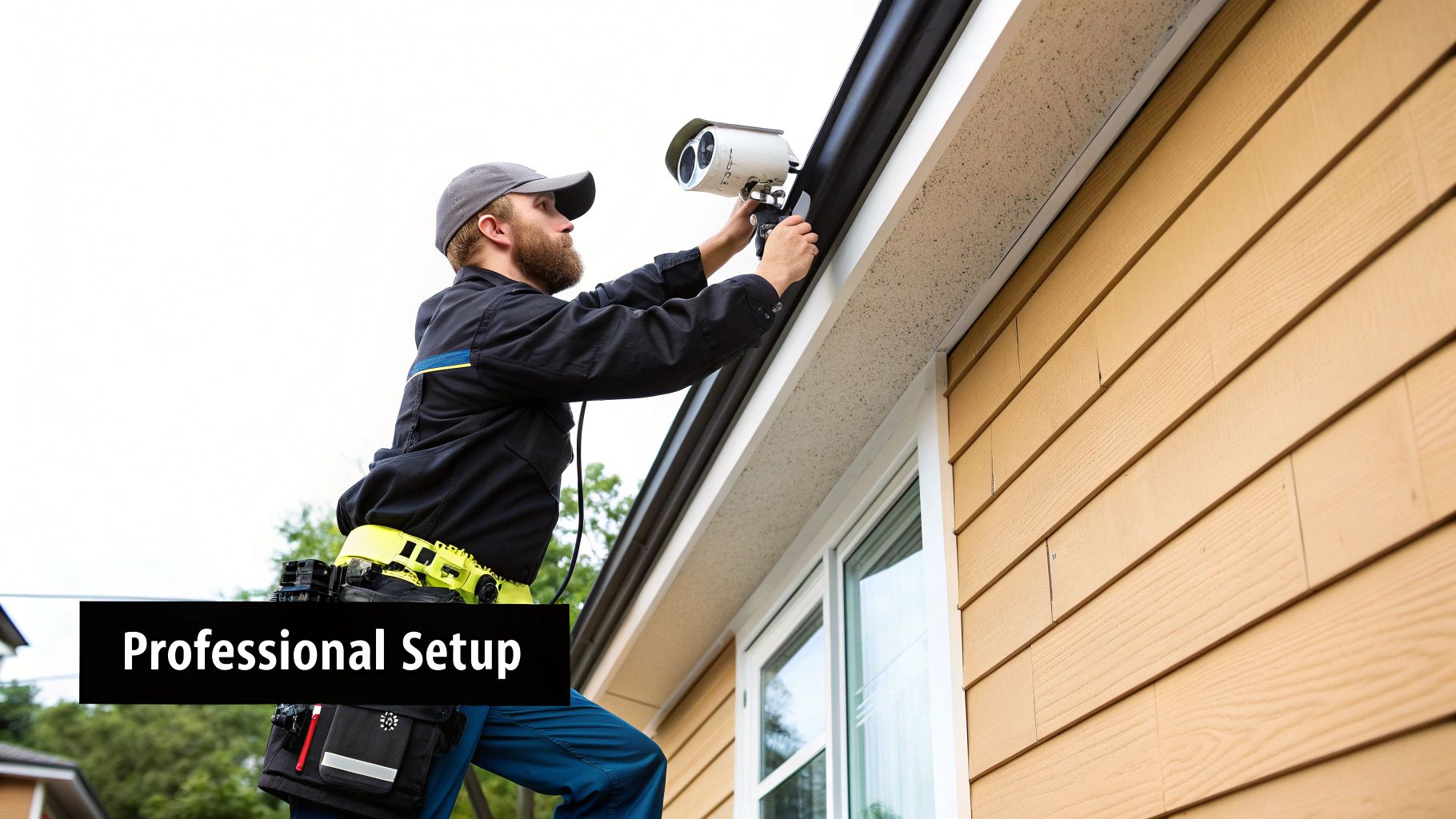
Choosing a professional installer over a weekend DIY project is a strategic move. It directly impacts just how effective and reliable your security system will actually be. While those off-the-shelf cameras look easy enough, they almost never account for the unique vulnerabilities of your specific property.
A certified installer brings a trained eye to your home or business. They spot the blind spots you'd likely miss and know exactly which type of camera works best for each location. This isn't just about getting wide coverage; it's about creating overlapping fields of view and using the right lens to capture clear, usable footage where it counts.
The Technical Advantage of a Professional
Placement is one thing, but the technical execution is where a pro really earns their keep. They know the ins and outs of running low-voltage wiring so it's both hidden and secure, protecting it from weather damage and anyone trying to tamper with it. A sloppy amateur job often leaves exposed cables—basically an open invitation for a criminal to disable your entire system.
A pro also makes sure your system is properly connected to your network. This is a critical step that includes:
Configuring the DVR or NVR for the best recording quality and storage.
Securing your network so no one can hack into your cameras.
Setting up dependable remote viewing on your phone and other devices.
A professional installation isn't just another expense. Think of it as an investment in long-term reliability and the peace of mind that comes from knowing your system will actually work when you need it most.
Market Growth and Smarter Security
The demand for real security is growing fast. The global security camera market was valued at USD 3.76 billion back in 2025 and is expected to climb to USD 7.45 billion by 2032. This boom is fueled by huge leaps in technology like smart motion detection, cloud storage, and instant mobile alerts. It just goes to show how essential effective surveillance has become for everyone. You can discover more insights about the security camera market and its future.
At the end of the day, hiring local security camera installers turns a box of equipment into a complete security shield. It's the difference between simply recording a break-in and actively preventing one from happening in the first place. A professional ensures your system isn’t just installed, but properly implemented for maximum protection.
Figure Out What You Need Before You Call a Pro
Before you even think about Googling "security camera installers near me," take a little time to map out what you're actually trying to accomplish. Trust me on this one. Walking into a consultation without a plan is like going to a custom car builder and just saying, "Make me a fast car." You'll get plenty of opinions, but you probably won't get the right solution for you.
A bit of prep work now makes the conversation with an expert infinitely more productive. It also means the quotes you get back will actually reflect your needs, not just a generic package they sell to everyone.
First thing's first: walk your property. Put on your "bad guy" hat and take a lap, inside and out. Where are the weak spots? It’s not just the front door. Look for that side gate that’s always hidden from the street, the basement window tucked behind a bush, or that poorly lit corner of the yard. Your main goal here will dictate every other decision you make.
What’s the End Goal?
So, what are you really trying to do? Are you trying to stop porch pirates from swiping your packages? Do you want to keep an eye on the kids playing out back? Or do you need crystal-clear footage that can identify a face and a license plate for the police?
Each of those goals requires a totally different approach. For example, just scaring off a casual thief might only require a few obvious, visible cameras. But if you need evidence for a potential prosecution, you're going to need high-resolution cameras placed in very specific spots to capture those critical details. That's a completely different ballgame.
Jot down your top 3 security priorities. This little list is your North Star. It'll keep you and the installer focused on what actually matters for your home or business.
Having a clear goal is the best way to avoid overspending on fancy features you'll never use. Even worse, it prevents you from cheaping out and ending up with a system that can't do the one thing you bought it for.
Pinpoint Your Must-Have Camera Views
Once your goals are set, it's time to identify the non-negotiable spots that absolutely must be on camera. These are your critical coverage zones.
Doors, Doors, Doors: Every single entry and exit point. Front door, back door, garage door—all of them.
The Good Stuff: Where do you keep valuables? Think home offices, safes, a retail stockroom, or a garage full of expensive tools.
Natural Pathways: Driveways, front walks, and staircases are "choke points" where everyone has to pass. These are golden opportunities for a clear shot.
Hidden Corners: Don't forget about that detached shed, the dark side of the house, or a parking area that gives people too many places to hide.
Thinking through these areas also helps you zero in on specific camera features. For instance, that pitch-black driveway absolutely requires one of the modern cameras with advanced night vision capabilities to be effective after sunset.
This handy table can help you connect your goals to the camera specs that will actually deliver.
Matching Camera Features to Your Security Goals
Security Goal | Essential Camera Feature | Why It Matters |
|---|---|---|
Deterring Intruders | Visible Design (e.g., Bullet Camera), Status LED | A camera that is easily seen is a powerful psychological deterrent. It tells potential thieves to move on to an easier target. |
Identifying Faces/License Plates | 4K (8MP) Resolution or Higher | You need high resolution to zoom in on recorded footage and capture fine details without the image turning into a blurry mess. |
Monitoring in Darkness | Advanced Infrared (IR) or Color Night Vision | Standard night vision can be grainy. Modern color or high-performance IR provides much clearer images when you need them most. |
Covering Wide Areas | Wide-Angle Lens (110° or more) | A single wide-angle camera can cover an entire yard or parking lot, reducing the total number of cameras you need. |
Two-Way Communication | Built-in Speaker and Microphone | This lets you talk to a delivery person, greet a visitor, or verbally warn off a trespasser directly through your phone. |
Knowing the difference between basic camera types helps, too. A bullet camera is obvious and screams "you're being recorded," which is great for deterrence. A dome camera is tougher to tamper with and more discreet. Then you have turret cameras, which are often my go-to recommendation because they offer great night vision and are easier to install and aim than a traditional dome.
Coming to the table with this level of understanding shows an installer you're serious and helps you work together to pick the perfect tool for each spot. The result is a system that's smarter, more effective, and built for your specific property.
How to Find and Vet Trustworthy Local Installers
Alright, you've got your plan. Now, searching for "security camera installation services near me" feels a lot less like shouting into the void. The real goal isn't just finding someone who can screw a camera to a wall; you're looking for a professional partner who will get the job done right, the first time.
It’s fine to start big. Places like Angi and Thumbtack, or even your local Facebook groups, are great for casting a wide net and getting a few names. But that's just the starting line. Don't ever just trust the star ratings on those sites. Think of them as a launchpad to build a shortlist of maybe three to five installers you can really dig into. A company's real reputation is rarely captured on a single profile page.
Digging Deeper Than Online Reviews
Once you have your list, it's time to put on your detective hat. Online reviews are a good starting point, but you have to read between the lines. I always look for patterns. Are multiple people raving about a specific technician's attention to detail? Do they consistently mention great follow-up support? That’s gold.
On the flip side, you have to watch for the red flags. A bunch of glowing but generic five-star reviews could be fake. More importantly, consistent complaints about installers showing up late, hitting clients with surprise fees, or systems failing a week later—those are serious warnings. Getting this part right is crucial for any security project, and many of the same principles apply when learning how to find, vet, and choose the best local security installers for any purpose.
A trustworthy installer should be an open book, willing to hand over their credentials without you even having to push. If a company gets cagey about their licensing or insurance details, that’s a massive red flag. Just walk away.
Next, you absolutely must check their official credentials. This part is non-negotiable.
Licensing: Are they properly licensed as a low-voltage contractor in your state or city? This is the bare minimum proof of professionalism.
Insurance: You need to see proof of both general liability and workers' compensation insurance. If someone gets hurt or something gets damaged on your property during the install, this is what protects you from a financial nightmare.
Certifications: Do they have specific certifications for the brands they're recommending, like Axis, Hikvision, or Verkada? Manufacturer-certified installers have received specialized training on that gear, which is a huge plus.
This process chart gives you a good idea of the stages a real pro will follow, from the first look at your property all the way to the final system check.
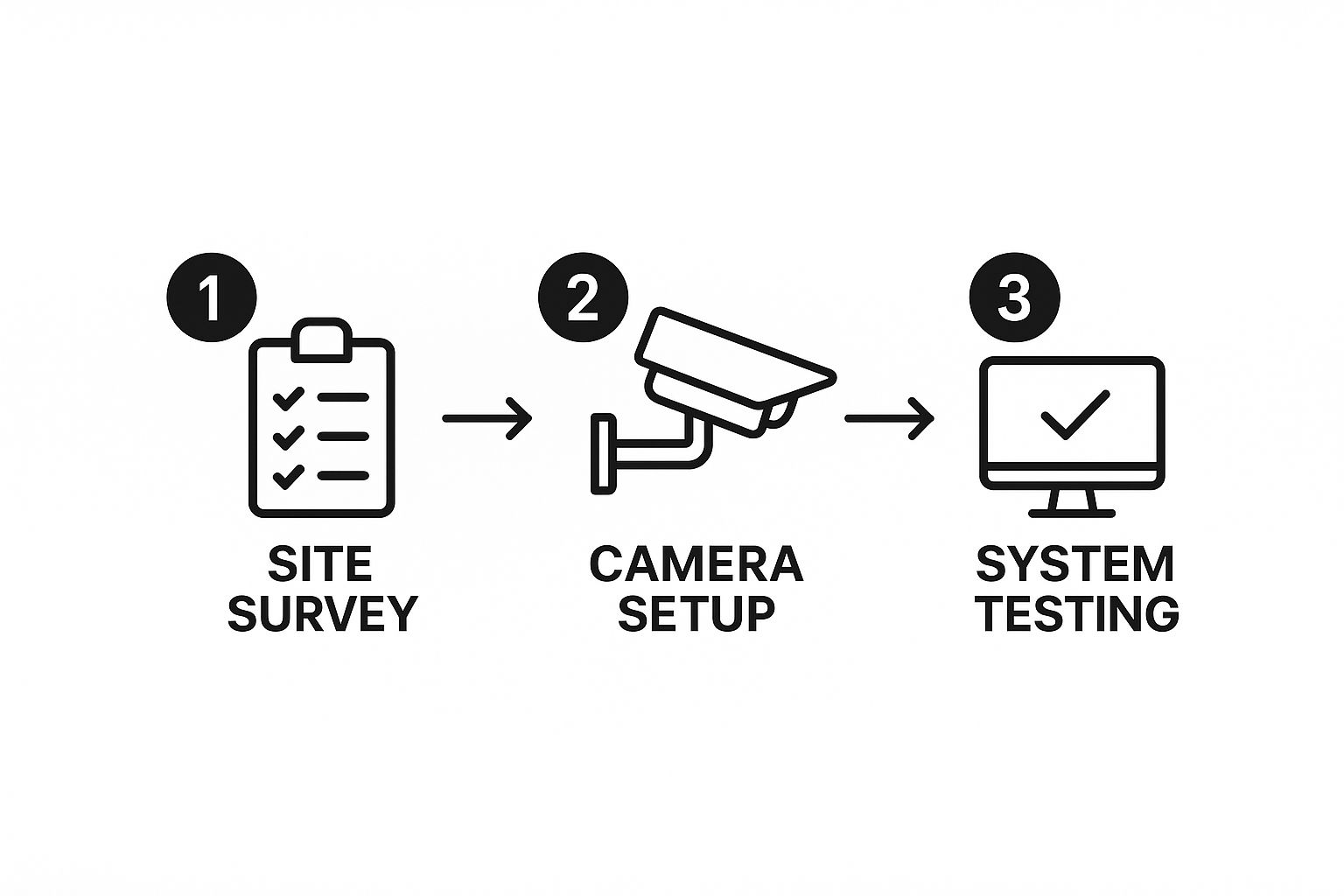
Seeing a structured approach like this is a good sign. It shows they have a repeatable, professional process and aren't just winging it.
Asking the Right Questions
With your background research solid, it's time to pick up the phone. The questions you ask in this conversation will instantly separate the seasoned experts from the amateurs. You're trying to get a feel for their technical knowledge, their professionalism, and what happens after they've cashed your check.
Don't go into this call unprepared. Having a list of specific questions ready shows them you're a serious, informed customer, and it makes it much easier to compare companies apples-to-apples.
Here are the non-negotiables I always ask:
"What kind of warranty do you provide on your installation and labor?" Any installer worth their salt will stand behind their workmanship for at least a year.
"What does post-installation support look like? How do you handle service calls?" You need to understand their process and how quickly they respond when you have a problem.
"Will I get a detailed, itemized quote?" This is critical. It prevents misunderstandings and protects you from hidden "gotcha" fees later.
"Can you give me a few references from recent local projects similar to mine?" An online review is one thing, but a conversation with a real past customer is invaluable.
How they answer these questions will tell you everything you need to know. It shines a light on their business practices and will give you the confidence to make the right hire.
Decoding Quotes and Understanding the True Cost

Getting a few quotes in hand is one thing; knowing how to read between the lines is another entirely. A genuinely professional estimate should lay everything out clearly, not leave you guessing with a bunch of jumbled numbers. Your first instinct might be to grab the lowest bid, but I can tell you from experience, that's often a mistake.
A solid quote will always break down the two major cost centers: hardware and labor. The hardware side covers all the physical gear—the cameras themselves, the NVR or DVR, and every foot of cable. Labor is what you're paying for the installer's time, skill, and expertise to get it all mounted, wired, and configured just right.
Spotting Hidden Fees and Comparing True Value
This is where you need to put on your detective hat and really look at the details. A vague quote with a single, lump-sum price is a massive red flag. You need a detailed list of every component and service so you can compare apples to apples across different bids.
As you search for "security camera installation services near me," you’ll see that pricing can be all over the map. This is why you have to scrutinize what you're actually getting for your money.
Equipment Quality: Is one installer quoting a cheap, off-the-shelf camera brand while another is specifying professional-grade equipment that comes with a real warranty and a much longer service life?
Labor Hours: Did one company estimate way fewer hours? It might sound good, but it could mean they're rushing the job, cutting corners, or just don't have the experience to quote accurately.
The "Extras": Keep an eye out for line items like "conduit," "mounting hardware," or "network configuration." These are all legitimate and necessary parts of a proper install, but a transparent company will spell them out instead of burying them in a miscellaneous fee.
The cheapest quote often ends up being the most expensive one down the road. It can easily hide shoddy equipment that fails in a year or sloppy work that creates security holes and leads to one expensive service call after another.
There's a reason the global surveillance camera market was recently valued at USD 47.91 billion and is expected to hit USD 81.37 billion by 2030. Technology is always improving, and you want an installer who keeps up. You can learn more about trends in the surveillance market to see just how far the tech has come. Partnering with someone who uses quality, modern equipment means your system won't be obsolete the day it's installed.
A Real-World Quote Comparison
Let's break down two imaginary quotes for a small retail shop. It's a classic scenario.
Component | Quote A (The Low Bidder) | Quote B (The Value Bidder) |
|---|---|---|
Cameras | 4x Generic 4MP Dome Cameras | 4x Brand-Name 4K Turret Cameras |
Labor | 6 Hours @ $75/hr | 8 Hours @ $90/hr |
Cabling | Standard Cat5 Cable | Shielded, Outdoor-Rated Cat6 |
Warranty | 90-Day Labor | 2-Year Labor, 3-Year Hardware |
Total Cost | $1,550 | $2,420 |
At a quick glance, Quote A looks like a steal. But when you dig in, Quote B is offering much higher resolution 4K cameras (which means you can actually identify faces), superior cabling built to last, and a comprehensive warranty that protects your investment for years. That’s not just a better price—that’s true value.
What to Expect on Installation Day and After
So, you’ve picked your installer and the big day is finally on the calendar. Knowing how things usually unfold can take a lot of the stress out of the process and help you make sure everything goes off without a hitch.
When the pros arrive, the first thing they should do is a quick pre-installation walkthrough. This is their chance to confirm every camera placement you’ve already discussed, making sure there are no last-minute surprises for you or for them.
From there, a skilled technician gets to work. They’ll have a clear game plan for running cables, mounting cameras, and hooking up your recording device. A real professional works cleanly, taking care to hide wires and treat your property with respect. This part of the job can take a good chunk of the day, easily several hours, especially if you have a large system or a tricky building layout.
The Critical Handoff and System Tutorial
Once the last camera is up and running, the work is far from done. In fact, arguably the most important part of the day comes next: the system tutorial. A good installer won't pack up their tools until you feel completely confident using your new security setup.
This isn’t just a five-minute "here's the power button" kind of deal. A proper handoff should feel more like a personalized training session.
A Live System Demo: They should walk you through the software from top to bottom, whether you're viewing it on a dedicated monitor or on your phone.
Training on Core Features: You need to know exactly how to pull up a live feed, find specific recordings from the past, and export a video clip if you ever need to.
Getting Your Phone Connected: They should help you install the mobile app, log in, and double-check that you're getting motion alerts and other notifications properly.
This is your time to ask anything and everything. Don't hold back—knowing how to actually operate your system is every bit as important as the quality of the cameras themselves.
Your installer's job is to empower you to take control of your own security. If you feel rushed or confused during the tutorial, speak up. Quality training is part of a quality installation.
Long-Term Support and Maintenance
What happens if something goes wrong a month from now? Or a year? This is where you see the real difference between a one-and-done job and a true professional partnership. Before your installer leaves, make sure you're crystal clear on what the support looks like moving forward.
Here are the final points you'll want to lock down:
Warranty Details: You should walk away with paperwork detailing the warranty for both the equipment and the installation labor. How long does it last? What exactly does it cover?
Maintenance Plans: It's worth asking if they offer any ongoing maintenance plans. These can be a great value, often including things like annual camera cleaning, firmware updates, and general system health checks to catch small problems before they become big ones.
Who to Call for Help: If a camera suddenly goes offline or you can't remember how to download a clip, who do you call? Get a direct phone number or email for their support team, not just a generic company line.
A reliable local installer becomes your long-term security partner. They’re the ones who will help ensure your system keeps protecting your property for years to come, and that peace of mind is the final, crucial piece of the puzzle.
Frequently Asked Questions About Camera Installation
When you start looking into professional security camera installation, a lot of questions pop up. It’s completely normal. Getting solid answers is the key to setting a realistic budget, knowing what to expect, and feeling good about the expert you hire. We’ve pulled together some of the most common questions we get from clients to give you the straightforward info you need.
This isn’t just about the tech—it's about the practical side of things. We'll cover everything from cost and timelines to equipment choices and those pesky local rules you need to know about.
How Much Does Professional Security Camera Installation Cost?
This is the big one, and the honest answer is: it varies. There's no flat rate because every job is different. The final cost really boils down to the number of cameras you need, how complex the system is, and even the unique layout of your property.
For a pretty standard home setup with 2-4 cameras, you might be looking at a few hundred dollars for the labor. But if you’re outfitting a large commercial space with advanced cameras and tricky wiring, the cost can easily climb into the thousands.
My best advice? Get at least three detailed quotes from reputable local installers. This is the only way to get a true sense of the going rate in your area and make sure you’re not overpaying.
Will Installers Set Up Cameras I Bought Myself?
Many will, but you need to go into this with your eyes open. It’s a common request, and while most pros are happy to install equipment you've already purchased, there are some important trade-offs.
When you supply your own gear, the installer typically only warranties their own work—the physical installation. They won't cover the hardware. If one of your cameras dies a week later, it's on you to deal with the manufacturer's warranty process.
On the other hand, many professionals prefer to provide the equipment because they're certified partners with specific brands. This lets them offer a single, comprehensive warranty on the entire system, giving you one number to call if anything goes wrong. It's a crucial point to discuss with any installer you’re considering.
How Long Does a Typical Installation Take?
For most homes, this is usually a one-day affair. A skilled team can typically get a system with 4 to 8 cameras installed and configured in about 4-8 hours.
Of course, that’s just a ballpark figure. The timeline can stretch depending on a few things:
Property Size: Bigger homes and commercial buildings simply take longer to wire and set up.
Construction: Drilling through brick or concrete is a lot more involved than running a cable through drywall.
System Type: A fully hard-wired system will always take more time than a wireless one because of the physical cabling work required.
Do I Need a Permit to Install Security Cameras?
Probably not, at least for a typical residential installation. Most of the time, you won’t need to pull a permit from the city.
However, that doesn't mean it's a free-for-all. Your local government or even your homeowners' association (HOA) might have specific rules about where you can point your cameras, especially if they overlook public areas or a neighbor’s yard. A good local installer will be up-to-date on these ordinances and will make sure your setup is 100% compliant, saving you a major headache later.
Ready to secure your property with a professionally installed surveillance system? The experts at PCI Audio-Video Security Solutions design and install custom security solutions for businesses and homes. Visit us online to schedule your free consultation!
Comments