


Small Business Security Camera System for Small Business: Essential Guide
- Бонус за регистрацию онлайн казино
- Aug 24, 2025
- 16 min read
When you think about a security camera system for your small business, your mind probably jumps straight to deterring theft. And while that’s a big part of it, modern systems have evolved into so much more. They're now powerful, versatile tools that can help with safety, cut down on liability risks, and even give you a clearer picture of how your business runs day-to-day.
The best part? These systems are no longer a massive, complicated expense. They’ve become affordable, surprisingly easy to use, and can grow right along with your business, making them a savvy investment for anyone from a neighborhood coffee shop owner to a manager of a bustling warehouse.
Why a Modern Camera System is a True Business Asset

As a small business owner, you’ve got a lot on your plate, and security is always buzzing in the back of your mind. It's about more than just what happens after hours. While stopping break-ins or catching a shoplifter is critical, today’s camera systems offer benefits that directly boost your operations and protect your bottom line.
Thinking of a camera system as just a passive device recording in a corner is a huge missed opportunity. You should see it as an active part of your team. The right setup doesn't just deliver peace of mind; it provides a real return, turning what feels like an expense into a genuine strategic investment.
It's More Than Just Preventing Theft
Of course, deterring and documenting crime is the most obvious job of a security camera. But its value runs much deeper. Imagine a customer claims they slipped and fell in your store. High-definition video can be the single most important piece of evidence in a liability dispute like that. Clear footage gives you an objective account of what actually happened, protecting your business from false claims and potentially saving you thousands in legal fees or insurance hikes.
It’s also about your team. Cameras create a safer environment for employees, especially if you have staff working early morning shifts or closing up late at night. Just knowing a reliable surveillance system is watching over the premises can do wonders for morale.
Unlocking Key Insights into Your Operations
This is where a modern system really starts to shine. A well-placed set of cameras becomes a powerful management tool. You can check in on daily operations from anywhere, making sure your team is following procedures and that your customer service standards are being met, even when you can't be there yourself.
For example, a restaurant owner can quickly verify that the kitchen staff completed all the closing duties correctly. A retail manager can look at customer traffic patterns to figure out the best store layout or decide when to add more staff to the floor during peak hours.
You get to make decisions based on what’s actually happening, not just on gut feelings. This growing realization of a camera system's potential is why the video surveillance market exploded from $23.6 billion in 2019 to nearly $35 billion by 2022. It’s on track to hit $62.4 billion by 2027. You can dig into the full market statistics and projections to see just how fast this technology is being adopted.
The real power of a modern security camera system lies in its ability to provide clarity. It clarifies what happened during an incident, clarifies how your team is performing, and clarifies how customers interact with your space.
Ultimately, putting a quality security camera system in your small business is about gaining control, insight, and confidence. It’s a tool that helps you protect your assets, support your people, and run a smarter, more efficient operation.
Auditing Your Unique Security Vulnerabilities
Before you even think about camera models or tech specs, the most important thing you can do is conduct your own security audit. This doesn't need to be a complex, formal process. It’s as simple as walking through your space and trying to think like someone who might pose a threat.
A truly effective security camera system for a small business is one that’s designed to solve specific problems, not just record everything all the time. I've seen too many business owners jump straight to buying equipment. This is a classic mistake that leads to overspending on features they don't need or, far worse, leaving critical blind spots completely unprotected.
The goal here is to build a system that responds directly to your actual vulnerabilities. A downtown coffee shop has completely different security needs than a landscaping depot on the edge of town, and your camera setup should reflect that reality.
Identifying Your High-Risk Zones
Grab a notepad or your tablet and start by physically walking through your business. The first mission is to pinpoint the areas where your business is most exposed. These are the spots that absolutely, without question, need to have a camera watching them.
Think about the natural flow of money, products, and people. Where do they all come together? For most businesses, this simple exercise will shine a light on a few key areas:
Points of Entry and Exit: Cover all your doors—customer entrances, employee-only doors, and any delivery bays. These are the most obvious weak points for unauthorized entry.
Point of Sale (POS) Systems: Your cash registers and payment terminals are magnets for trouble. A well-placed camera here can discourage employee theft and give you irrefutable evidence if there's ever a robbery or a cash dispute.
Stockrooms and Inventory Storage: I can't tell you how many times I've seen theft happen in unmonitored storage areas. This is where you keep your valuable assets, making them a prime target for both internal and external threats.
Parking Lots and Exteriors: Don't forget the outside. Monitoring your parking area helps you capture vehicle details, deter vandalism, and keep your employees safe when they arrive or leave, especially after dark.
One of the most common oversights I see is a singular focus on the front of the business. Back alleys, rear entrances, and unsecured windows often represent the path of least resistance for intruders. Make sure your audit covers every single angle of your property.
Defining Your Primary Security Goals
Once you have your map of high-risk zones, the next step is to get crystal clear on why you need a camera in each spot. What specific problem are you trying to solve? Defining these goals will directly shape the kind of cameras and features you end up choosing.
For example, a retail boutique's main goal might be to deter shoplifters. In that case, highly visible dome cameras placed over high-value merchandise and near the entrance would be a smart move. The goal is deterrence just as much as it is recording evidence.
A warehouse manager, on the other hand, might be more worried about break-ins at a loading dock after hours. Their objective is to get clear footage of any vehicle that pulls up to the bay doors. For that job, a tough, weather-resistant outdoor camera with excellent night vision—and maybe even license plate recognition—is the right tool.
Considering Your Hours of Operation
Your business hours create entirely different sets of risks. An office that's only open from 9-to-5 faces different threats than a bar that's buzzing until 2 a.m.
During Business Hours: Your attention is likely on interactions between customers and staff. Are you trying to watch for slip-and-fall incidents to reduce liability? Or maybe you're keeping an eye on the register to prevent employees from giving unauthorized discounts to friends.
After Hours: When the lights are off and the building is empty, the threat shifts to break-ins, theft, and vandalism. This is when features like infrared night vision and motion-detection alerts really prove their worth. A camera that sends an alert to your phone the second it detects movement in the stockroom at 3 a.m. is an incredibly powerful tool.
Thinking through your physical security is the perfect starting point. But while you're at it, it's wise to consider your company's protection as a whole. You can learn more about general security strategies by checking out these 7 Website Security Best Practices For Small Businesses.
When you finish this self-audit, you'll have a clear, prioritized checklist. Instead of just buying a generic "8-camera kit," you’ll have a precise plan: "I need two dome cameras for the sales floor, one bullet camera for the back door, and an outdoor turret camera watching the parking lot." This thoughtful approach ensures every dollar you invest directly addresses your unique risks, giving you real security without wasting a cent.
Picking the Right Cameras and Recording Gear
With a clear map of your security needs in hand, it's time to get into the fun part: the hardware. The world of security cameras can feel a bit technical with terms like NVR, PoE, and IP ratings, but it's much more straightforward than it seems. Once you get these core components, you'll be able to build a rock-solid security camera system for your small business.
Think of it like choosing the right tools for a job. You wouldn't use a hammer on a screw, and you definitely wouldn't stick a basic indoor camera in a dark, rainy parking lot. Let's break down the essential pieces so you can confidently pick the gear that matches the security plan you just created.
Matching the Camera to the Job
Not all cameras are built the same. Each type is designed for a specific environment and purpose. Getting this part right means you'll have perfect coverage where it counts, without wasting money on features you'll never use.
Here are the most common types you’ll come across:
Dome Cameras: These are the subtle, dome-shaped units you often see inside retail stores or offices. Their main advantage is being discreet; it’s hard for someone to know exactly where the lens is pointing, which is a great deterrent. They're also generally more vandal-resistant, making them perfect for indoor spots within reach, like hallways or right above a cash register.
Bullet Cameras: Instantly recognizable by their long, cylindrical shape, bullet cameras are all about highly visible surveillance. They practically scream, "You're on camera," making them perfect for scaring off potential intruders at entrances, in parking lots, or near loading docks. Their design also allows for bigger lenses and more powerful infrared sensors, often giving them fantastic night vision.
Turret Cameras: Sometimes called "eyeball" cameras, turrets really do offer the best of both worlds. They have a slick ball-and-socket design that makes them incredibly easy to aim, and they completely avoid the infrared glare issues that can sometimes plague dome cameras at night. Their versatility makes them an excellent all-around choice for both indoor and outdoor spots.
A classic mistake I see is people buying a big multi-camera kit where all the cameras are the same. A truly effective system often mixes and matches—using discreet domes inside, a powerful bullet for the back alley, and a versatile turret to cover the main entrance.
The Brains of the Operation: NVR vs. DVR
Every camera system needs a central hub to record and manage all the video footage. Your two main options are a Network Video Recorder (NVR) and a Digital Video Recorder (DVR). While they do a similar job, the technology behind them is worlds apart. For any modern business, the choice is crystal clear.
A DVR system is old-school tech that works with analog cameras. This means you need to run a clunky coaxial cable for video and a separate cable for power to every single camera. It's a messy installation, and the video quality is nowhere near what modern digital systems can deliver.
An NVR system, on the other hand, is built for today's digital IP (Internet Protocol) cameras. This is the gold standard for any serious security camera system for a small business. To really see what these systems are capable of, it's worth learning more about modern cloud-managed security cameras.
The image below breaks down the key steps for a successful installation.
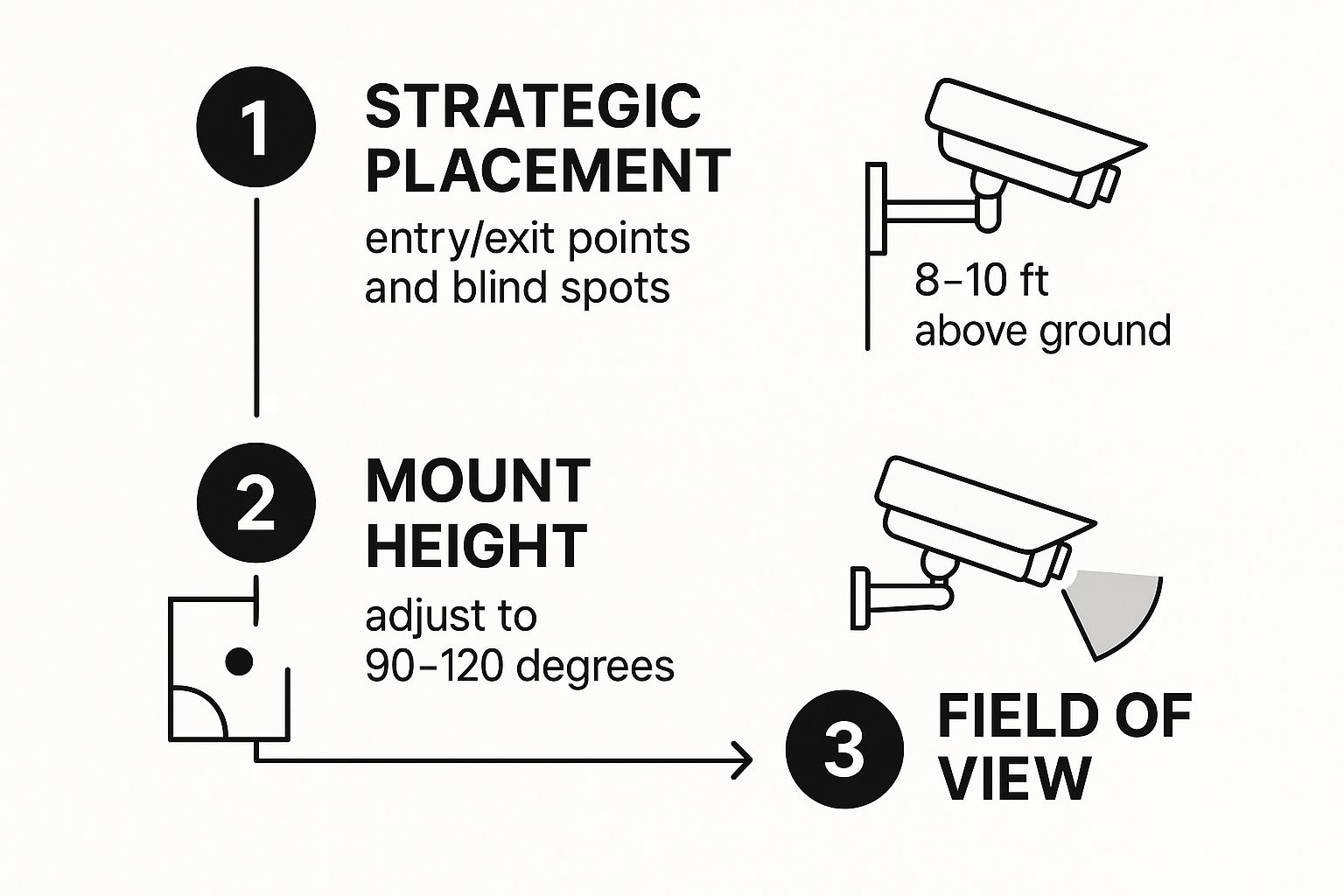
As you can see, success starts with smart placement and proper mounting before you even think about plugging in a single cable.
Why NVR with PoE Is the Smart Money
The real game-changer for NVR systems is a technology called Power over Ethernet (PoE). This genius tech allows a single, standard Ethernet cable to carry both video data and electrical power to the camera. It radically simplifies installation, gets rid of cable clutter, and gives you a far more reliable connection than Wi-Fi ever could.
This NVR and PoE camera combo has become the go-to solution for small businesses that need dependable, scalable surveillance. A single cable per camera makes the setup clean and fast, and you don't have to worry about finding a power outlet near every camera location. A common starting point for a small business is 4 to 8 PoE cameras wired into an NVR that handles all the recording and storage.
To make the choice even clearer, let's put these two systems head-to-head.
NVR vs DVR Systems for Small Business
Deciding between a Network Video Recorder (NVR) and a Digital Video Recorder (DVR) is one of the most important hardware choices you'll make. This table breaks down the key differences to show why one is a modern solution and the other is a relic of the past.
Feature | NVR System (Recommended) | DVR System (Older Technology) |
|---|---|---|
Camera Type | Digital IP Cameras | Analog Cameras |
Video Quality | Superior (Up to 4K and higher) | Lower (Limited resolution) |
Cabling | Single Ethernet cable for power & data (PoE) | Separate coaxial (video) and power cables |
Installation | Simple, clean, and flexible | Complex and cable-intensive |
Scalability | Easy to add cameras using a PoE switch | Limited by the number of ports on the DVR |
Remote Access | Native feature with high-quality streaming | Often requires complex network configuration |
Future-Proofing | Supports modern features like AI & analytics | Limited to basic recording and playback |
The takeaway here is pretty clear. An NVR system isn't just a small upgrade; it's a fundamental leap forward in quality, reliability, and ease of use. Investing in an NVR with PoE cameras ensures your security camera system for a small business is built on a modern, stable, and expandable foundation. It's a decision that gives you better performance from day one and saves you from the headaches of outdated tech down the road.
Putting Smart Features to Work for Your Business

The days of a security camera system for a small business being a passive gadget that just records footage are long gone. Today's systems are active, intelligent partners in your daily operations, packed with smart features that go way beyond simple motion detection to deliver real business insights.
This evolution is a game-changer. Your camera system can shift from a reactive security measure—something you check after a break-in—into a proactive tool that helps you run your business. It's all about getting ahead of problems, improving workflows, and spotting patterns you'd otherwise miss.
The market reflects this massive shift in value. Around 72% of U.S. households now own at least one smart security device, a trend we're definitely seeing in the small business world. Owners are adopting these systems not just to deter crime, but for real-time operational oversight powered by AI that can tell the difference between a real threat and a cat running across the parking lot. If you're curious, you can explore more data on the smart security market to see just how fast this is growing.
AI Analytics That Actually Make a Difference
The single biggest leap forward has been baking artificial intelligence right into the camera analytics. This isn't just marketing fluff; it has a direct, practical impact on how you manage security by cutting out the noise from false alarms.
Older motion detection was famously finicky. A branch swaying in the breeze, a car's headlights, or even heavy rain could trigger an alert. After a while, that constant stream of bogus notifications just becomes background noise, and you start ignoring them—which defeats the whole purpose.
Modern AI-powered systems nail this problem.
Person Detection: The camera is trained to recognize the specific shape and movement of a person. That means you get an alert when someone enters a restricted area, not when a raccoon decides to inspect your dumpster at 2 a.m.
Vehicle Detection: In the same way, you can set alerts for when a car or truck pulls into a specific zone, like a loading dock after hours. This is perfect for monitoring unauthorized access without getting a notification for every car that drives down a nearby street.
This kind of filtering makes your alerts count. When your phone buzzes, you know it's for something that actually needs your attention.
Think of it like this: old motion detection was a car alarm that went off every time the wind blew. AI analytics is a personal security guard who only taps you on the shoulder when there's a real reason to be concerned.
Going Beyond Motion with Virtual Tripwires
With smart features, you can draw up customized security rules that are way more sophisticated than basic motion detection. Two of the most powerful tools in the box are line-crossing and intrusion detection.
Line-Crossing Detection lets you draw a virtual line anywhere in the camera's view. You can then create a rule to trigger an alert only when something crosses that line, often in a specific direction.
Real-World Example: Imagine a retail manager drawing a line at the entrance to their stockroom. They can set an alert to go off if anyone crosses that line after closing, giving them an instant heads-up about a potential issue.
Intrusion Detection works by drawing a virtual box around a sensitive area. An alert is triggered only when a person or object enters and stays within that defined zone for a set amount of time.
Real-World Example: A construction site manager can draw a box around a pallet of expensive copper wiring. If the system detects a person inside that zone for more than a few seconds overnight, they get an immediate notification and can respond quickly.
Remote Access from Anywhere
Of course, all these intelligent features are only useful if you can access them easily. A well-designed mobile app is the final, crucial piece of the puzzle. It puts the full power of your security camera system for small business right into your pocket, no matter where you are.
A great mobile app lets you do more than just watch a live feed. You should be able to:
Receive and review those AI-filtered push notifications.
Quickly search for specific events (e.g., "show all person detections at the back door between 1 a.m. and 4 a.m.").
Easily save and send video clips to law enforcement.
Tweak camera settings and alert rules on the fly.
For a restaurant owner, this means being able to check that the staff completed all closing duties before locking up. For a boutique owner on vacation, it’s the peace of mind that comes from knowing their inventory is secure. It's about having total control and visibility without being physically tied to your business.
Getting Your Hands Dirty: Installation and Setup
You've picked out the perfect gear for your small business security camera system. Now comes the fun part: bringing it all to life. A successful installation is less about technical wizardry and more about smart placement and thoughtful configuration. Whether you go the DIY route or call in a pro, knowing the fundamentals is key to getting peak performance from day one.
Proper installation is so much more than just screwing cameras to a wall. You have to think like a burglar, an employee, and even the sun. A well-placed camera is your best witness, capturing crisp, usable footage. A poorly placed one? It might just give you a beautiful, but useless, video of a sun flare or the top of someone's head.
Where to Put Your Cameras
Honestly, where you place your cameras is probably the single most important decision you'll make. The whole point is to cover your high-risk areas, get the widest useful view, and keep the cameras themselves safe from bad weather or a well-aimed rock.
Over the years, I've seen a lot of setups, and a few placement rules always hold true:
Go High: Get those cameras up and out of easy reach. Aim for 8 to 10 feet off the ground. This one move makes it incredibly difficult for someone to tamper with, disable, or steal the camera itself.
Mind the Light: Never, ever point a camera directly at the sun or a powerful light. It creates a nasty glare that will completely blow out your image. Instead, try to position cameras with the light source behind them, lighting up the scene you want to see.
Kill the Blind Spots: Walk your property and think about where someone could duck out of sight. Corners, alcoves, and entryways are classic problem areas. Sometimes, using two cameras to cover a large space from different angles is far more effective than one wide-angle lens that can distort the edges of the picture.
Here's the biggest rookie mistake I see: people drill holes before checking the actual view. Before you commit, hold the camera exactly where you plan to mount it and look at the live feed on your phone. What you see on that screen is the only thing that matters.
Hooking It All Up
With your cameras mounted, it's time to connect the dots and get the system online. If you went with a Power over Ethernet (PoE) system—and I hope you did—this part is refreshingly simple. A single Ethernet cable runs from each camera straight back to a dedicated port on your Network Video Recorder (NVR).
Once everything's plugged in, you'll fire it up and walk through a setup wizard on a monitor connected to the NVR. This is where you lay the groundwork, turning a box of hardware into an intelligent security tool.
Dialing in the Settings
Draw Your Motion Zones: Don't settle for generic motion detection across the whole screen. Modern systems let you draw specific boxes or zones where you care about movement. For a camera watching a back door, for instance, draw a tight zone right around the door itself. This stops you from getting an alert every time a squirrel runs across the parking lot.
Decide How to Record: You've got two main options: record everything 24/7 (continuous) or only record when something moves (motion-activated). For critical spots like a cash register or server room, continuous recording is the way to go. For quieter areas, motion-activated recording will save you a ton of hard drive space.
Get Connected Remotely: This is non-negotiable. You'll plug your NVR into your internet router. From there, the system's mobile app will walk you through linking it to your phone, usually by just scanning a QR code on the NVR itself. Now you can check in from anywhere.
Taking a few extra minutes to fine-tune these initial settings makes all the difference. It's how you turn a passive recording device into an active security partner that gives you the right information, right when you need it.
Answering Your Top Questions
Getting into the specifics of a security camera system for your small business always brings up a few key questions. Let's tackle some of the most common ones I hear from business owners so you can move forward with confidence.
How Much Video Storage Do I Really Need?
This is a classic "it depends" question, but I can give you a solid starting point. Your storage needs are a direct result of how many cameras you have, the resolution they record in (e.g., 1080p vs. 4K), and your recording schedule.
For most small businesses I work with, running between four and eight cameras at a standard 1080p resolution, a 2TB to 4TB hard drive is the sweet spot. That typically gives you several weeks of continuous recording before the system automatically overwrites the oldest footage.
Pro Tip: Don't want to guess? Most NVR manufacturers have online storage calculators. You can plug in your exact camera count and settings to get a precise estimate, taking the guesswork out of the equation.
Can I Just Install This System Myself?
You absolutely can. Modern Power over Ethernet (PoE) systems are built with DIY in mind. The setup is surprisingly straightforward—it's mostly about running Ethernet cables from your NVR to your cameras and then following the on-screen prompts.
If you're comfortable with a drill and have a basic understanding of how a network works, you can save a good bit of money on installation. That said, if your building has a tricky layout or you'd just rather have it done right the first time, bringing in a professional installer guarantees everything is placed for optimal coverage and performance.
Are Wireless Cameras a Good Option for a Business?
Honestly, for a business, I almost always steer people away from wireless cameras. While they're great for home use, they just aren't as reliable as a wired PoE system in a commercial setting.
The problem is their reliance on Wi-Fi. In a busy business environment, your Wi-Fi signal can get congested or suffer from interference, leading to dropped footage. When you need that recording to be there after an incident, "mostly reliable" isn't good enough. A wired PoE connection for power and data is simply more stable and professional.
Do I Have to Tell People They're Being Recorded?
Yes, and this is non-negotiable. You are legally and ethically required to post clear signage stating that video surveillance is in use. These signs not only fulfill your legal duty but also serve as a great deterrent.
Just as important, it is illegal to place cameras in areas where people have a reasonable expectation of privacy—think restrooms, fitting rooms, or employee break rooms. Laws can vary by state, especially regarding audio recording, so it's always smart to double-check local regulations to make sure your security camera system for small business is fully compliant.
At PCI Audio-Video Security Solutions, we specialize in designing and installing security systems that protect and empower your business. From advanced 4K cameras to seamless remote access, we build solutions that fit your unique needs. Secure your business with a professional consultation today.
Comments