


Surveillance Cameras Surveillance Cameras: Ultimate Security Guide
- Бонус за регистрацию онлайн казино
- Aug 9, 2025
- 18 min read
When you think of a surveillance camera, you might picture the grainy, black-and-white footage from old heist movies. But that's a world away from where the technology is today. Modern security cameras are more than just a set of eyes; they're sophisticated, intelligent systems that actively help protect people and property. They've gone from being passive observers to essential tools for proactive security.
The Evolution of Modern Surveillance Cameras
The journey from those old analog cameras to the smart systems we have now is a story of incredible technological leaps. For years, analog CCTV was the standard. It did the job, but it had its limits—think clunky coaxial cables for every camera and fuzzy footage that was a pain to sort through. It was a purely reactive system. You only looked at the tape after something had already happened.
The real shift happened when cameras went digital. The move to IP (Internet Protocol) cameras was a massive turning point. Suddenly, cameras weren't just sending a raw video signal down a wire; they became miniature computers on a network. They could capture crisp, high-resolution digital video and send it anywhere over a standard network connection.
It's like the difference between old broadcast TV and a modern streaming service. Analog was a one-way street with a single, fixed feed. IP cameras are interactive, offering rich data you can access, analyze, and manage from anywhere with an internet connection.
From Crime Prevention to Business Optimization
This jump to digital blew the doors wide open for innovation. High-definition and even 4K resolution became the norm, giving us footage so clear you can easily make out faces and license plates. But the evolution didn't stop there. The real game-changer has been the integration of artificial intelligence (AI) and video analytics.
Today’s cameras do so much more than just help catch criminals. They’ve become powerful tools that can improve how a business runs.
Analyze Customer Behavior: A retailer can use heat mapping to see which aisles get the most foot traffic, helping them design a more effective store layout.
Improve Workplace Safety: In a factory, cameras can spot a potential safety hazard on an assembly line or an equipment failure the second it happens.
Streamline Access Control: A logistics company can use license plate recognition to automatically open gates for authorized trucks, which keeps things moving smoothly.
Market Growth and Technological Innovation
It’s no surprise that with all this new capability, the demand for modern surveillance systems is skyrocketing. The global market, valued at around USD 43.65 billion in 2024, is expected to nearly double to over USD 81.37 billion by 2030. This boom is driven by a combination of rising security concerns and massive infrastructure projects worldwide.
We're also seeing incredible innovation in how these systems are deployed. For instance, solar-powered cameras with 4G connectivity mean you can now set up high-tech surveillance in remote locations that have no traditional power or network infrastructure. It’s a perfect example of how the industry is adapting to solve real-world problems. For a deeper dive, you can find detailed industry reports that break down these market trends and growth drivers.
Choosing the Right Type of Surveillance Camera
With so many cameras on the market, picking the right one can feel like a huge task. But it really isn't. Your decision comes down to just two things: how the camera sends its signal and what its physical shape is built to do. Once you get a handle on these fundamentals, you’ll be able to confidently pick the right tools for the job.
The first major choice you'll make is between analog and IP cameras. Think of it as the difference between old-school broadcast TV and a modern streaming service.
Analog (CCTV) cameras are the old guard. They capture video and send it over a coaxial cable directly to a recorder. It's a simple, closed-loop system that’s been reliable for decades, but the trade-off is lower resolution and limited features. IP (Internet Protocol) cameras are the modern standard. They're essentially mini-computers that capture high-resolution digital video and send it as data across a network. This opens up a world of possibilities, from crystal-clear images and smart analytics to the ability to check in on your property from anywhere with an internet connection.
While you'll still find traditional CCTV systems out there, the industry is overwhelmingly moving toward IP solutions. This shift is happening globally, with the CCTV market projected to explode from USD 59.64 billion in 2025 to a staggering USD 234.11 billion by 2034. A massive driver of this is the Asia-Pacific region, which is expected to pour over USD 160 billion into surveillance tech by 2034, thanks to huge infrastructure projects and the rise of smart cities. You can dig deeper into these global market dynamics to see how technology adoption is playing out worldwide.
Matching Camera Shape to Your Environment
After you've landed on IP or analog, the next puzzle piece is the camera's physical design, or form factor. A camera's shape isn't just for looks—it has a direct impact on its field of view, how visible it is, and how well it stands up to tampering. Each style is a tool designed for a specific purpose.
The image below highlights a central theme in modern surveillance: the push for high-definition video.
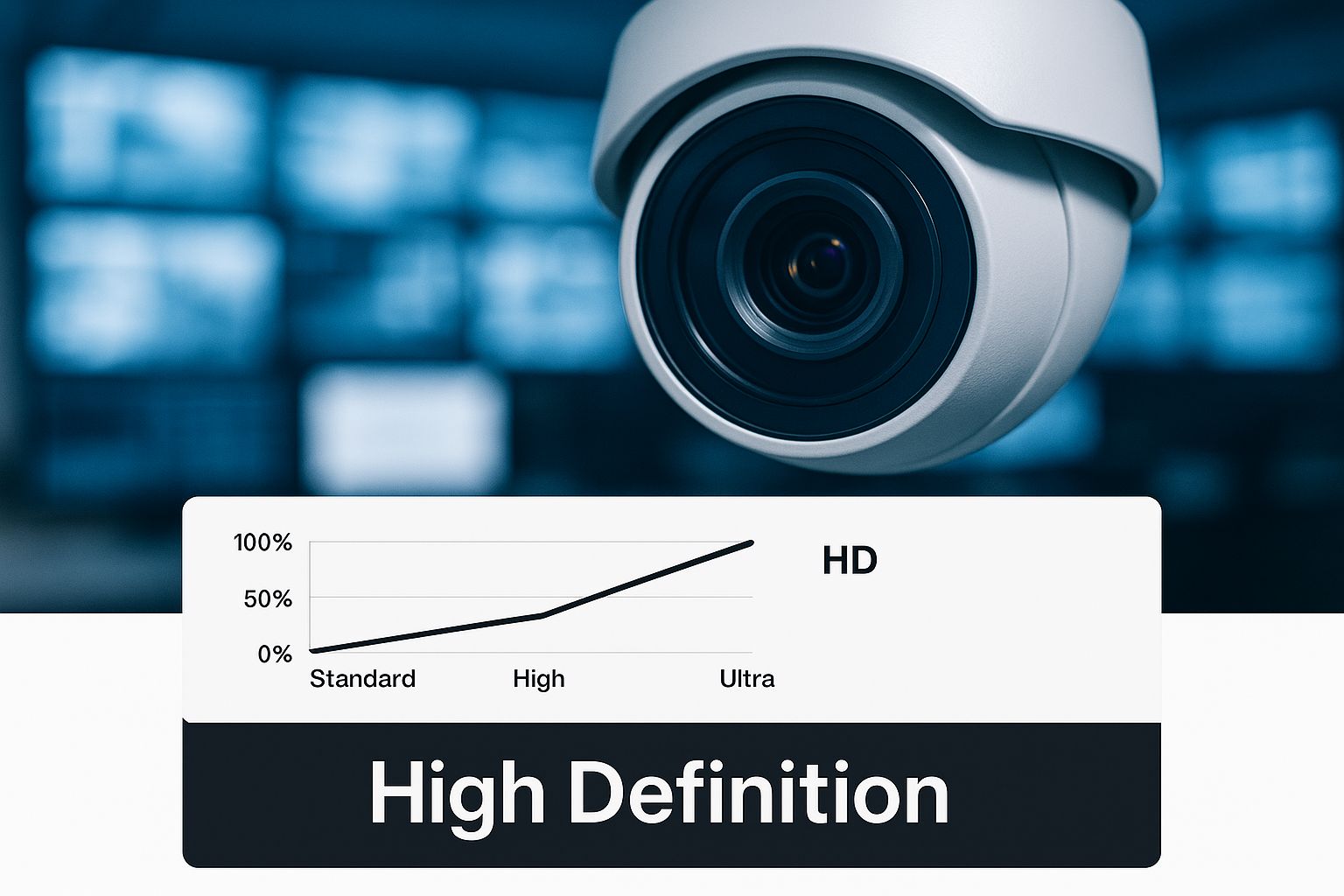
This focus on HD is non-negotiable in today's world. Clear, detailed footage is what turns a camera from a simple deterrent into a powerful tool you can actually use to identify people and events.
To help you decide, here’s a breakdown of the most common camera styles you'll encounter.
Comparing Common Surveillance Camera Styles
This table gives you a quick side-by-side look at the main camera types, so you can easily compare their strengths and see which one fits your needs.
Camera Type | Key Feature | Ideal Environment | Vandal Resistance | Cost Level |
|---|---|---|---|---|
Bullet | Highly visible, long-range view | Outdoors, hallways, fence lines | Moderate | Low-Mid |
Dome | Discreet, wide viewing angle | Indoors, retail, offices, ceilings | High | Low-Mid |
PTZ | Remote pan, tilt, and zoom control | Large open areas, active monitoring | Varies | High |
Turret | Easy to aim, compact design | Versatile indoor/outdoor use | Low-Moderate | Low-Mid |
Ultimately, the best choice depends entirely on the specific spot you need to monitor. A visible bullet camera might be perfect for a parking lot, while a discreet dome is better for an office lobby.
Let's look at these types in a bit more detail:
Bullet Cameras: These are the classic security cameras you probably picture in your head. Their obvious presence makes them a fantastic visual deterrent. Because of their shape, they excel at monitoring long, straight areas like driveways, perimeters, and corridors.
Dome Cameras: Sleek and unobtrusive, dome cameras are designed to blend in. Their tinted, protective casing makes it nearly impossible for someone to know which way the lens is pointing, making them ideal for indoor public spaces like retail stores, hotel lobbies, and reception areas.
PTZ (Pan-Tilt-Zoom) Cameras: These are the workhorses of active surveillance. A security operator can remotely control the camera to scan wide areas, tilt up and down for a better look, and zoom in on specific details with incredible clarity. They are unmatched for monitoring large, dynamic environments like stadiums, public squares, and sprawling construction sites.
Turret Cameras: Often called "eyeball" cameras, turrets are a fantastic hybrid. They give you the easy-to-aim flexibility of a bullet camera but in a more compact, dome-like body. This makes them a great all-rounder for a wide variety of indoor and outdoor applications where you need a good balance of performance and aesthetics.
Choosing the right mix of these cameras is the key to creating a security system with no blind spots. By placing the right camera in the right location, you ensure every critical area is covered effectively, giving you true peace of mind.
Decoding Key Camera Performance Features
When you start comparing different surveillance cameras, the spec sheet can feel like you're trying to read a foreign language. It's just a wall of acronyms and technical terms. But those features are what separate a camera that just records video from one that delivers truly useful, actionable evidence. Getting a handle on these core metrics is the key to choosing a system that actually solves your security problems.
Think of it this way: buying a camera without understanding its specs is like buying a car without checking its horsepower, fuel efficiency, or safety rating. You might end up with something that looks the part but completely fails to perform when you need it most. Let's break down the jargon into real-world benefits.
Resolution: The Foundation of Clarity
Video resolution is one of the first things to look at, and for good reason. It directly impacts your ability to identify crucial details in your footage. It’s measured in pixels, just like a digital photo. The more pixels a camera captures, the sharper and more detailed the image will be. A low-resolution camera might show you that someone was there, but a high-resolution one can show you who it was.
Here’s a practical look at how common resolutions stack up:
1080p (Full HD): This is really the baseline for any professional security setup today. It provides clear images that are perfect for general monitoring of smaller areas, like an office or a small storefront, where you need to identify people at a moderate distance.
4K (Ultra HD): This is a huge leap forward, offering four times the number of pixels as 1080p. The difference is staggering. With 4K security cameras, you can digitally zoom in on a recording and still see everything clearly, making it possible to read a license plate or identify small details from far away.
For covering large areas like parking lots or warehouses, higher resolution is vital. A single 4K camera can often provide the same coverage as several lower-resolution cameras, which can save on installation costs while delivering far better evidence.
When you're reviewing an incident, the difference between a blurry, pixelated face and a sharp, identifiable one almost always comes down to resolution. Investing in higher resolution is a direct investment in the quality of your security footage.
Focal Length and Field of View
If resolution determines the quality of your image, then focal length determines its scope. Put simply, a camera's focal length dictates its field of view—how wide or narrow a scene it can capture. It works just like the zoom on a traditional camera lens.
A short focal length, like 2.8mm, gives you a very wide field of view. This is perfect for getting a big-picture overview of an entire room, a retail sales floor, or a small parking area. The trade-off is that objects will appear smaller and farther away.
On the other hand, a long focal length, like 12mm, creates a narrow, zoomed-in view. These lenses are designed to focus on a specific, distant target, such as a single entryway, a cash register, or a gate at the far end of a long driveway.
Many modern surveillance cameras now come with a varifocal lens, which lets you adjust the focal length and field of view either manually or remotely. This flexibility is a massive advantage, allowing you to perfectly fine-tune the camera’s perspective after it's installed to make sure you're capturing exactly what you need without any blind spots.
Conquering Darkness and Difficult Lighting
Security threats don't clock out when the sun goes down, so your cameras can't either. Effective night vision is a non-negotiable feature for any real security system. The most common technology you'll see is Infrared (IR). It uses IR LEDs to flood the scene with light that's invisible to our eyes but perfectly visible to the camera, creating a crisp black-and-white image.
But technology has come a long way. A growing number of cameras now offer color night vision. These models use incredibly sensitive sensors, and sometimes a bit of supplemental white light, to capture full-color images even in very low-light conditions. Being able to identify the color of a getaway car or a suspect's jacket can be a game-changer for an investigation.
Another critical feature for tricky lighting is Wide Dynamic Range (WDR). Picture a lobby with a large glass entrance on a bright, sunny day. A standard camera would be overwhelmed, forced to choose between a blown-out, white glare from outside or a pitch-black interior.
WDR solves this by acting like the human eye. It takes multiple pictures at different light levels and merges them into a single, perfectly balanced image. This ensures you can see clear details in both the brightest and darkest parts of the scene at the same time. It's an essential feature for any camera pointed at windows, doors, or covered loading docks.
Unlocking the Power of AI and Video Analytics
Modern surveillance cameras have come a long way from just passively recording video. They don't just sit and watch anymore; they can think, analyze, and even start to predict what might happen next. This leap in capability comes from artificial intelligence (AI) and sophisticated video analytics, which transform a standard security feed into a source of real intelligence for both security and business operations.
Think of old-school motion detection like a simple digital tripwire. It triggers an alert when anything moves—a passing car, a stray cat, or even just a tree branch swaying in the wind. Anyone who’s used it knows this leads to a flood of false alarms, burying real threats in a sea of noise.
Advanced AI, on the other hand, is more like having a highly trained guard on duty 24/7. It doesn’t just see movement; it understands what it's seeing. It can tell the difference between a person, a car, and an animal, slashing the number of false positives and letting you focus on events that actually matter. This is the fundamental shift that makes today's cameras so much more powerful.
Going Beyond Basic Motion Detection
With AI baked in, surveillance systems can now handle tasks that seemed like science fiction just a few years ago. These aren't just flashy features; they deliver real, tangible benefits that extend a camera's value far beyond just catching criminals after the fact. The applications are incredibly diverse, solving specific problems for all kinds of businesses.
Some of the most impactful AI-driven features include:
Facial Recognition: This technology can identify and flag people from a pre-approved or watch-listed database. It's a powerful tool for controlling access to sensitive areas or getting a heads-up when a known shoplifter enters your store.
License Plate Recognition (LPR): LPR cameras automatically read license plates, which is perfect for automating gate access at a warehouse, managing a paid parking lot, or simply logging every vehicle that enters a secure site.
Behavioral Analysis: This is where it gets really smart. The AI learns what "normal" activity looks like for a specific scene. It then alerts you when something out of the ordinary happens, like someone loitering in a restricted area after hours or a car driving the wrong way down a one-way lane.
This kind of intelligent analysis turns your surveillance system from a reactive tool—something you use to look back at what happened—into a proactive one that can help you stop incidents before they even start.
Real-World Applications Driving Business Value
You can see the practical benefits of these analytics everywhere. A retail store, for instance, can use AI-powered heat mapping to see exactly where customers are spending the most time. This shows which displays are grabbing attention and which aisles are getting ignored—gold-standard data for optimizing store layouts and boosting sales.
Or take a construction site manager. They can use AI to draw a virtual "fence" around the perimeter. If a person or vehicle crosses that line after hours, the system sends an instant alert with a video clip, allowing for a quick response. That's a world of difference from sifting through hours of footage the next morning to figure out what was stolen. It’s these advanced applications that are driving the market's incredible growth.
The global video surveillance market has exploded, jumping from $23.6 billion in 2019 to a projected $62 billion by 2027. This rapid adoption is fueled almost entirely by the integration of AI and analytics, which add immense value beyond basic security. You can dig deeper into these numbers by reviewing these IP camera market statistics.
Analytics That Enhance Operational Efficiency
Beyond just security, video analytics can make day-to-day operations much smoother. Imagine a busy logistics hub. With LPR cameras, authorized delivery trucks get in and out automatically, cutting down on lines at the gate and freeing up security staff from manually checking drivers in.
In an office, AI analytics can monitor how many people are using meeting rooms or common areas. This gives facilities managers the data they need to optimize the use of their space or even adjust cleaning schedules. These aren't just security features; they're business intelligence tools. They help companies run more efficiently, save money, and make smarter decisions based on real data. The modern surveillance camera isn't just watching your property anymore—it's helping you manage it.
How to Plan Your Surveillance System Layout
Having a box full of high-tech surveillance cameras is one thing; knowing where to put them is another entirely. The best gear in the world won't do you much good without a smart plan. Effective security is all about strategic design and thoughtful placement. Think of it like drawing up a blueprint for a fortress—you need to find the weak spots, create clear lines of sight, and make sure every critical area is covered without leaving any dangerous gaps.
The whole process kicks off with a site assessment. Put on your thinking cap and walk your property, but try to see it through the eyes of someone who might want to cause trouble. Where are the most likely entry points? Where are your most valuable assets kept? Identifying these vulnerabilities is the very first step to securing them. Don't just focus on the front door and windows; look at service entrances, loading docks, and even weak points in your perimeter fence.
A classic mistake is to zero in on the obvious entryways while completely ignoring the less-traveled paths. A camera on the front door is a given, but it’s often the one covering a back alley or a hidden side window that provides the most crucial evidence after an incident.
Pinpointing Critical Coverage Zones
Once you've mapped out your vulnerabilities, it's time to define your critical coverage zones. These are the non-negotiable spots that absolutely must be on camera. Every business is different, of course, but these zones usually fall into a few key categories.
The goal here is to create overlapping fields of view. You want a seamless, unbroken record of activity in these high-priority areas. This methodical approach ensures your surveillance cameras function as a cohesive system, not just a bunch of disconnected monitors.
Entry and Exit Points: This covers every door, window, gate, and loading dock. You need a clear shot of every person and vehicle coming and going.
High-Value Areas: Think server rooms, inventory storage, cash registers, or safes. Anywhere you keep valuable assets or conduct important transactions needs to be under watch.
Choke Points: These are narrow spots people are forced to pass through, like hallways, stairwells, and reception desks. They're perfect for capturing clear, identifiable footage.
Exterior Perimeters: Don't forget your parking lots, fence lines, and outdoor storage areas. Monitoring the outside helps you spot potential threats before they even reach the building.
As you plan your layout, explore different camera mounting solutions to get the best possible viewing angles. The right mount can be the difference-maker, whether it's putting a camera high on a pole to overlook a parking lot or tucking it discreetly under an eave.
Backend Decisions: Storage and Security
With your camera locations mapped out, you now need to figure out how you'll manage all that video footage. This backend infrastructure is the brain of your security operation, handling the recording, storage, and protection of your data. Your two main choices are a local Network Video Recorder (NVR) or cloud-based storage.
An NVR is a physical box you keep on-site. This gives you direct control over your data and you won't have any monthly subscription fees. On the other hand, cloud storage sends your footage to a secure remote server. This offers easy access from anywhere and protects your recordings from on-site disasters like a fire or theft. Many modern setups even offer a hybrid approach, recording locally while backing up important clips to the cloud.
Just as important is securing the system itself. It's shocking how many internet-connected security cameras are left exposed online, often because no one bothered to change the default password. An unsecured camera system quickly goes from a security asset to a major liability.
To help you get started, I've put together a simple checklist for assessing your property. Walking through these points will help you think critically about where your cameras need to go.
Site Assessment Checklist for Camera Placement
Assessment Area | Key Considerations | Recommended Camera Type | Notes |
|---|---|---|---|
Main Entrance | Capture faces clearly, track visitor flow | 4K Dome or Bullet | Mount high enough to avoid tampering but low enough for facial recognition. |
Parking Lot | Wide coverage, license plate capture, night vision | PTZ or 4K Bullet with LPR | Consider pole mounts for better vantage points. Weatherproof (IP66/67) is a must. |
Loading Dock | Monitor shipments, vehicle plates, unauthorized access | Varifocal Bullet or PTZ | Zoom capabilities are useful for inspecting details on pallets or vehicles. |
Server Room | High-detail on faces, access control monitoring | High-Resolution Dome | Focus on the door and server racks. Consider thermal for overheating alerts. |
Retail Floor / POS | Transaction monitoring, wide area overview | 360° Fisheye, Dome | A fisheye can cover a large open area. Place a dedicated camera on cash registers. |
Perimeter Fence | Intrusion detection before a breach occurs | Bullet with IR, Thermal | Look for cameras with line-crossing analytics. Place at corners and gates. |
This checklist is a starting point. Every site has its own unique challenges, so adapt it to fit your specific needs and vulnerabilities.
Here’s a quick rundown on locking down your system once it's installed:
Change All Default Credentials: This is the single most important thing you can do. Create strong, unique passwords for every camera and for the NVR or cloud account.
Keep Firmware Updated: Manufacturers regularly release updates to patch security vulnerabilities. Make a habit of checking for and installing these updates.
Restrict Remote Access: If you don’t absolutely need to view your cameras from outside your local network, turn off remote access. If you do, use a secure VPN instead of exposing the system directly to the open internet.
Navigating Surveillance Laws and Ethics
Putting up surveillance cameras isn't just about security hardware; it comes with some serious responsibilities. While they're fantastic tools for protecting your property, their use is wrapped in a complex web of laws and ethical lines designed to protect people's privacy. Getting this wrong isn't a small mistake—it can land you in legal hot water and seriously damage your reputation.
The Expectation of Privacy
The single most important legal idea you need to wrap your head around is the "reasonable expectation of privacy." This is the legal line that separates public areas from private ones.
Think about it like this: A camera monitoring a public lobby or a storefront where anyone can walk in? That's generally fine. But putting a camera in a private office, a staff breakroom, or especially a restroom is a major no-go. These are spaces where people rightfully expect they aren't being watched.
When it comes to audio, the rules get even tighter. In many places, it's flat-out illegal to record conversations unless at least one person (and sometimes everyone) knows and agrees to it. This is why the vast majority of commercial security cameras don't record sound out of the box. Your safest bet is to assume audio recording is off-limits unless you've confirmed your local laws and have clear consent.
Your Duty to Manage Recorded Data
Your job doesn’t stop once the cameras are on the wall. How you handle the footage they capture is just as important. The video from your surveillance cameras is sensitive stuff, and you have a duty of care to everyone you record—employees, customers, and visitors alike.
This responsibility breaks down into a few key actions:
Secure Storage: You absolutely have to protect the footage from prying eyes. This means strong passwords, encrypted storage, and a secure network to prevent data breaches.
Controlled Access: Only specific, authorized people should ever see the recordings. You need a clear internal policy that spells out who can view footage and why.
Purpose Limitation: Use the video only for its stated, legitimate purpose—like investigating a theft or an accident. Never use it to casually spy on your team.
Transparency: Be open about your cameras. Posting clear, visible signs that say "You are being recorded" isn't just polite; it's often legally required.
The core ethical principle is balance. Your need for security must be carefully weighed against an individual's right to privacy. A system that feels invasive or secretive erodes trust and can create a hostile environment.
If you're dealing with a complex setup or have any doubts, it's often a smart move to look into consulting a privacy lawyer to make sure you're fully compliant. Taking that step now can help you build a security plan that’s both effective and ethical, protecting your business from legal headaches down the road.
Frequently Asked Questions About Surveillance Cameras
Getting into the nitty-gritty of surveillance cameras often brings up a lot of practical questions. Even after you’ve wrapped your head around the tech, you’re probably wondering about the day-to-day realities of actually running a system. Let's tackle some of the most common queries to give you that clarity.
We’ll dig into the big decisions around storage, installation, and camera reliability, giving you the straightforward info you need to move forward.
How Much Storage Do I Need For My Security Camera Footage?
There’s no magic number here. The amount of storage you need is a classic balancing act, and it all comes down to four things: how many cameras you're running, their video resolution, the frame rate, and your policy on how long to keep footage.
To put it in perspective, a single 1080p camera recording 24/7 can easily eat up 1-2TB of storage space per month. But here's the trick: switch that same camera to record only when it detects motion, and its storage appetite shrinks dramatically. It's only saving video when something actually happens.
Your best bet is to use an online storage calculator to get a solid estimate tailored to your exact setup.
Can I Install A Surveillance System Myself?
Whether you should go DIY or call in a pro really hinges on the size and complexity of your system. It's a question of scale.
For smaller setups, especially wireless systems with 1-4 cameras, the manufacturers often design them specifically for do-it-yourself installation. They’re usually quite user-friendly and don't require a deep technical background. However, for a larger or more involved business security system, I almost always recommend a professional installation.
Bringing in an expert is particularly smart when you're dealing with:
Wired IP camera networks that involve the messy work of running physical cables.
Complex NVR (Network Video Recorder) configurations that need to be set up just right.
Precise camera placement and aiming to ensure you don't have any glaring blind spots.
A professional installer doesn't just hang cameras; they ensure your system delivers the best possible coverage and reliability right from the start.
Are Wireless Security Cameras As Reliable As Wired Ones?
In the world of reliability, wired surveillance cameras are still king. Because they have a physical cable for both power and network connection, they aren't susceptible to Wi-Fi dead zones or signal interference. That direct line gives you an incredibly stable and consistent video feed.
That said, modern wireless cameras have come a long way and are perfectly dependable for most homes and small businesses. Their main weak points are the strength of your Wi-Fi signal and the risk of a network outage.
If you’re setting up a system for a mission-critical scenario where even a few minutes of downtime is a major problem, a wired system is the only way to go.
Ready to secure your property with a system designed and installed by people who live and breathe this stuff? The experts at PCI Audio-Video Security Solutions provide advanced camera, access control, and alarm systems built for your exact needs.
Visit us at the PCI Audio-Video Security Solutions website to learn more.
Comments