


Top Commercial Audio System Tips for Your Business
- Бонус за регистрацию онлайн казино
- Aug 31, 2025
- 17 min read
A commercial audio system is the purpose-built sound network for a business, engineered for the grind of continuous daily operation. It's so much more than just background music. Think of it as a powerful tool for shaping the atmosphere, communicating with customers and staff, and even ensuring safety in places like retail stores, offices, and restaurants.
Understanding the Voice of Your Business
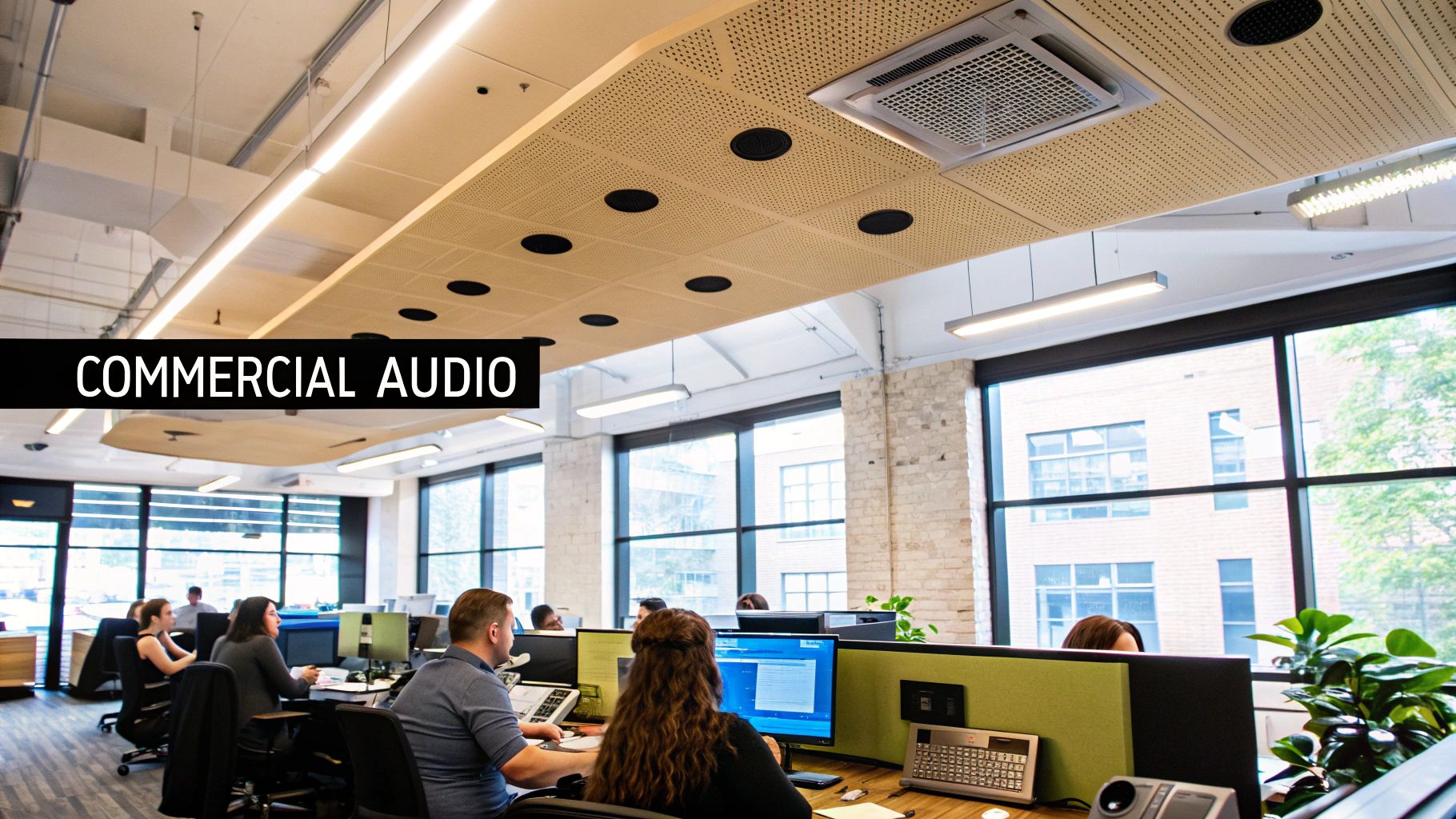
You can think of a commercial audio system as the central nervous system for your business's sound. While a home stereo is designed for high-fidelity listening in a quiet living room, a professional system is built for a completely different challenge: performance, reliability, and scale in a public space. It’s the unsung hero working tirelessly behind the scenes to shape customer experiences and keep operations running smoothly.
This distinction is absolutely critical. I've seen countless businesses try to get by with consumer-grade gear, like a simple Bluetooth speaker, and it almost always ends in disappointment. You get patchy sound, inconsistent volume, and frequent breakdowns. These systems simply aren't built to run for 8-12 hours a day, every day. A proper commercial audio setup, on the other hand, is designed from the ground up for durability, ensuring it just works.
More Than Just Music
While setting the right vibe with music is a huge part of its job, a commercial audio system's true value comes from its versatility. It handles several key functions that directly impact everything from customer mood to operational efficiency. Its purpose goes way beyond a simple playlist.
A well-designed system can seamlessly handle several jobs at once:
Atmosphere and Branding: Music and soundscapes can create a welcoming environment that reinforces your brand identity. The right audio encourages customers to stay longer and feel more connected to your space.
Clear Communication: Need to page a team member or make a store-wide announcement? The system ensures your voice cuts through the noise and is heard clearly by everyone.
Safety and Security: This is a big one. A core function is integrating with life-safety systems. In an emergency, it can broadcast automated alerts and evacuation instructions, which is often a regulatory requirement.
A professional commercial audio system is an investment in control. It gives you the power to manage how your entire space sounds and feels, ensuring consistency and quality from the front door to the back office.
The Foundation of a Professional Sound Experience
At the end of the day, the goal is to deliver the right sound, to the right people, at the right time. That might be gentle background music in a spa, an energetic playlist in a gym, or a critical announcement in a busy airport. The system has to be reliable.
It's all about achieving even sound distribution, so a customer in one corner of your shop has the same pleasant audio experience as someone in another. That level of precision is only possible with hardware and design strategies made specifically for commercial environments. In the next sections, we’ll pull back the curtain and look at the components that make all of this happen.
Decoding the Core System Components
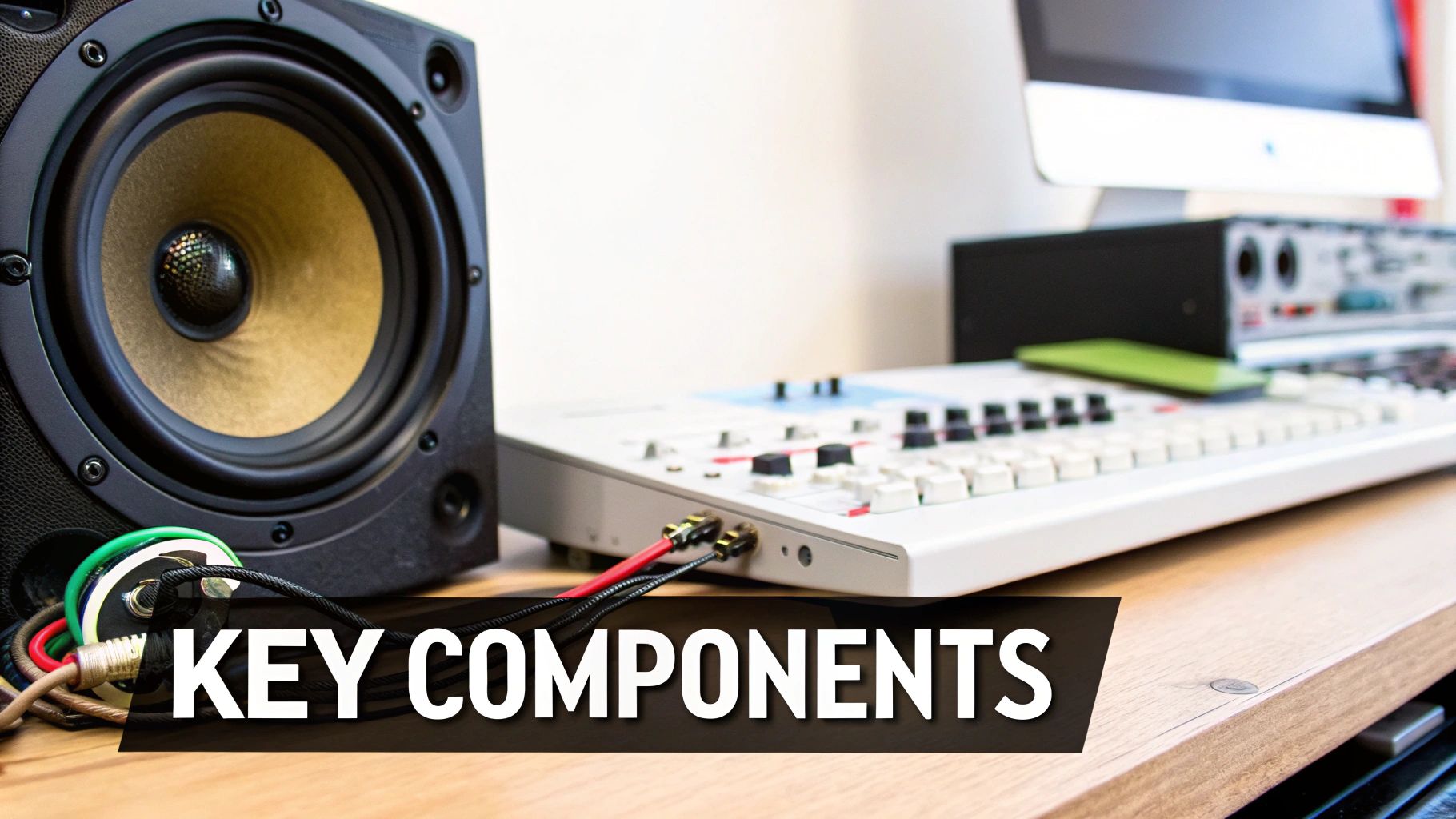
To really get what a commercial audio system can do, you have to look under the hood. It’s easy to think of it as one big thing, but the magic is in how the individual parts work together. Knowing what each component does is the key to making smart decisions for your space.
Let’s pull back the curtain on the four essential pillars of any professional audio setup. Each one has a specific, critical job to do to deliver that final, immersive sound experience.
Amplifiers: The Engine of Your Sound
The amplifier is the absolute powerhouse of your entire system. Think of it as the engine in a car—without it, you're going nowhere. Its sole purpose is to take a weak audio signal from a source and give it enough muscle to drive all the speakers connected to it.
This is where a home theater receiver just won't cut it. Professional amplifiers are built like tanks, designed for constant, all-day operation and pushing a clean, stable signal over long cable runs to potentially dozens of speakers without any drop in quality. Getting the right amplifier is all about matching its power to the demands of your speaker layout.
Mixers: Mission Control for Audio
If the amplifier is your engine, then the mixer is mission control. This is the central hub where every audio input—your microphones, music streamers, TVs—all come together to be managed. The mixer lets you take all those different sources, adjust their levels, and blend them into one seamless output.
It’s all about having granular control. In a restaurant, for example, a mixer lets you easily dip the background music to make a clear announcement from a microphone. Without one, you'd be stuck juggling a bunch of disconnected sources, which is a recipe for a chaotic and unprofessional sound experience.
Key Takeaway: A mixer isn't just for DJs. For any business, it’s the non-negotiable tool for managing multiple sound sources, ensuring announcements cut through clearly and the background music is always at that perfect "just right" level.
Speakers: The Voice of the System
Speakers are the most obvious part of the setup; they’re the "voice" that actually delivers the sound to your customers and staff. But unlike the speakers in your living room, which are meant to fill a single, predictable space, commercial speakers are specialized tools built for specific jobs and environments.
Choosing the right type is absolutely critical for getting even sound coverage and avoiding annoying "hot spots" (where it's too loud) or "dead zones" (where you can't hear a thing).
Here are the most common types you'll encounter:
Ceiling Speakers: Installed right into the ceiling, these give you broad, even coverage from above. They are perfect for retail shops, offices, and hallways where you want the sound to feel like it’s everywhere and nowhere at once, keeping the hardware discreet and out of sight.
Wall-Mounted Speakers: These are your go-to for directing sound into a specific area, like a bar, patio, or conference room. They provide a more focused audio experience and are a fantastic solution for rooms with extremely high or solid ceilings.
Pendant Speakers: You’ll see these hanging down from the ceiling like a stylish light fixture. They’re a brilliant and modern-looking fix for spaces with high, open ceilings, like you’d find in a brewery, a trendy loft-style office, or a grand atrium.
The global commercial audio system market, valued at around $10 billion, is a huge testament to how vital quality components are. Industry giants have built their reputations on creating reliable, high-performance hardware that just works.
Source Devices: The Content Origin
Finally, we have the source devices. These are the "brains" of the operation—they are what actually provide the music, voice, or other audio that your system will play. This is where the sound journey begins.
Your sources can be a wide range of things:
Microphones: Absolutely essential for paging customers, making announcements, or hosting live events.
Media Players: These are dedicated devices for playing licensed background music from services like Soundtrack Your Brand, running audio files from a USB drive, or tuning into satellite radio.
Televisions & Projectors: Tying the audio from your visual displays into the main system ensures everyone hears the big game or presentation through your high-quality speakers, not the tiny, tinny ones built into the TV.
Even looking at how high-end Audio Visual Smart Home Systems are put together can offer some great insights into how these technologies work and integrate. At the end of the day, every one of these components has to work in perfect harmony. After all, your audio system is only as strong as its weakest link.
Choosing the Right Audio System for Your Space
Picking out a commercial audio system isn't like buying a home stereo. It’s much more like choosing the right engine for a specific vehicle. You wouldn't put a sports car's engine in a semi-truck, and you wouldn't use a massive concert speaker in a tiny boutique. It’s all about matching the tech to what your business actually needs.
The first step is understanding the fundamental system types. Each one is engineered to solve a different problem, whether it's covering a huge open space with even sound or delivering crystal-clear, high-fidelity audio to a smaller, more intimate setting.
The Workhorse: 70-Volt Systems
Think of a 70-volt system as the ultimate broadcasting tool. It’s the undisputed champion for large areas that need a lot of speakers, like a big-box retail store, a sprawling warehouse, or the long corridors of a hotel. The magic here is how simple and efficient it is over long distances.
Let’s use an analogy. Imagine you’re trying to water a massive garden with dozens of sprinklers. Instead of running a separate, high-pressure hose to each one (which would be a nightmare), you’d run one main pipe at a consistent pressure and just tap into it wherever you need a sprinkler. A 70-volt system works the same way, using a high-voltage signal that lets you chain many speakers to a single amplifier with thin, affordable wire. This makes installation a breeze and keeps costs down for big jobs.
The main goal is clear, consistent coverage for background music and paging—not necessarily audiophile-level sound quality. If you need ambiance and announcements to reach every corner, this is your go-to.
A 70-volt commercial audio system is built for scale. Its design prioritizes efficient power distribution and simplified wiring, making it the most practical and economical choice for covering large, multi-speaker environments.
The Performer: Low-Impedance Systems
Now, let's switch gears from broadcasting to performance. A low-impedance system, often called an 8-ohm system, is what you’d find in a high-end home stereo, a live music venue, or a trendy bar. This setup is all about one thing: rich, dynamic, high-fidelity sound.
Going back to our water analogy, this is like having a dedicated, high-pressure hose for just one or two powerful sprinklers. Each speaker gets a direct, beefy connection to the amplifier. This allows the full range of sound to come through, giving you deeper bass, crisper highs, and a much more immersive experience.
But all that power has its trade-offs. The wiring is thicker and more expensive, and you have to keep the speaker cables pretty short to avoid losing signal quality. This makes low-impedance systems perfect for smaller, focused areas where sound quality is everything—think of a restaurant's main dining room, a fitness studio, or a premium retail shop where the music is a key part of the brand.
This graphic gives you a sense of how installation needs can scale depending on the venue.
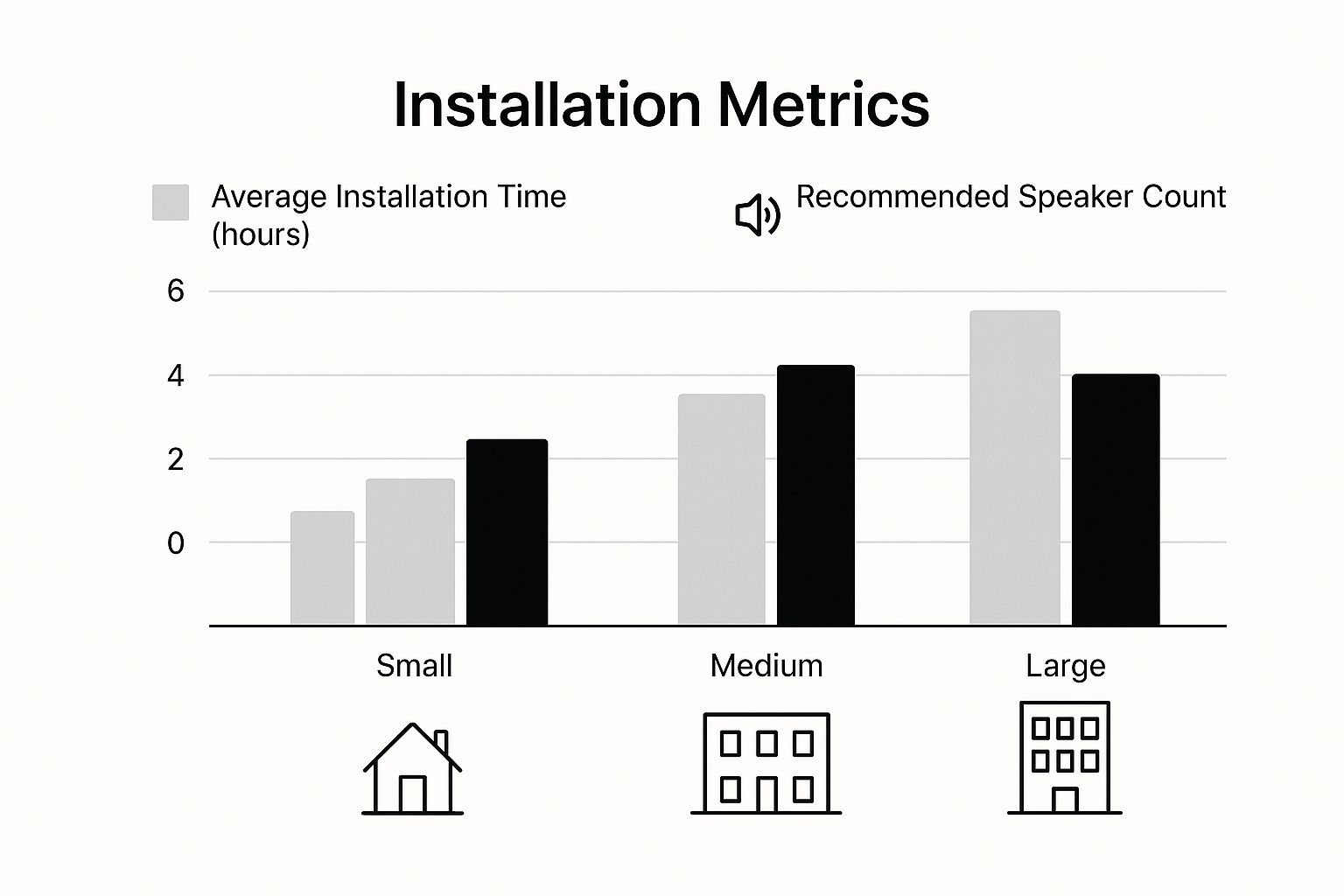
As you can see, bigger venues don’t just need more speakers; they demand a much larger investment in installation time, reflecting the complexity of getting everything wired up and configured correctly.
The Modern Solution: Networked Audio Systems
The newest player in the game is the networked audio system, sometimes called Audio over IP (AoIP). This is by far the most flexible and scalable option, as it uses your existing computer network to move audio around. Forget speaker wire; think of it more like sending an email. The audio gets converted into digital data and can be sent anywhere the network reaches.
This approach gives you an incredible amount of control. Using software, you can route any audio source to any speaker or group of speakers on the fly. It's the perfect fit for complex places like corporate campuses, airports, or modern hotels with multiple buildings. Need to send an announcement only to the second-floor conference rooms? A few clicks and it's done. Want to play different playlists in the lobby, gym, and pool area from one central computer? Networked audio makes it easy.
While the initial setup can be more technical and the gear a bit pricier, the long-term flexibility is unmatched for any large, multi-zone space. It's really the future of commercial audio management.
Commercial Audio System Types Compared
To help you figure out which system is the best fit, let's break down the key differences. Each type excels in different environments, so matching the system to your space is crucial for getting the results you want without overspending.
System Type | Best For | Key Advantage | Main Consideration |
|---|---|---|---|
70-Volt System | Large areas with many speakers (retail, warehouses, offices) | Cost-effective and simple to wire for large-scale coverage | Good for background music and paging, not high-fidelity audio |
Low-Impedance System | Smaller, performance-focused spaces (bars, restaurants, venues) | Superior, full-range sound quality with deep bass and crisp highs | More expensive wiring and limited cable distance |
Networked Audio (AoIP) | Complex, multi-zone environments (campuses, airports, hotels) | Unmatched flexibility, zoning control, and scalability | Higher initial cost and requires more IT expertise to set up |
Ultimately, the right choice depends on a simple question: what are you trying to achieve? By understanding these core system types, you’re already well on your way to designing an audio experience that truly enhances your business.
Key Considerations Before You Install
Jumping into a commercial audio installation without a solid plan is like building a house without a blueprint. The initial excitement over new gear can wear off fast, leaving you with costly mistakes and a system that just doesn't sound right. A little strategic thinking upfront is the single biggest factor in getting the results you want.
Before you even think about buying a speaker or running a cable, you need to understand your space. Every room has its own unique personality and acoustic challenges. Taking the time to do a thorough assessment will save you a world of headaches and ensure your system delivers crystal-clear sound exactly where you need it.
Think of this planning phase as your roadmap. It will guide every decision, from which components to buy to where to place the speakers, helping you build a system that works for you today and can adapt as your business grows.
Assess Your Acoustic Environment
First things first: listen to your room. The physical makeup of a space has a massive impact on sound quality. Hard, reflective surfaces are usually the main offenders, causing sound waves to bounce around like a pinball, which leads to distracting echoes and garbled audio.
Keep an eye out for these common acoustic troublemakers:
High Ceilings: Big, open ceilings might look impressive, but they can create cavernous spaces where sound gets lost or turns into an indistinct rumble.
Glass Walls: Those beautiful floor-to-ceiling windows and glass partitions? They're notorious sound reflectors that can make a room feel unpleasantly loud and harsh.
Hard Flooring: Concrete, tile, and hardwood floors bounce sound far more than carpet does, adding to the overall echo in a room.
Sometimes, the fix is as simple as adding some area rugs or acoustic wall panels. Other times, your findings will directly influence the type of speakers you choose. For instance, pendant speakers that hang from the ceiling are a fantastic solution for high-ceiling spaces because they bring the sound source closer to the listener.
Create Intelligent Audio Zones
It’s unlikely that every part of your business needs the same music at the same volume. That's where zoning comes in. Think of it as creating invisible audio boundaries that give you independent control over different areas from one central hub.
A zoned commercial audio system lets you fine-tune the atmosphere in each area. It’s the difference between a clumsy, one-size-fits-all approach and a truly customized experience that makes every part of your business better.
A restaurant, for example, could set up separate zones for its bustling bar area, the quieter main dining room, and the outdoor patio. Each zone can play different music at a different volume, all managed from a single interface. This is how you craft the perfect ambiance for every single customer.
Plan for Scalability and Integration
Your business isn't static, and your technology shouldn't be either. A classic mistake is installing a system that perfectly meets your needs today but has no room to expand. Planning for future growth from the very beginning is a much smarter, more cost-effective way to go.
This means picking components that can handle more speakers or new audio sources later on. It also means considering how your new sound system will play with other critical building systems. Integration is what turns a good system into a great one.
Think about how your audio will connect with:
Fire Alarm and Emergency Systems: In a crisis, your system needs to automatically cut the music and broadcast clear, intelligible evacuation instructions.
Digital Signage: Syncing your audio with video content on displays creates a much more engaging and powerful message.
Security Systems: You can link audio to security alerts, enabling things like pre-recorded warnings or even live two-way communication.
Pulling off a complex installation and integration requires serious planning. Applying effective telecom project management strategies is key to ensuring a smooth rollout. This kind of forward-thinking turns your audio system from a simple background music player into a vital part of your building's infrastructure.
Seeing (and Hearing) It in Action: Real-World Applications
A commercial audio system is more than just a collection of speakers and wires. When you see it in action, you realize it's a powerful business tool. Its real value isn't in the hardware, but in the goals it helps you achieve—from shaping how customers feel about your brand to making daily operations run smoother. The right audio strategy can completely transform a space and deliver a direct, measurable return.
Let's dive into how different industries are putting these systems to work, turning simple sound into a strategic asset that builds their brand and boosts their bottom line.
Crafting the Perfect Retail Vibe
In retail, you're fighting for every bit of customer attention and loyalty. A well-designed audio system is one of your best allies, creating an environment that makes shoppers want to stick around and, ultimately, spend more. It’s all about building an atmosphere that feels intentional and inviting from the second they walk in.
Think about a clothing boutique playing a curated, upbeat playlist to project a vibrant, youthful energy. That music isn't just background noise; it's a core part of the brand's identity. With a zoned system, they can take it even further:
Play slightly softer music near the fitting rooms for a more relaxed, private feel.
Deliver subtle, targeted announcements about a flash sale in the shoe department.
Gently increase the volume during peak hours to match the store's bustling energy.
This level of control is proven to increase how long customers stay in a store, which is directly linked to higher sales. In fact, one study found that 40% of shoppers will hang around longer if they like the music.
Boosting Focus in the Corporate Office
In a modern office, distractions are the enemy of productivity. Open-plan layouts are great for collaboration, but the constant hum of chatter can make it tough to concentrate. This is where a commercial audio system plays a dual role: helping people focus and making sure important messages get heard.
One of the most powerful tools for this is sound masking. It's a system that emits a soft, unobtrusive background sound—think gentle airflow—that’s specially engineered to cover up human speech. It doesn't silence the office, but it makes nearby conversations unintelligible and far less distracting.
Sound masking isn’t about adding more noise. It’s about adding the right kind of sound to make unwanted noises fade into the background, creating a more productive and confidential workspace.
Beyond that, the very same system can be used for crystal-clear audio during all-hands meetings, broadcasting emergency alerts, or making building-wide announcements. It’s a single solution for both focus and communication.
Setting the Mood in Hospitality
For restaurants, bars, and hotels, ambiance is everything. The right soundtrack makes guests feel comfortable, enhances their experience, and keeps them coming back. A zoned audio system is non-negotiable here, as it allows you to create different audio experiences in different parts of the same building.
Imagine a restaurant with several distinct areas:
The Bar: A lively, contemporary playlist keeps the energy high and social.
The Main Dining Room: Softer, more sophisticated instrumental music encourages conversation and a relaxed meal.
The Outdoor Patio: Its own set of weather-resistant speakers plays a laid-back, ambient soundtrack perfect for an evening outdoors.
This precise control lets the business create a unique vibe for each space, catering to different guests all at once. To get this just right, especially in a complex venue, it often takes the expertise of an audio engineer who can fine-tune the acoustics of each zone. That investment pays for itself with happier customers, better online reviews, and more repeat business.
Where Commercial Audio is Headed
The world of commercial audio is moving far beyond just speakers on a wall. We're seeing a massive shift towards systems that are smarter, more connected, and woven into the very operations of a building. The future isn't about just playing background music; it's about creating intelligent environments that actively improve the experience for everyone inside.
At the heart of this change is the move to IP-based, or networked, audio. Think about the difference between old-school landline phones and making a call over the internet. Instead of pulling heavy, dedicated copper wires to every single speaker, the sound is converted into data and sent over the same computer networks you already use.
This opens up a world of flexibility. A facilities manager can instantly re-route audio to a different zone, adjust volume across an entire campus, or schedule announcements from a simple web browser—whether they're in the building or halfway across the world.
AI Is Becoming the Sound Engineer
The next big leap is artificial intelligence. AI is starting to act as a virtual, always-on sound engineer, making real-time adjustments to optimize the audio. It can automatically tweak the EQ as a room fills with people or as background noise from the street gets louder.
Picture a restaurant where the audio system subtly raises the music as the dinner rush peaks, so the vibe is never lost in the chatter. AI can also power predictive maintenance by analyzing performance data to spot a component that's about to fail before it breaks, saving you from a system outage during business hours.
We're seeing this same trend in the consumer world, which often points to where the commercial market is going. The home audio equipment market was valued at $32.69 billion in 2023 and is expected to more than double by 2030, driven largely by AI features like voice assistants and smart sound tuning. You can read more about this growth in the home audio market to see how consumer tech paves the way for commercial applications.
The ultimate goal is for a commercial audio system to become invisible but essential. It should just work, adapting to its surroundings on the fly to deliver perfect clarity and atmosphere without anyone having to touch a dial.
Joining the Smart Building Ecosystem
Ultimately, commercial audio is becoming a crucial piece of the larger "smart building" puzzle. It’s no longer a siloed utility. It’s a key data source and output that works hand-in-hand with other building systems to create truly responsive spaces.
This tight integration unlocks some powerful new possibilities:
Lighting Systems: Imagine a critical alert in a large venue that automatically brings up the house lights for safety, triggered directly by the audio system.
Security and Access Control: The system can sync with security cameras to broadcast automated warnings when motion is detected in a restricted area after hours.
Digital Displays: Audio can be perfectly timed with video walls and digital signs, creating powerful multimedia experiences that grab a customer's attention and won't let go.
Taking this integrated approach is really about future-proofing your investment. When you choose a system built on networking, you're not just buying audio hardware. You're laying the groundwork for a more intelligent, efficient, and engaging environment for years to come.
Got Questions? We’ve Got Answers.
When you're looking into a commercial audio system, a lot of practical questions pop up. We get it. Let’s tackle some of the most common ones that business owners ask so you can move forward with confidence.
What’s the Real Difference Between a Commercial and a Home Stereo System?
It really boils down to three things: durability, scale, and purpose. Think of a commercial audio system as the workhorse of the audio world. Its components are built tough, designed to run all day, every day without a hitch. These systems are also engineered to push sound across long distances to a large number of speakers.
Beyond just being rugged, they’re packed with features you’d never find in a home setup. We’re talking about things like multi-zone control to play different audio in your lobby and your conference rooms, microphone inputs for paging customers, and critical integrations with fire alarms and emergency alerts. A home stereo just isn't built for the rigors or requirements of a public space.
A home stereo is built for listening pleasure. A commercial audio system is built for business performance—it’s a reliable piece of infrastructure designed for constant use.
Do I Really Need a Professional to Install It?
In a word, yes. Professional installation is a must, and we can't recommend it enough. A seasoned integrator does so much more than just run wires. They’ll start by analyzing your building’s unique acoustics, mapping out the perfect speaker placement to eliminate dead spots, and ensuring all the wiring is safe and meets local building codes.
Trying to DIY a commercial system usually ends in frustration. You end up with poor, uneven sound quality and can even risk damaging your new equipment or creating a safety hazard. Investing in a pro means your system will work exactly as it should from the moment they flip the switch.
How Much Is This Going to Cost?
This is the big question, and the honest answer is: it varies—a lot. A simple background music setup for a small boutique might only run a few thousand dollars. On the other hand, a sophisticated, multi-zone system for a large corporate campus or hotel could easily get into the tens of thousands.
The final price tag is really driven by a few key factors:
The total square footage you need to cover.
How many speakers you need and what kind they are (e.g., in-ceiling, wall-mounted).
The power and capabilities of the amplifier and mixer.
The complexity of the wiring and the installation itself.
Your best bet is to get detailed quotes from a couple of qualified installers. They can design a system that’s truly built for your space and your budget.
Comments