


Top Perimeter Security Systems for Maximum Protection
- Бонус за регистрацию онлайн казино
- Jul 26, 2025
- 16 min read
A perimeter security system is your property's very first line of defense. Think of it less like a single camera or a locked gate and more like a modern-day moat and watchtower—a smart, interconnected network designed to stop threats before they ever reach your building's doors.
What Is a Perimeter Security System?
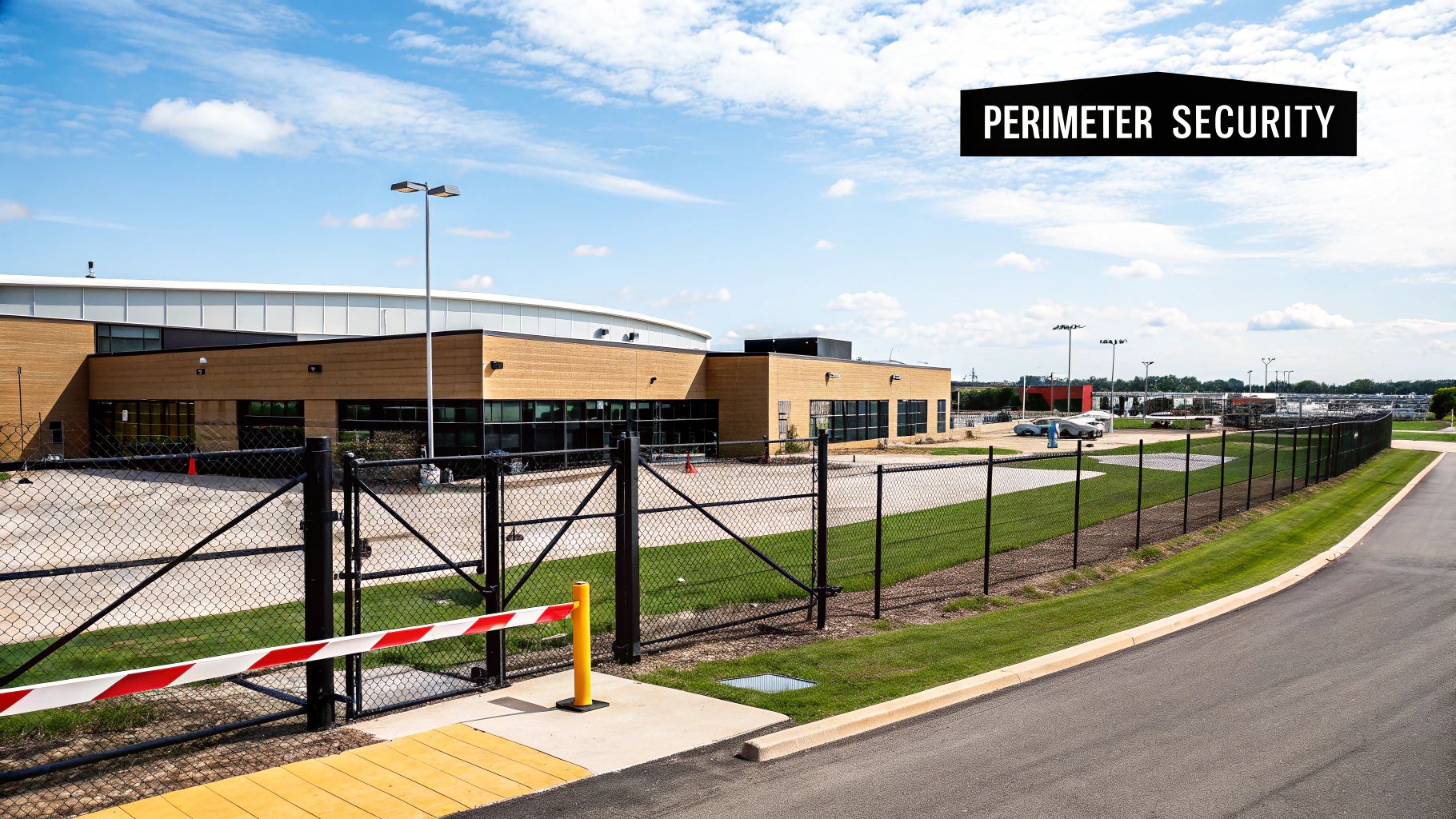
Let's use an analogy. If your business were a castle, you wouldn't just lock the door to the treasure room and call it a day. You’d build high walls, dig a moat, and station guards in watchtowers. A perimeter security system brings that same layered thinking to modern properties. It’s an integrated system of physical barriers, electronic sensors, and video surveillance all working in concert at the very edge of your site.
The whole point is to create an invisible shield that gives you a crucial head start. Instead of only reacting after a window is smashed, you're alerted the second someone even thinks about hopping the fence. This proactive philosophy is what really separates basic security from a genuine perimeter defense strategy.
An effective system doesn’t just record a break-in—it actively works to prevent it from ever happening. It's about flipping the script from a reactive stance to a proactive one, buying you precious time to respond.
This approach has become essential for all sorts of places, from sprawling commercial parks and industrial plants to critical infrastructure like data centers and power grids. The numbers back this up, too.
The global market for perimeter security systems hit USD 66.41 billion in 2024 and is expected to soar past USD 165 billion by 2034. This explosive growth isn't just a trend; it's a direct response to the need for smarter, more reliable ways to stay ahead of sophisticated threats. You can dive deeper into these figures with this detailed security market report.
Core Functions of a Perimeter Security System
At the end of the day, a well-designed perimeter security system is built to accomplish a few key things. Think of these functions as a sequence—each one building on the last to create a formidable defense.
Function | Description |
|---|---|
Deter | The system's visible components—like tall fences, warning signs, and obvious cameras—act as a powerful psychological barrier. The goal is to make a potential intruder think twice and move on. |
Detect | This is where the technology kicks in. Using advanced sensors (infrared beams, fiber optic cables, motion detectors), the system instantly identifies an unauthorized entry attempt right at the boundary line, triggering an immediate alert. |
Assess | Once an alert is triggered, surveillance cameras and monitoring software give security personnel eyes on the situation. They can visually confirm the threat, gauge its seriousness, and dispatch the right response. |
Together, these three functions—deter, detect, and assess—form the backbone of any robust perimeter security strategy, protecting your assets from the outside in.
The Building Blocks of a Modern Perimeter Defense
A truly effective perimeter security system isn't just one piece of equipment; it's a team of specialized components all working in concert. I like to think of it as building a fortress. You don't just build a wall; you add watchtowers, guards, and controlled gates. Each part has a job, and together, they create a layered defense that's tough to beat. To get it right, you have to understand what each of these building blocks brings to the table.
A solid system hinges on the seamless cooperation between physical barriers, smart electronic sensors, and intelligent surveillance. The whole idea is to create multiple hurdles an intruder has to overcome. Each layer is designed to detect a threat and instantly communicate it to the next, creating a "defense-in-depth" strategy that is far more powerful than any single security measure on its own.
This infographic gives a great visual breakdown of the core elements that form a complete perimeter defense.
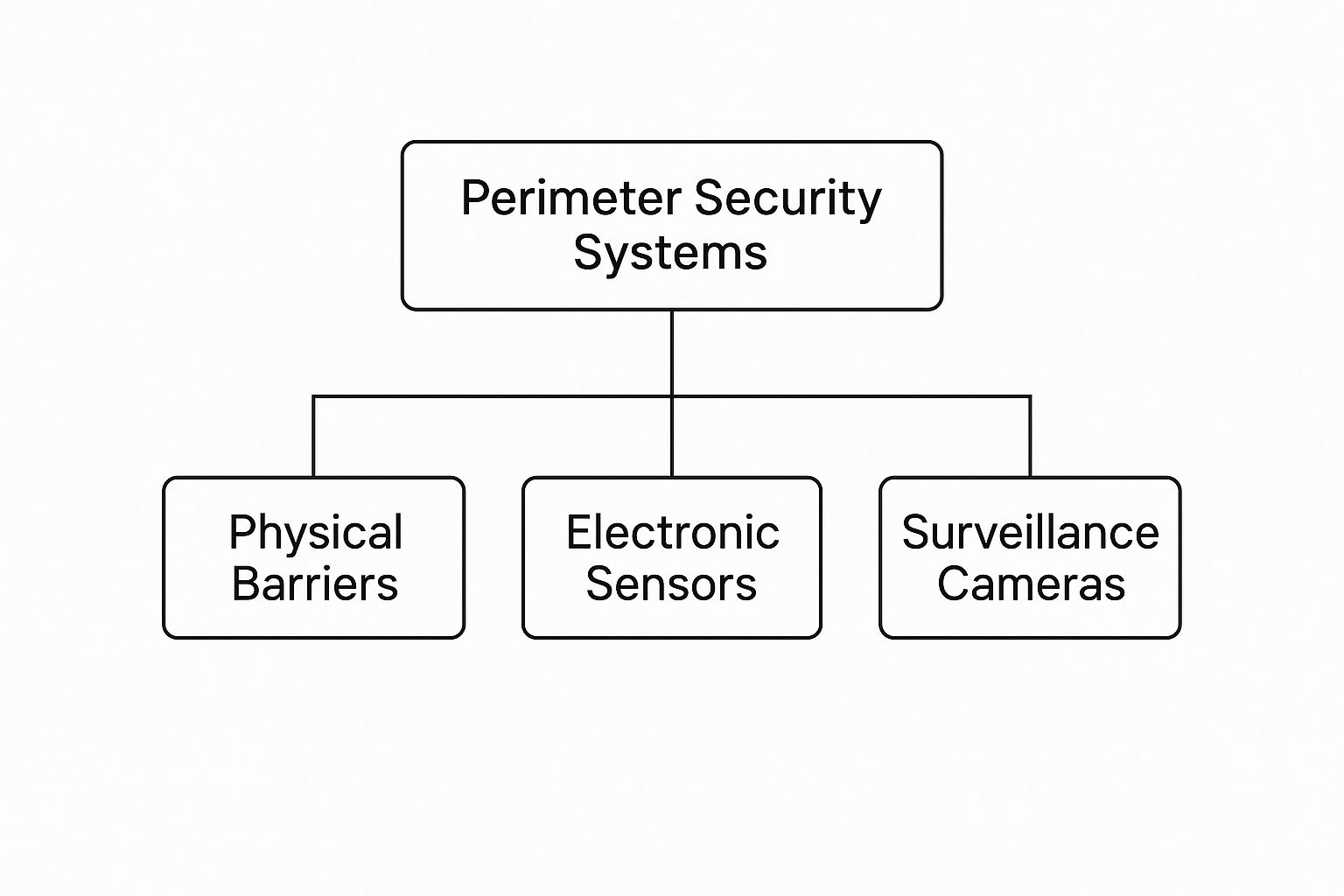
As you can see, the foundational pillars of any modern system are the physical barriers, the electronic sensors, and the surveillance cameras that watch over them. Let's dig into what each of these components actually does.
Physical Barriers: The First Line of Defense
Physical barriers are the most obvious part of your security. They're the first thing anyone sees, and their main job is to deter, delay, and clearly define the boundary of your property. Think of them as the front-line soldiers of your perimeter.
Fences and Walls: These are the most common physical barriers, doing the simple but critical job of marking your perimeter. Options run the gamut from basic chain-link fences all the way to high-security, anti-climb fencing designed to seriously slow down an intruder.
Gates and Bollards: These elements are all about controlling access points for people and vehicles. Automated gates, when paired with access control systems, make sure only authorized people get in. Meanwhile, fixed or retractable bollards are fantastic for preventing vehicle-ramming attacks.
Barbed and Razor Wire: Often added to the top of fences, these toppings are a powerful deterrent. They make any attempt to climb over the barrier significantly more difficult and dangerous for a potential trespasser.
But here’s the thing: these structures are passive. Given enough time and determination, they can be bypassed. That’s precisely why they must be paired with active detection technologies that send an alert the second a barrier is challenged.
Detection and Sensors: The Nervous System
If physical barriers are the skeleton of your security, then detection sensors are its nervous system—constantly feeling for any sign of trouble. These technologies are designed to pick up on an intrusion attempt in real-time, often before a physical barrier is even touched.
The real power of a modern perimeter security system is its ability to detect threats instantly and accurately. This is what flips the script from reactive to proactive, giving you the early warning you need to stop a breach before it happens.
These sensors are what turn a dumb fence into an intelligent, responsive boundary. Of course, for all this to work, you need a solid network backbone. Key components like network routers and switches are crucial for allowing your sensors, cameras, and control systems to communicate with each other instantly.
Surveillance and Access Control: The Eyes and Gatekeepers
Once a sensor trips, you need to know exactly what’s going on. This is where surveillance and access control systems step in, acting as the system’s eyes, ears, and trusted gatekeepers.
Surveillance and Assessment
CCTV Cameras: Modern 4K and thermal cameras give you crystal-clear visual evidence, day or night. This allows your security team to look at a triggered alarm, verify if it’s a real threat or a false alarm, and track an intruder's movements.
Video Analytics: This is the really smart stuff. Intelligent software can be programmed to automatically spot specific behaviors—like someone loitering near a fence or a vehicle entering a restricted zone—and trigger an alert without a human having to watch the screen 24/7.
Access Control Systems
These systems are all about managing who is allowed to pass through your perimeter’s checkpoints.
Card Readers and Keypads: A common and highly effective way to manage entry for employees and approved visitors.
Biometric Scanners: For high-security areas, nothing beats biometrics. Fingerprint or facial recognition scanners provide an unmatched level of identity verification, making absolutely sure only the right people get in.
How to Integrate Your Security Components
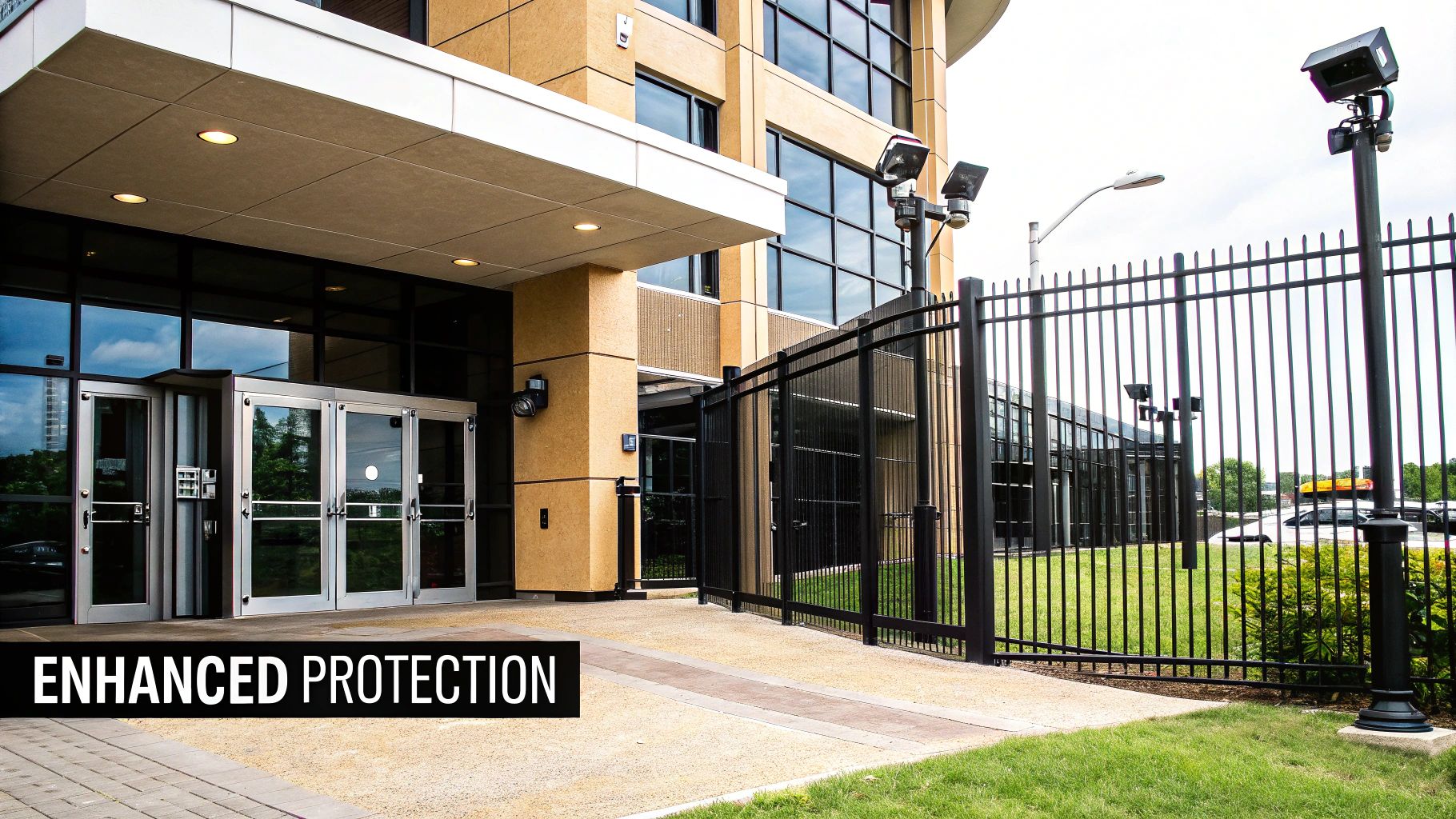
Standalone security devices are helpful, but they don't see the big picture. Their real power is only unleashed when they communicate and work together as a single, cohesive unit. Think of it like an orchestra—a lone violin is nice, but a full symphony creates something powerful and layered. Integrating your security components turns individual instruments into a coordinated, intelligent defense.
This integration is conducted by the system's "brain." This is often a Video Management System (VMS), which excels at handling video feeds, or a more comprehensive Physical Security Information Management (PSIM) platform. A PSIM is the true command center, pulling data from every camera, sensor, and access point into one unified dashboard.
The result is a security force that responds automatically and instantly. This seamless communication is what gives a modern perimeter security system its real edge.
Creating an Intelligent Response Chain
A truly integrated system builds an automated cause-and-effect chain that all but eliminates human error and dramatically slashes response times. It’s not just about getting an alert; it’s about that alert triggering a series of smart, pre-planned actions across your entire network. This is where modern IP-based systems really shine, allowing different devices to "talk" to one another seamlessly.
Imagine this playing out in real-time:
Detection: A vibration sensor on a perimeter fence detects someone trying to climb it.
Assessment: The system instantly commands the nearest Pan-Tilt-Zoom (PTZ) camera to turn, point, and zoom in on that exact spot, giving you immediate eyes on the situation.
Deterrence: At the same moment, high-intensity floodlights snap on in that zone, and an automated voice warning blares from a loudspeaker.
Alerting: A high-priority alert, complete with a live video feed, is pushed directly to the security team's mobile devices, showing them exactly what’s happening and where.
This entire sequence unfolds automatically in seconds—far faster than any human operator could possibly react.
By linking detection, assessment, and response, integration transforms your perimeter from a passive barrier into an active, thinking defense mechanism. It ensures that for every action, there is an immediate and calculated reaction.
This level of smart automation is what’s pushing the security industry forward. The shift from older, rigid analog systems to flexible IP-based networks is a key reason the global perimeter security market is expanding so rapidly. Valued at roughly USD 92.89 billion in 2024, the market is expected to climb to over USD 101.21 billion by 2025. This incredible growth, detailed in this perimeter security market analysis, highlights the massive industry-wide move toward smarter, integrated solutions.
The Role of Open Platforms
For this kind of communication to work, your components need to speak the same language. In the past, many security systems were "closed," meaning a camera from one brand wouldn't work with a control panel from another. This created huge headaches and locked customers into a single, often expensive, ecosystem.
Thankfully, the industry has since embraced an open-platform approach. This uses standardized protocols that allow devices from different manufacturers to integrate without a hitch. Choosing components built on these open standards is one of the smartest decisions you can make. It ensures your perimeter security systems are not only effective today but also flexible enough to adapt to new technologies tomorrow, safeguarding your investment for the long haul.
Of course. Here is the rewritten section, designed to sound like it was written by an experienced human security expert.
The Game-Changer: How AI is Redefining Perimeter Security
If you think the biggest advancements in perimeter security are just sharper cameras or tougher fences, you're missing the real story. The genuine leap forward has been the infusion of intelligence. Artificial Intelligence (AI) is what’s turning security systems from passive recording devices into proactive, thinking defense networks.
It's the difference between having a night guard who just stares blankly at a wall of monitors and having one who instinctively knows what to look for, can spot trouble before it happens, and can tell the difference between a real threat and a distraction.
From Nuisance Alarms to Actionable Intelligence
Picture this: you're trying to secure a long fence line right next to a patch of woods. A traditional motion-based system would go haywire all night long. An alert for a wandering deer. Another for a tree branch swaying in the wind. Even shifting shadows at sunset could trigger it. This flood of false alarms creates "alert fatigue," and pretty soon, your team starts tuning out the noise—which completely defeats the purpose of having a system in the first place.
This is exactly where AI changes everything.
AI-powered video analytics give your security system a brain. Instead of just detecting a blur of motion, it performs object classification. The system has been trained to understand what it's seeing, so it can instantly tell the difference between a person, a car, and an animal with astonishing accuracy.
The result is a massive drop in false alarms—we've seen it reduce them by over 95% on some sites. This means when an alert finally does come through, your team knows it’s real and requires immediate attention.
AI doesn’t just give you more data; it gives you answers. It cuts through the static so you can focus on genuine threats, making your response faster and dramatically more effective.
This shift is huge. Your security staff stops wasting time rewinding footage of a stray cat and can instead pour their energy into responding to confirmed, credible threats. It not only tightens up security but also makes your whole operation more efficient.
Real-World AI Security Applications
The impact of AI isn't just about quieting down false alarms. It’s unlocking capabilities that once felt like something out of a spy movie, making your perimeter a truly smart, responsive shield.
Here are a few ways it's already being used out in the field:
Behavioral Analytics: AI learns the normal rhythm of your property. It establishes a baseline for what "normal" looks like, then automatically flags anything out of the ordinary—like someone loitering near a secure gate, a car circling the parking lot, or an individual trying to tamper with a camera.
Predictive Threat Assessment: This is where it gets really interesting. Advanced systems can start to analyze intent. By tracking a person's posture, speed, and trajectory, the AI can assess whether they're just walking by or if their movements—like crouching near a fence—suggest they're about to attempt a breach.
Autonomous Drones and Robotics: AI-powered drones can now run their own patrols. If a sensor on the fence is tripped, a drone can be dispatched automatically. Within seconds, it provides live aerial video, tracking an intruder across a huge property without ever putting a human guard in harm's way.
To really see the difference, it helps to put the old way of doing things side-by-side with the new, AI-driven approach.
Traditional vs. AI-Powered Perimeter Security
The table below breaks down how AI elevates every core function of a security system, moving from a reactive model to a proactive one.
Feature | Traditional System | AI-Powered System |
|---|---|---|
Threat Detection | Relies on basic motion or pixel changes | Identifies specific objects (people, vehicles) and analyzes behavior |
Alerts | Constant false alarms from animals, weather, and shadows | Highly accurate alerts focused only on verified threats |
Monitoring | Demands constant human eyeballs on screens | Automates monitoring and notifies on specific events |
Response | Reactive; operators must manually verify every single alert | Proactive; delivers verified threats with crucial context and tracking |
Data Analysis | Requires manually scrubbing through hours of video | Allows instant, searchable events (e.g., "show me all people near the north gate after midnight") |
By bringing AI into the fold, a perimeter security system becomes so much more than just a pile of hardware. It transforms into a dynamic, intelligent network that actively works to protect your assets with a level of speed, intelligence, and reliability that was simply impossible before.
Designing Your Perimeter Security Strategy
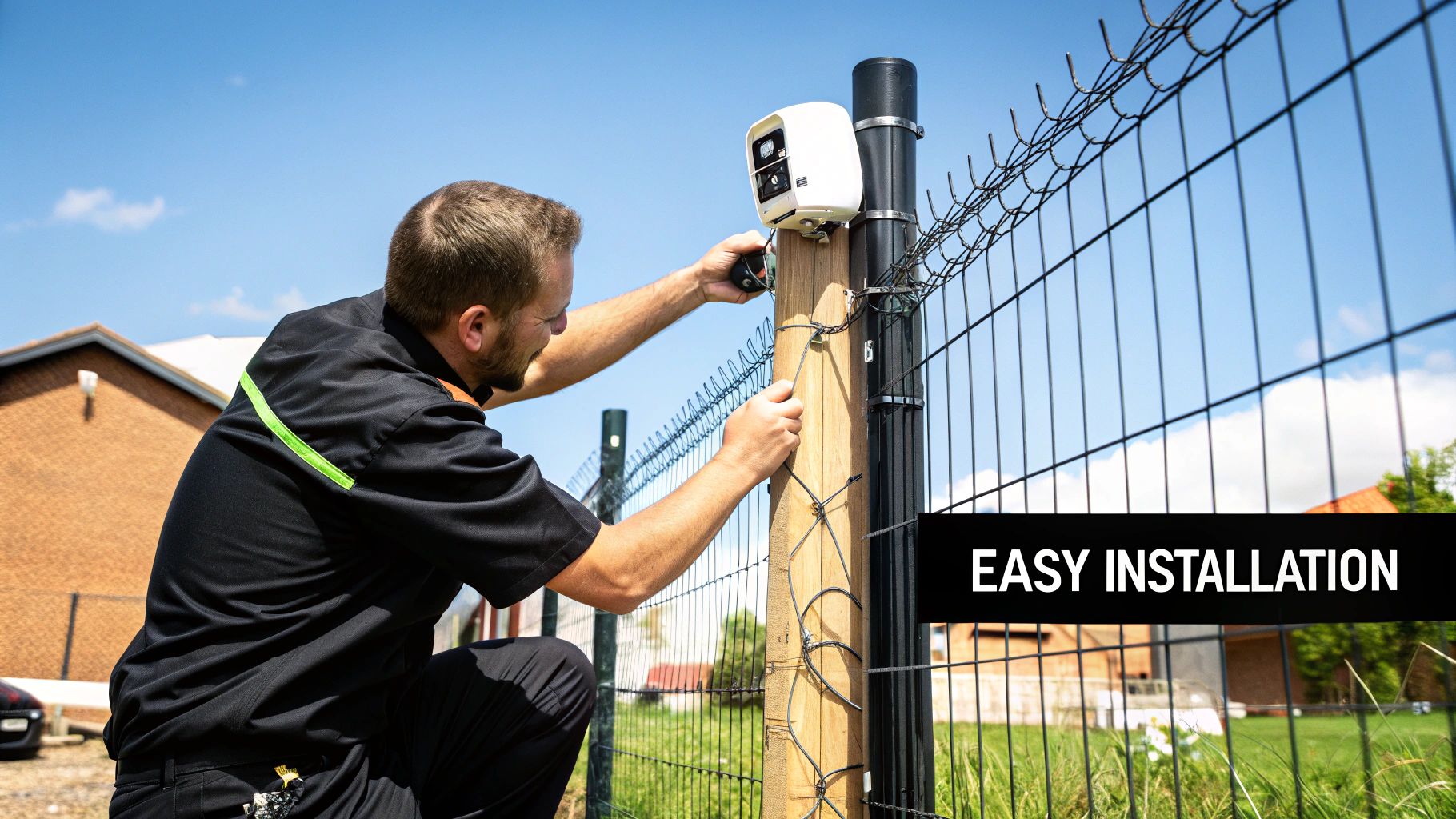
Putting together an effective security perimeter isn't about buying the most expensive gadgets off the shelf. It's about smart, thoughtful design. A powerful system is born from a clear strategy, not a random shopping list. This process helps you think like a security professional, making sure every dollar you spend directly counters a real risk and builds a defense you can truly rely on.
This approach is so much more than just sticking up a few cameras. It's about following a methodical roadmap that turns a collection of devices into a cohesive security shield, built specifically for your property’s unique layout and challenges. When you follow a structured plan, you create perimeter security systems that are both highly effective and cost-efficient.
Stage 1: Perform a Thorough Risk Assessment
Before you even glance at a product catalog, you have to understand your vulnerabilities. A risk assessment is the bedrock of your entire security plan. Think of it like a doctor diagnosing an illness before writing a prescription; you need to know exactly what you're trying to protect against.
Walk your property with a critical eye and ask yourself some tough questions:
Where are the weak points? Look for those poorly lit corners, the blind spots between buildings, overgrown bushes near the fence line, or that one gate that never seems to latch properly.
What are the most likely threats? Are you worried about kids causing mischief, organized thieves targeting your equipment, or someone trying to drive a vehicle where they shouldn't? The threat dictates the solution.
What are your most valuable assets? Pinpoint the high-value equipment, sensitive server rooms, or critical operational areas that absolutely must be protected.
This walk-through will help you create a "threat map" of your site, showing you exactly where to focus your resources for the biggest impact. A proper assessment stops you from wasting money solving problems you don’t actually have.
Stage 2: Craft a Layered System Design
With your risk assessment in hand, you can start designing the system itself. The core principle here is defense-in-depth, or what we in the industry simply call layering. A single line of defense is fragile and easily broken, but multiple layers working in concert create a much tougher obstacle. Your goal is to force any intruder to overcome a series of detection and deterrence measures.
A typical layered design looks something like this:
Outer Layer (Deterrence): This is all about visible prevention. We're talking clear signage ("You Are on Camera"), well-maintained fencing, and obvious, strategically placed security cameras. The goal is to make a potential intruder feel exposed and decide your property is just too much trouble.
Mid-Layer (Detection): This is your invisible tripwire. It could be fence-mounted vibration sensors that feel someone climbing, infrared beams that create an invisible gate across a pathway, or video analytics programmed to spot movement in a restricted zone. This layer gives you that critical early warning.
Inner Layer (Response): The moment an alarm is triggered, this layer snaps into action. It can include high-intensity floodlights that instantly illuminate the area, automated audio warnings telling the person to leave, and PTZ cameras that automatically lock onto and track the intruder, giving your team live, actionable intelligence.
A well-designed system makes it impossible for an intruder to approach without being seen, difficult to proceed without being detected, and certain they will be challenged before reaching their target.
Stage 3: Follow Installation Best Practices
Here’s a hard truth: even the best equipment on the market will fail if it's installed poorly. Proper installation is a technical skill that demands serious attention to detail. A sloppy job can create brand new vulnerabilities, from major camera blind spots to sensors that cry wolf with constant false alarms.
Key installation points to obsess over include:
Strategic Camera Placement: Cameras must be positioned to eliminate blind spots, cover every possible entry point, and have clean lines of sight. They need to be high enough to prevent tampering but low enough to capture clear, identifying details.
Sensor Calibration: Every sensor has to be fine-tuned for its specific environment. This means adjusting sensitivity to ignore things like tree branches swaying in the wind or normal vibrations from a nearby road. Getting this right is the secret to dramatically reducing false alarms.
Weatherproofing and Durability: All your exterior components must be rated to survive your local climate, whether that means blistering sun, driving rain, freezing temperatures, or high winds.
Stage 4: Conduct Rigorous System Testing
Once everything is installed, it’s time to try and break it. You heard me right. Thorough testing is the only way to know for sure that every component works together exactly as you planned. This is more than just checking if a camera turns on; it’s about simulating real-world intrusion scenarios.
Walk the perimeter and intentionally trigger every sensor. Have a team member try to sneak in from an unexpected angle. Verify that when a specific alarm goes off, the correct cameras pan to the spot, the right lights switch on, and alerts are sent to the right people, instantly. This "stress test" will expose any weaknesses in your design or installation, giving you the chance to fix them before a real event puts your security to the test.
Your Top Perimeter Security Questions, Answered
When you're tasked with protecting a property, the world of security tech can feel overwhelming. Getting straight answers to your questions is the first step toward making a smart, confident decision. Here, we'll tackle the most common questions we hear from facility managers and business owners about building an effective perimeter security system.
It's no surprise these questions are coming up more often. The perimeter security market is booming—it was valued at around USD 72.52 billion in 2024 and is projected to hit USD 78.27 billion by 2025. This isn't just about spending more; it's about smarter spending on things like biometrics, cloud integration, and intelligent sensors. You can get a deeper look at what’s driving this growth in this insightful perimeter security market overview.
Let's get into the practical side of things.
How Do I Stop My System from Crying Wolf with False Alarms?
Nothing kills a security system's credibility faster than constant false alarms. When your team is bombarded with alerts from swaying trees, stray cats, or bad weather, they start tuning it all out. This "alert fatigue" is incredibly dangerous because it means a real threat could be easily missed.
The solution isn't just to dial down the sensitivity—it's about making the system smarter.
Use Better Sensors: Start with quality, dual-technology sensors. For instance, a device combining passive infrared (PIR) and microwave technology requires both sensors to be triggered before sounding an alarm. This simple change eliminates a huge number of errors caused by a single trigger.
Bring in AI Analytics: This is the real game-changer. Modern AI video analytics can perform object classification, which means the system can actually tell the difference between a person, a vehicle, and a blowing plastic bag. This is how you get to near-zero false alarms from harmless activity.
Get the Installation Right: Where and how you install your equipment is critical. A motion sensor aimed at a busy public road is going to be a nightmare. Professional installation and regular calibration fine-tune your devices to the specific quirks of your environment, filtering out predictable noise from the start.
Can a New Perimeter System Work with My Old Security Gear?
Absolutely. This is a huge concern for anyone who has already invested in security infrastructure. The good news is that modern perimeter security systems are designed for integration, especially if they are IP-based and built on an open platform.
Think of an open-platform system as a universal translator. It helps devices from totally different brands speak the same language and work as a team.
A Physical Security Information Management (PSIM) platform takes this a step further. It acts as the ultimate command center, pulling feeds from your brand-new digital gear and your older analog components into one cohesive dashboard.
This means a new sensor on your fence line can automatically trigger your existing cameras to pan, tilt, and zoom to the right spot. A new card reader at a gate can talk to your old alarm panel. This approach protects your initial investment while letting you upgrade key areas strategically, one piece at a time. The trick is to choose new components that play well with others.
What’s the Single Biggest Mistake People Make When Designing a System?
The biggest and most expensive mistake we see is putting technology before strategy. Too many people start by shopping for the fanciest cameras or the most high-tech sensors without first doing a proper risk assessment of their property. It’s like a doctor prescribing a powerful drug without ever diagnosing the patient.
When you buy impressive hardware without truly understanding your specific vulnerabilities, you end up with a system that feels secure but isn't. You might have state-of-the-art cameras watching a low-risk wall while a critical access point is left wide open.
A successful design process always begins with a thorough, boots-on-the-ground analysis of the site. This involves:
Identifying the most likely paths an intruder would take.
Pinpointing what your most valuable or vulnerable assets are.
Accounting for environmental factors like lighting, blind spots, and terrain.
Understanding how your security team will actually use the system day-to-day.
Only after you have a crystal-clear map of your risks should you even begin to look at product spec sheets. A security plan that starts with a risk assessment—not a product catalog—is the only way to build a perimeter defense that is both robust and cost-effective.
Ready to design a security strategy that addresses your unique risks with smart, integrated solutions? PCI Audio-Video Security Solutions provides advanced security camera systems, access control, and alarms tailored for commercial and industrial clients. Protect your property with a system built on expertise. Learn more at https://www.pciavss.com.
Comments