


Understanding Alarm System Installation Cost
- Бонус за регистрацию онлайн казино
- Sep 2, 2025
- 14 min read
When you start looking into alarm systems, the first question is always the same: "How much is this going to cost me?" For a typical home, you can expect the alarm system installation cost to land somewhere around $747.
Of course, that's just an average. The final price tag can swing wildly, from a simple DIY kit you can pick up for under $100 to a sophisticated, professionally installed setup that could run you over $2,500. It all comes down to the gear you choose, who puts it in, and whether you want ongoing professional monitoring.
Decoding Your Initial Security Investment
Trying to pin down the exact cost of a new alarm system can feel a bit like guesswork. There’s no single price, but rather a range that depends entirely on what you need to protect and how you want to do it.
Think of it like buying a car. You could go for a reliable, no-frills sedan that gets you from A to B, or you could opt for a luxury SUV loaded with all the latest tech. Both are great options, but their prices are worlds apart. It's the same deal with security systems.
Your final bill is shaped by a few core choices you'll have to make:
System Type: Are you looking for a basic, unmonitored system that just makes a lot of noise and sends an alert to your phone? Or do you want a professionally monitored system where a team is ready to dispatch emergency services 24/7?
Installation Method: Are you a hands-on person ready to tackle a DIY setup, or would you rather have a pro handle the installation for a seamless, guaranteed result?
Equipment Complexity: Do you just need a few sensors on your doors and windows, or does your property call for a full suite of cameras, motion detectors, and smart home gadgets?
To give you a clearer benchmark, the average cost to install a home alarm system in 2025 is right around that $747 mark, but the typical range spans from $55 to $2,500. That big gap accounts for everything from the brand you choose to the labor involved. For instance, hardwired systems, which are more complex to install, often have higher labor fees, typically between $120 and $600. You can dig into more of these national cost averages from homeadvisor.com.
The biggest trade-off you'll face is between the upfront equipment cost and the ongoing monthly monitoring fees. Don't be fooled by "free" installation offers—those costs are almost always baked into a long-term service contract.
Getting a handle on this trade-off is key. A system with a low upfront cost might lock you into a higher monthly fee for years, while paying more for equipment out of pocket could lead to significant savings down the road. Let's break down each of these costs so you can build a budget that makes sense for you.
Decoding the Main Cost Components
Figuring out your total alarm system installation cost is a lot like looking at a car's window sticker. The final price isn't just one number; it's a sum of different parts, each with its own specific job and price tag. When you break down a quote, you'll see four main pillars that shape your total investment.
These core components are hardware, labor, permits, and ongoing monitoring. Think about it: a high-performance engine costs more than a standard one. In the same way, an AI-powered security camera will naturally be more expensive than a simple door contact sensor. Understanding how these elements add up helps you make smarter decisions for your business.
The Foundation: Hardware and Equipment
The physical devices are the most visible part of your security system, and they usually make up the biggest chunk of your upfront cost. This isn't just a single item but a whole family of components that work in sync to protect your property. The price tag can swing wildly depending on the tech you choose and how much of it you need.
For example, a single high-definition surveillance camera can run anywhere from $500 to over $2,000. The final price depends on features like smart motion detection or pan-tilt-zoom capabilities. For businesses, access control systems can be even more varied, potentially costing $1,500 to $10,000 per door.
Your specific hardware needs will likely include a mix of these key pieces:
Control Panel: This is the brain of the operation, communicating with every other device.
Sensors: Think door and window contacts, motion detectors, and glass break sensors.
Cameras: These range from basic indoor models to sophisticated outdoor units with built-in analytics.
Keypads: Your main interface for arming and disarming the system.
This image gives you a great visual breakdown of how these costs are structured, with the hardware serving as the base expense.
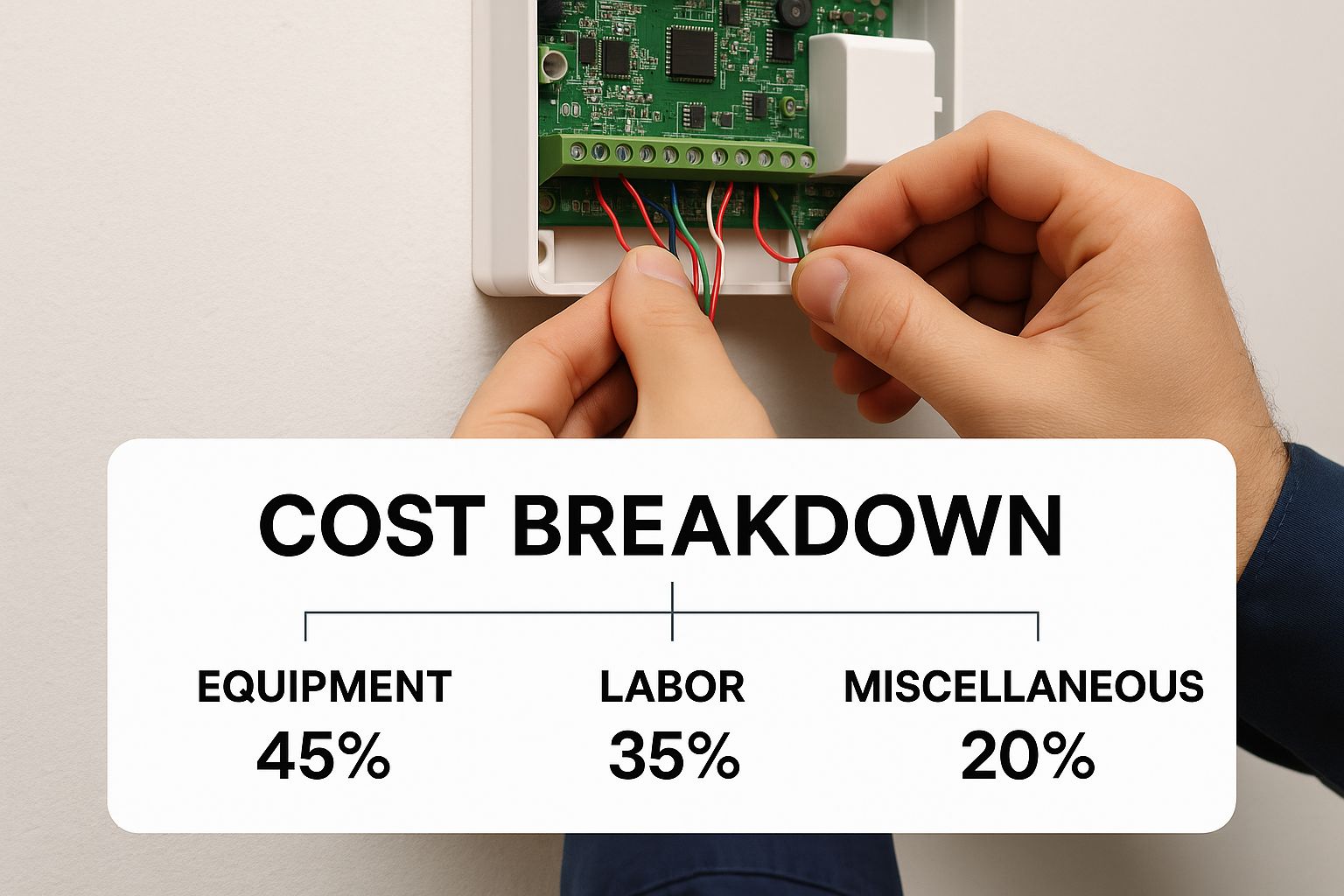
As you can see, while the equipment forms the foundation, the labor to install it and the ongoing monitoring fees are significant costs that build on top of that initial investment.
The Expertise: Labor and Professional Setup
Unless you're going the DIY route, professional installation is a major factor in your budget. This isn't just about plugging things in. It’s about strategic placement of sensors, secure and tidy wiring, and proper system configuration to make sure everything works perfectly and there are no vulnerabilities.
Labor charges for a pretty standard wireless system often fall between $500 and $1,000. But that number can climb quickly for more complex jobs. Hardwired systems, for instance, are much more involved—they require running cables through walls and ceilings, which takes more time and, therefore, costs more.
Paying for professional installation is really an investment in reliability. An expert makes sure sensors are placed correctly, blind spots are eliminated, and the system works exactly as it should from day one. This prevents frustrating false alarms and, more importantly, dangerous security gaps.
Finally, don't forget to account for any municipal permits that might be required, especially for commercial fire alarm systems. These can add a few hundred dollars to the bill. The last piece of the puzzle is the recurring monitoring fee, which ensures a professional team is keeping an eye on your property 24/7, completing your total cost picture.
Comparing DIY and Professional Installation
Deciding how to install your alarm system is one of the biggest forks in the road you'll face, and it has a massive impact on the final alarm system installation cost. This isn't just about money; it's a classic trade-off between upfront savings and the peace of mind that comes with proven expertise.
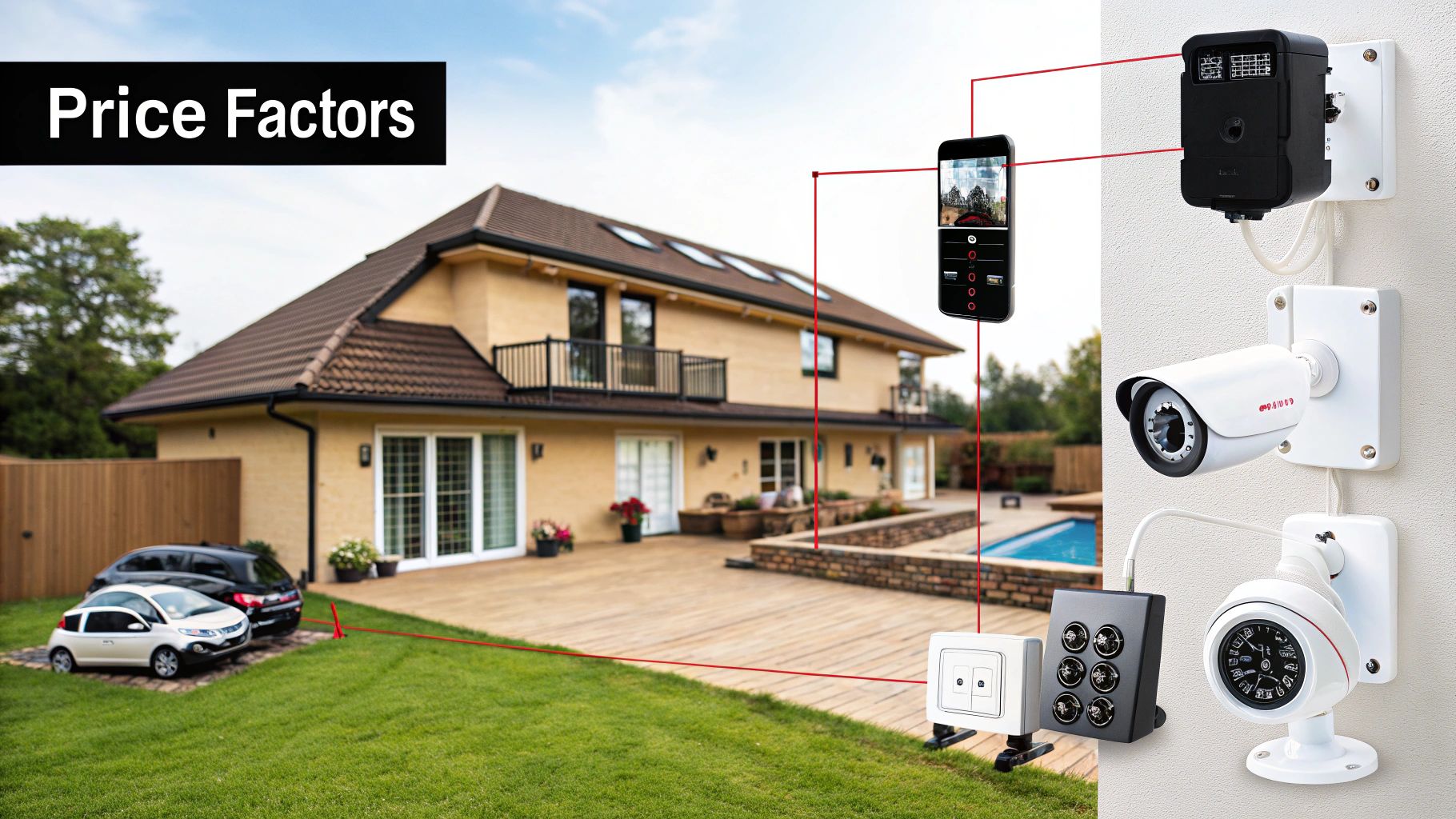
The DIY route is tempting, no question. The main draw is cutting out labor costs, which can easily save you $500 to $1,000 right off the bat. Many modern wireless systems are practically plug-and-play, designed for anyone who can peel an adhesive backing and follow an app's instructions.
But this path isn't without its pitfalls. Your own time has value, and what looks like a quick afternoon project can easily morph into a frustrating weekend-long ordeal. More critically, the risk of getting it wrong is very real. A motion sensor placed just a few inches too low could create a blind spot an intruder could exploit, or a misconfigured camera might not record at the one moment you desperately need it to.
If you're leaning towards a hands-on approach and want to see what's involved, it's worth checking out a comprehensive DIY CCTV installation guide to get a feel for the process.
The Value of Professional Expertise
Hiring a pro, on the other hand, is about buying confidence. An installer isn't just someone who runs wires—they're a security architect. They’re trained to look at your property and see vulnerabilities you’d never notice.
They know the exact height to mount a motion detector so your golden retriever doesn't trigger a false alarm at 3 a.m. They understand the perfect camera angle to cover both the back door and the side window with a single device. This level of precision is what you're paying for.
Of course, this expertise comes at a price. Professional labor for a typical system often falls between $500 and $1,000, and that figure can climb for larger properties or complex hardwired setups. But what you get for that investment is a system that's correctly installed, fully tested, and guaranteed to work from the moment they leave.
A professional installer's most valuable asset is their experience. They can spot security flaws you might overlook, ensuring your system provides maximum protection without frustrating glitches or false alarms.
To really get a handle on which path is right for you, it helps to put the two options side-by-side. Think about your own technical comfort level, the layout of your property, and how much you value the assurance that an expert has your back.
DIY vs Professional Installation Head-to-Head
Here's a direct comparison of the key factors to consider when choosing between a DIY setup and a professional installation.
Factor | DIY Installation | Professional Installation |
|---|---|---|
Upfront Cost | Lower (equipment only) | Higher (equipment + labor) |
Time Investment | Significant personal time | Minimal personal time |
Expertise | Relies on your own skill | Certified, experienced technicians |
System Design | Based on your assessment | Strategic, expert-led placement |
Guarantee | Equipment warranty only | Installation and equipment warranty |
Best For | Small, simple properties; tech-savvy users; tight budgets | Large or complex properties; users seeking peace of mind |
Ultimately, the choice depends on your specific situation. A DIY system can be a smart, budget-friendly solution for a small apartment, while a professional installation is often a non-negotiable for a large business with multiple entry points and complex security needs.
How System Technology Shapes Your Final Bill
The single biggest piece of the puzzle when it comes to your alarm system installation cost is the technology itself. Think of it like buying a car. You can get a reliable, no-frills sedan that gets you from A to B, or you can opt for a luxury SUV with all the latest tech. Both will get you there, but the experience—and the price tag—will be worlds apart.
Your first big decision is usually choosing between a wired or wireless system.
A wired alarm system is the old-school, tried-and-true option. It's like the landline phone in your parents' house—rock-solid and dependable. Because everything is physically connected with cables run through your walls, you don't have to worry about signals dropping or hackers interfering. The downside? Installation is a much bigger job, often requiring a professional to drill holes and snake wires, which means higher labor costs.
On the flip side, a wireless system is all about flexibility and convenience, much like your home's Wi-Fi network. Sensors communicate over radio frequencies, so you can stick them just about anywhere without any major construction. This makes for a much faster, cleaner, and cheaper installation. The trade-offs are minor but worth noting: you'll need to stay on top of battery replacements and consider potential signal interference from other devices.
The Rise of Smart Security Systems
Moving beyond the basic wired vs. wireless question, we get into the world of smart technology. This is where the possibilities—and the price points—really open up. A straightforward intrusion detection system that just makes a loud noise when a door is opened might run you anywhere from $1,000 to $5,000.
But once you start layering in smart features, you’re playing a whole new ballgame.
A smart security system isn't just a burglar alarm anymore. It's an active management tool for your property. It’s the difference between simply knowing a door opened and being able to control who can open it, from anywhere in the world, at any time.
This shift toward interconnected systems is what's driving the market. The global home security industry is expected to balloon to $109.4 billion by 2030, and that growth is fueled by smart devices. With 24% of US households already owning three or more smart home products, it's obvious that people want security that does more. You can dig deeper into these global security market trends at researchnester.com.
How Advanced Features Impact Your Quote
This is where your installation cost can really start to add up. Every cool new feature you add brings more convenience and control, but it also adds to the initial investment. Here’s a quick look at how some popular upgrades can affect the final price:
Smart Home Integration: Want your security system to talk to your smart locks, lights, and thermostat? Tying everything together can add $400 to $1,500 to the bill, depending on how complex you want to get.
Video Analytics: Cameras are no longer just passive eyes. Modern ones with AI that can tell the difference between a person and a raccoon or read a license plate will cost more than a basic model—often several hundred dollars more per camera.
Cellular Backup: This is your system’s safety net. If your internet connection gets cut, a cellular backup ensures your alarm can still call for help. It’s a must-have feature that adds a small monthly fee to your monitoring plan.
Access Control Systems: For a business, this is a game-changer. Adding keycard readers or biometric scanners to manage who goes where can cost between $1,500 to $10,000 per door. It's a serious investment, but the security payoff is huge.
In the end, it all comes down to finding the right balance between the latest tech and what you actually need to feel secure. A decked-out smart system gives you incredible power, but a well-planned traditional system can still offer fantastic protection at a much lower cost.
Uncovering Hidden and Long-Term Expenses
That initial quote for your alarm system? It’s just the tip of the iceberg. To get a real handle on your alarm system installation cost, you have to think about the Total Cost of Ownership (TCO). This means looking beyond the upfront price tag to all the ongoing costs that will keep your system humming along for years.
These aren't just minor details—they can seriously affect your budget over the life of the system. Getting ahead of them now means no sticker shock later and helps you pick a security solution you can actually afford to maintain.
The Reality of Monthly Monitoring Fees
The most predictable recurring expense you'll face is the monthly monitoring fee. This is what you pay for a team of professionals to be on standby, ready to jump into action 24/7 the moment an alarm goes off. For a business, you can expect this to be anywhere from $40 to over $150 per month.
But it's not a flat rate for everyone. What you pay really boils down to the level of service and what happens when that alarm is triggered.
Basic Monitoring: This is the standard package. An operator gets the alert, gives you a call, and then dispatches the police or fire department.
Video Verification: A huge step up. Here, operators can peek at your camera feeds to see if it's a real emergency or just a raccoon setting off a motion sensor. This cuts down on false alarms and can often get police to your door much faster.
Cellular Backup: A must-have feature. If your internet line gets cut or the power goes out, this keeps your system communicating via a cellular signal. It usually adds a small, but worthwhile, fee to your plan.
Beyond the Monthly Bill
While monitoring is the most consistent cost, it's not the only one. Other expenses will inevitably pop up over time, and a smart business owner plans for them. This is how you maintain a solid security setup without getting blindsided by surprise invoices.
Calculating the true Total Cost of Ownership means looking past the installation day. It involves planning for everything from battery replacements to potential municipal fines, giving you a realistic picture of your long-term security investment.
Here are a few other expenses to keep on your radar:
Equipment Upgrades: Technology moves fast. In five or seven years, you might find yourself wanting to swap out old cameras for new ones with sharper resolution or better analytics. That’s a new capital expense you'll need to budget for.
Battery Replacements: All those convenient wireless sensors run on batteries, and they don't last forever. While a single battery is cheap, replacing them across an entire facility adds up—think $10 to $50 per device.
False Alarm Fines: Nobody likes wasting the time of emergency responders. That's why most cities and counties hit you with a fine for false alarms, which can run from $50 to over $200 per incident. A well-maintained and properly used system practically pays for itself by avoiding these.
Cloud Storage Fees: If you've got video cameras, you need a place to store the footage. Cloud storage is the go-to solution, and it comes with a monthly or annual subscription fee that depends on how many cameras you have and how long you need to keep the recordings.
The Real Value of Investing in Security
It's one thing to crunch the numbers on an alarm system installation cost, but it’s another to understand the why behind it. Why are so many property owners deciding this is a necessary investment? The key is shifting your mindset: security isn't just a reactive expense you pay when something goes wrong. It’s a proactive tool that buys you protection and, just as importantly, peace of mind.
This isn't just a hunch; the market trends back it up. The global alarm systems market is on a steady climb, expected to hit nearly $5 billion by 2029. That kind of growth doesn't happen by accident. It’s fueled by real-world security concerns, the realities of increasing urbanization, and even the financial incentive from insurance companies that often cut premiums for well-protected properties. This tells us that a solid security system is quickly becoming a standard part of responsible property management. You can dive deeper into these market trends on researchandmarkets.com.
More Than Just an Alarm
A modern security system isn't just a noisemaker. It’s a powerful deterrent. Think about it from a burglar's perspective—why hit a protected house when there's an easier target down the street? The data is clear: properties with visible security systems are a staggering 300% less likely to be burglarized. That sign in your yard or the camera over the door is an upfront warning that your property is not an easy mark. This preventative power is where you see the real return on your investment.
And it doesn't have to stop there. Smart layers of security, like exploring effective outdoor security lighting options, can make your property even more secure. Every element you add strengthens the whole.
An alarm system transforms your property from a potential target into a fortified asset. The value isn't just in what it does during a break-in, but in how many potential incidents it prevents from ever happening.
At the end of the day, the cost is an investment in stability. It protects your physical assets, keeps the people on your property safe, and gives you an invaluable sense of security. It lets you focus on your daily life or business without that constant, nagging worry in the back of your mind.
Common Questions About Installation Costs
Even after you've run the numbers, a few key questions always seem to surface when you’re about to sign on the dotted line. Getting clarity on these points can make a real difference, not just to your initial alarm system installation cost, but to your peace of mind for years to come.
Let's dive into some of the questions we hear most often.
One of the first things people ask is whether their new alarm system will save them money on insurance. The answer is almost always yes. Most insurance providers are happy to give you a discount—often somewhere between 5% and 20%—for having a professionally installed and monitored security system. The exact savings will depend on your policy and the system’s features, so it's definitely worth a call to your agent.
Timelines and Cost-Saving Strategies
"How long will this take?" is another big one. If you're going the DIY route with a simple wireless kit, you could be done in just 1-3 hours. For a professional crew installing a standard wireless system, plan on about 3-5 hours. If you're looking at a more complex, hardwired installation, it could easily take a full day or even longer.
Of course, the million-dollar question is always about lowering that upfront price tag. The good news is, you have a few solid options for making the investment feel a lot less intimidating.
The most direct way to reduce upfront costs is often through a long-term monitoring agreement. Many security companies waive installation fees or provide free basic equipment in exchange for a two- or three-year contract.
This is a really common approach, but it’s not your only move. You can also:
Opt for a DIY system: This completely cuts out the professional labor costs, which can be significant.
Start with a basic package: Just get the essentials covered now—door sensors, a motion detector, a keypad. You can always add cameras and other bells and whistles down the road as your budget frees up.
By exploring these different paths, you can find that sweet spot between top-notch security and a price that doesn't break the bank.
Ready to secure your property with a system designed for your specific needs? The experts at PCI Audio-Video Security Solutions can design and install a reliable security solution that fits your budget and protects what matters most. Get a customized quote from pciavss.com.
Comments